

Last updated September 28, 2026
The terms that matter
If you only learn four, learn base, density, template, and maintenance. Those four decide almost everything about how your hair will look and what owning it is like.
- Hair system, hair unit, hair replacement: the same thing, a custom piece of hair fitted to your head
- Base: the thin material the hair is tied into, which sits against your scalp
- Density: how much hair is tied into the base, which decides how thick it reads
- Template: the mould of your head your system is built to
- Install: the appointment where the system is attached, cut, and blended
- Maintenance: the scheduled visit that cleans, re-cuts, and reattaches it
- Lace and skin: the two common base materials, one breathable, one durable
Every term, defined.
- Hair system
- A custom piece of hair, also called a hair unit, tied into a thin base and fitted to your scalp to cover thinning or loss.
- Base
- The thin, near invisible foundation the hair is tied into, which sits against your scalp and defines the unit's regions.
- Base size
- The dimensions of the base in inches, commonly around 7 by 9 or 8 by 10, matched to your coverage area.
- Base thickness
- How thick a skin base is in millimeters, which trades realism against how long the unit lasts.
- Swiss and French lace
- Two lace grades. Swiss is finer and more invisible but shorter lived, French is more durable and carries more density.
- Skin base
- A clear polyurethane film, sometimes called thin poly, that reads as bare scalp and wipes clean easily.
- Ultra thin skin
- The thinnest skin bases, around 0.03 to 0.05mm, the most undetectable option and the shortest wearing.
- Monofilament
- A durable mesh base that holds the highest density and stands up to repeated attachment.
- Silk top
- A multi layer construction that hides the knots beneath a top layer for a highly realistic result.
- Base construction
- How lace, skin, mono, and poly are combined across the front, top, and perimeter of one unit.
- Density
- How much hair is tied into the base, which decides how full the unit reads. Natural density is lower than most men expect.
- Density by base
- The maximum density each base material can carry, from light on Swiss lace to high on monofilament.
- Hair origin
- Where the hair is sourced, which affects its texture, caliber, and how it takes color.
- Remy and virgin hair
- Remy means the cuticles are aligned root to tip. Virgin means the hair was never chemically processed. They are not the same thing.
- Ventilation
- How each strand is attached to the base, by knotting, V-loop, or injection, which sets realism and durability.
- Knot types
- Single or double, flat or split knots, which trade holding strength against how visible the knot is.
- Bleached knots
- Lightening the knots so they read as scalp at the hairline, at the cost of some strength in that zone.
- V-loop
- A knotless attachment on skin bases, the most undetectable ventilation and the shortest wearing.
- Hair direction
- The way each strand exits the base, which decides how the unit parts and styles and cannot be changed after it is built.
- Wave and curl
- The set of the hair, specified by rod size, which also changes how full the unit reads.
- Color codes
- The number scale, from 1 darkest to 60 lightest, plus modifiers, used to specify the base shade.
- Grey percentage
- The share of white or silver hair worked into the base color, often set higher at the temples.
- Front contour
- The stock shape of the front edge, from recessed A to rounded C, or a fully custom freestyle front.
- Hairline
- The front two centimeters of the unit, built irregular and graduated so it reads as your own.
- Template and mold
- A mold taken of your scalp that captures both the outline and the curvature a tape measure cannot.
- Tape types
- The contoured tabs and roll formats used to bond a unit, chosen by hold time and moisture resistance.
- Adhesive types
- Water based, solvent based, silicone, and acrylic bonds, compared on hold, sweat tolerance, and skin contact.
- Order form
- The spec sheet that captures every field of a custom unit, from base size to hair direction, in one place.
- Measuring
- The tape method for capturing the length and width of the coverage area before a unit is ordered.
- Blending
- Cutting the unit into your surrounding hair so the density and perimeter transition disappears.
Real work
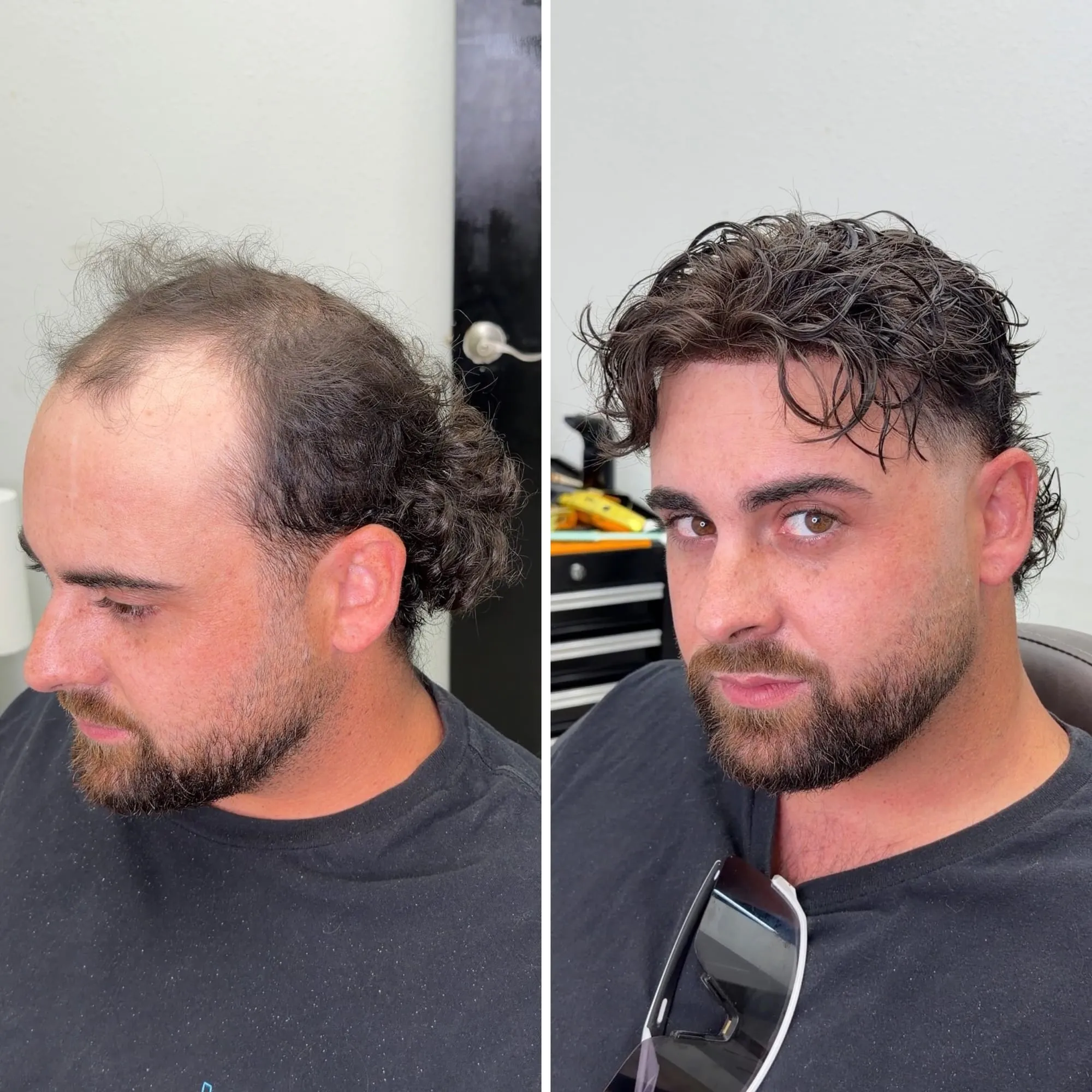
This is what it looks like.
A real client from our chair, photographed before and after his hair system was installed and cut in.
Questions, answered.
Why do you avoid certain words for this?
We use the words our clients and our trade use: hair replacement, hair systems, hair units. Other terms carry baggage that does not describe what we do.
Do I need to know all this before I come in?
Not at all. We explain everything as we go. This is here for people who like to read up first.
Keep reading
Related guides.
What Is a Hair System
A hair system is a custom hair unit fitted and blended into your own hair for a full, natural look. Here is how non surgical hair replacement works.
Types of Hair Systems
Lace, skin, and poly hair systems compared by look, feel, durability, and upkeep, so you can choose the right base for your hair and lifestyle.
Hair System Maintenance
How to keep a hair system clean, secure, and natural: your at home routine, the maintenance schedule, and what a studio visit covers.