

Last updated September 28, 2026
What 0.03 to 0.05mm actually means
Skin is a clear polyurethane film that the hair is injected or knotted into, and the whole family is measured in fractions of a millimetre. Ultra thin skin sits at the very bottom of that scale, 0.03 to 0.05mm, which is 30 to 50 microns, roughly the thickness of household cling film. At that gauge the film has almost no edge to see and almost no weight to feel.
This page is about that lowest band specifically. Standard thin skin runs thicker, and our thin skin hair system page covers the everyday 0.06 to 0.08mm grade and the sturdier 0.10 to 0.12mm builds that trade some invisibility for a longer working life. Ultra thin skin is the opposite trade taken to its limit: the most convincing scalp we can build, at the cost of the fastest wear.
- 0.03 to 0.05mm, ultra thin skin, the most undetectable front and parting we fit
- 0.06 to 0.08mm, standard thin skin, the everyday balance of look and life
- 0.10 to 0.12mm and up, thicker skin and poly, built for durability and a firmer adhesive grip
How the skin grades compare
The numbers move in one direction and the trade moves with them. The thinner the film, the better the edge disappears and the sooner it wears through. Here is how the ultra thin band lines up against the grades on the thin skin hair system page.
| Grade | Thickness | Front realism | Working life | Best for |
|---|---|---|---|---|
| Ultra thin skin | 0.03 to 0.05mm | Most undetectable, the edge melts into skin | Shortest, plan to replace soonest | Invisible front and part, photos, shorter styles |
| Standard thin skin | 0.06 to 0.08mm | Very natural, clean scalp look | Middle of the skin range | Everyday wear, a balance of look and life |
| Thicker skin and poly | 0.10 to 0.12mm and up | Least invisible at the edge up close | Longest of the skin family | Durability, firm hold, heavier daily handling |
Why it is the most undetectable base
Three things stack up at 0.03 to 0.05mm. First, a film this fine is close to translucent, so it takes on the tone of your own scalp underneath rather than sitting on top as a separate layer. Second, there is effectively no front edge to catch the light, because the perimeter can be trimmed down to nothing once it is attached. Third, the hair is set into the base with a V-loop or a single fine knot so there is no knot bulk to hide, which means the strands read as if they are leaving your scalp one by one.
Put together, that gives you a parting you can actually part. You can push the hair around, expose the base at the crown, and it still reads as skin with hair growing from it, in daylight and in a phone camera at arm's length. That is the hardest illusion in this craft, and ultra thin skin does it better than anything else we work with.
The shortest replacement cycle, honestly
This is the part that decides whether ultra thin skin is for you. A film in the 0.03 to 0.05mm range is asked to survive daily attachment, removal, cleaning, heat, and sweat, and it is the thinnest membrane doing that work. In our chair, most men get roughly one to two months of daily wear from an ultra thin skin unit before the perimeter starts to break down, where a thicker skin build can run noticeably longer. Your mileage moves with your scalp chemistry, your climate, and how carefully you handle the edges.
The edge always goes first. That is by design, because the edge is where the film is thinnest and where undetectability comes from. None of this makes ultra thin skin a poor choice, it makes it a deliberate one. The men who love it plan to replace the unit sooner and treat that as the price of the front edge. Rotating two units, so each one rests between wears, is the single most effective way to stretch the life of both.
- Finer film equals a better front and a shorter life, every time
- The perimeter breaks down before the body of the unit does
- Heat, sweat, and oil accelerate the wear on a membrane this thin
- Owning two units and rotating them extends the life of each
Who should not choose ultra thin skin
We would rather talk you out of it than sell you the wrong base. Ultra thin skin is not the right pick for everyone, and there are a few honest reasons to step up to a thicker grade instead.
- Heavy sweaters and men who work or train outdoors, since sweat degrades a 0.03 to 0.05mm film fast and a solid base already breathes less than lace
- Oily scalps, because oil works under the perimeter and lifts the thinnest edge sooner
- Anyone who handles their hair roughly or removes and reattaches aggressively every day, since the edge will not forgive it
- Men who want the longest possible life from each unit, who are far better served by standard thin skin or a thicker poly perimeter
- First time wearers who want a forgiving base to learn attachment and removal on, where a slightly thicker skin is easier to live with while the routine becomes second nature
Where the cost sits
We do not publish figures, because the honest number depends on the build and we would rather quote you something real at a consultation than a headline that is wrong for your unit. What we can be straight about is the drivers, ranked by how much they move the total.
The replacement cycle leads. Because ultra thin skin is replaced sooner than a thicker base, you go through more units over a year, and that yearly rhythm matters more than the price of any single unit. After that come the usual custom drivers: a fully custom template and mold cut to your head, European hair rather than a stock origin, and length beyond six inches. A silk top is not part of an ultra thin skin build, so that particular driver does not apply here. We put the actual figures in front of you once we have seen your scalp and know how often you will be reordering.
How we fit it in our chair
We do not start with the material, we start with your priorities. If an invisible front and a natural parting are the entire point and you are genuinely comfortable trading lifespan for them, ultra thin skin at 0.03 to 0.05mm is the base we reach for. If any of the reasons above apply to you, we say so and point you to a grade that will serve you better.
Nico Rigano, Ivette Rigano, and Denisse Diaz fit ultra thin skin at both our studios, in Peoria, Arizona and in Eighty Four, Pennsylvania. Arizona heat is a real factor with any solid film, so we weigh your climate, how much you sweat, and how you actually live before we recommend a grade, an attachment, and a maintenance rhythm. Book a consultation and we will show you where you sit on the line between the most invisible front and the longest working life.
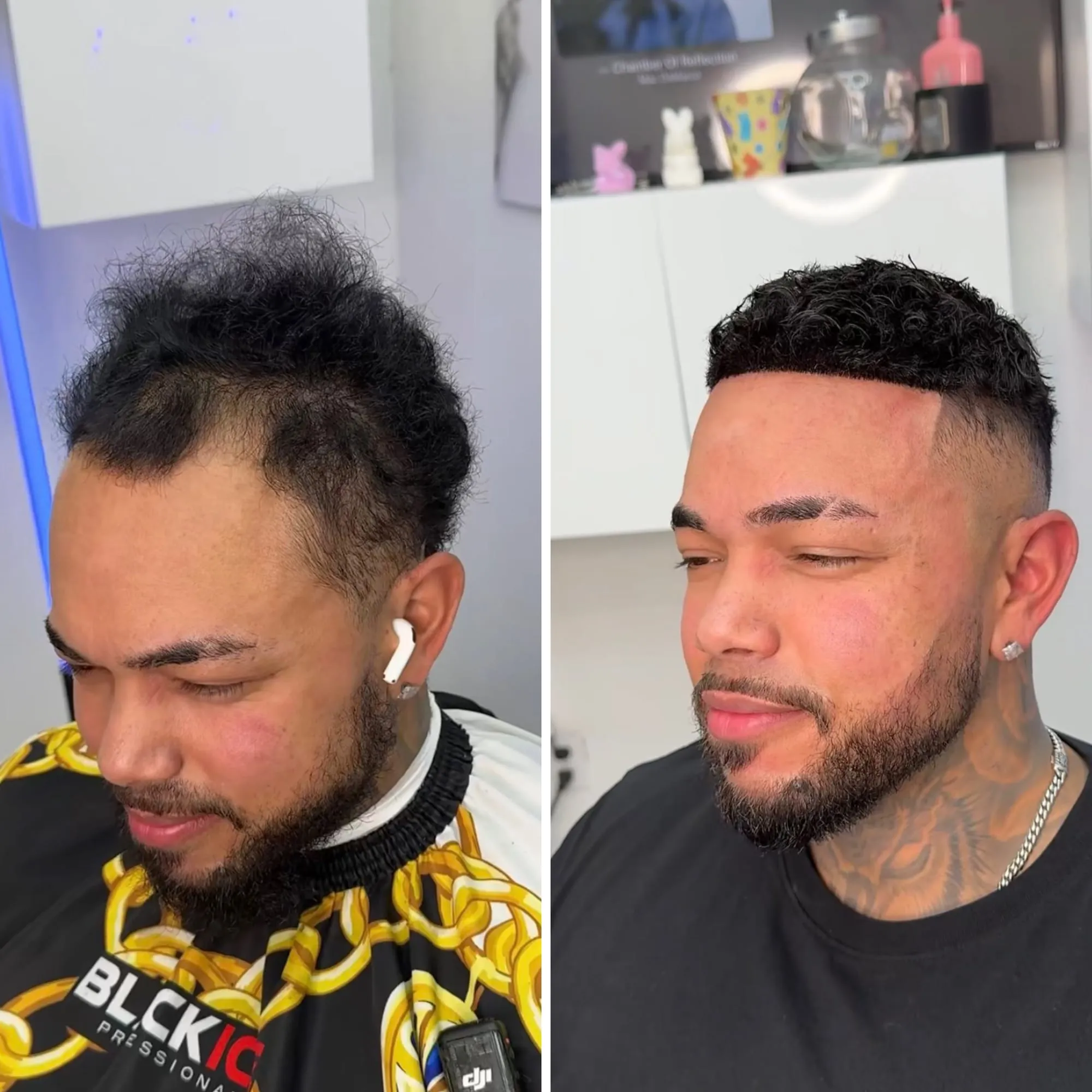
Real work
This is what it looks like.
A real client from our chair, photographed before and after his hair system was installed and cut in.
Questions, answered.
How thin is an ultra thin skin hair system?
Ultra thin skin is built in the 0.03 to 0.05mm range, which is 30 to 50 microns, roughly the thickness of household cling film. It is the thinnest grade we fit, which is exactly why the front edge and parting are the most undetectable of any base.
How long does an ultra thin skin unit last?
It has the shortest working life of any base. In our chair most men get roughly one to two months of daily wear before the perimeter starts to break down, and the edge always goes first. Your climate, scalp chemistry, and how you handle the edges all move that number.
Who should not choose ultra thin skin?
Heavy sweaters, men with oily scalps, anyone who handles their hair roughly or reattaches aggressively every day, first time wearers still learning the routine, and anyone who wants the longest possible life per unit. All of those are better served by a standard thin skin or a thicker poly grade.
How is ultra thin skin different from standard thin skin?
It is the same polyurethane idea taken thinner. Ultra thin skin sits at 0.03 to 0.05mm for maximum invisibility and the shortest life. Standard thin skin runs 0.06 to 0.08mm and the thicker builds 0.10 to 0.12mm and up, trading some undetectability for a longer working life. Our thin skin hair system page covers those thicker grades.
Can I make an ultra thin skin unit last longer?
Somewhat. Owning two units and rotating them so each one rests between wears is the most effective step. Beyond that, be gentle at the perimeter, avoid harsh solvents and aggressive scrubbing at the edge, dry it properly, and use the products we send you home with rather than whatever is under the sink.
Keep reading
Related guides.
Reading the Order Form
Every field on a custom hair system order form explained in one place: base size, material, density, color, grey, curl, length, origin, and more.
Thin Skin Systems
A thin skin hair system is a fine polyurethane base that gives the most invisible scalp look. Here is how thin and ultra thin skin bases feel and wear.
Lace, Poly, or Skin
Lace breathes and looks natural, skin is invisible and easy to clean, poly holds longest. How we pick a hair system base by realism and upkeep.
How Long Hair Systems Last
How long a hair system lasts depends on the base, your routine, and maintenance. Here is what to expect and how to make yours last longer.