

Last updated September 28, 2026
What a template actually captures
Your head is not flat and it is not a perfect dome. It has a crown that curves in two directions, temples that fall away at the sides, and a hairline shape that is unique to you. A tape measure can tell someone how wide and how long an area is, but it cannot record any of that shape. A template can, because it is a physical copy of the surface.
When we build a template we are recording three things at once, and all three matter for how the finished unit lays and holds.
- The perimeter, the exact outline of the area the unit will cover, traced where your own hair or scalp meets the zone
- The contour, the way your scalp curves across the crown, temples, and back so the base is molded to sit flush
- The hairline shape, so the front of the unit follows your natural line rather than a generic arc
Template versus a tape measure size
Ordering by measurement alone is fine for a stock unit, where you accept a standard base size and shape off the shelf. It falls short for a true custom build. A set of length and width numbers describes a rectangle, but your scalp is a curved, irregular surface, and the front contour that reads as natural on you is not a number you can write down.
This is the core reason a template exists. It turns your head into information the maker can build against. A well made mold removes the two problems that make a poorly fitted unit obvious, a base that bubbles or lifts because it was cut for a flatter head, and a front edge that sits in the wrong place because the hairline was guessed. Here is what a flat measurement cannot record on its own.
- How sharply your crown curves, which decides whether the base lays flat or tents up
- The precise front contour, the gentle shape of your hairline from temple to temple
- Recession points at the temples that a symmetric template would otherwise ignore
- Any scar tissue or uneven areas the base needs to bridge without pulling
How we make the template, step by step
The process is quick, painless, and done in the chair at either studio, in Peoria, Arizona or in Eighty Four, Pennsylvania. Nico, Ivette, or Denisse works over the area with the same care used for a fitting, because everything downstream depends on getting this right the first time.
- We agree on the coverage area with you and mark its perimeter directly on your scalp and into the surrounding hair, so the outline reflects the look you want, not a default box.
- We protect the hair around the zone and lay down a clear barrier film so nothing sticks to your own hair during the process.
- We build a transparent mold over that area in thin layers, letting it take on the exact curve of your scalp as it sets.
- We trace the marked perimeter and your desired front hairline directly onto the set mold with a fine marker, so the shape travels with it.
- We note the details that a mold alone does not show, such as your hair direction, the density you want, and where any part sits.
- We lift the finished template off cleanly, check it against your head, and it is ready to travel with your order form.
Why vendors ask for a template on custom orders
When a maker builds a custom unit, they are cutting and constructing a base to match a real head they will never see. The template is that head, translated into a form they can lay flat, measure, and build against. Without it they are working from numbers and assumptions, and the finished base is only as accurate as the guesses behind it.
A template answers the questions a spec sheet cannot. It shows the exact perimeter to cut to, the curvature to mold the base around, and the hairline shape to knot toward. That is why a reputable custom order pairs the template with the written specification, the base material, density, color, wave, and hair type. One document says what the unit is made of, the template says what shape it has to be.
What a template is not
It helps to separate three ideas that often get blurred together. Choosing between a stock unit and a custom unit is a buying decision, about whether you accept a standard base or commission one built for you. How a hair system is made is the manufacturing story, the knotting, the base construction, the ventilation. The template sits between them. It is the single step that makes a custom build possible, the bridge from your actual scalp to the maker's bench.
A template is also not a permanent record you keep at home. It is created for a specific order and reflects your head at that time. If your coverage needs change, or you want a different hairline or a larger area next time, we take a fresh template so the new unit is built to where things stand, not to an old shape.
From template to your finished unit
Once the template is made it becomes the reference for everything that follows. The maker cuts the base to the traced perimeter, molds it to the recorded curvature, and knots the front toward the hairline you chose, so when the unit arrives it should drop onto your scalp and sit flush the first time.
That accuracy pays off at attachment. A base that matches your contour bonds evenly, with no lifting corners begging to be picked at and no thick edge sitting proud of the skin. For most men, the custom template is the difference between a unit that reads as their own hair and one that fights them. It is a short step at consultation with a long payoff every day after, and it is where a custom fit truly begins.
Real work
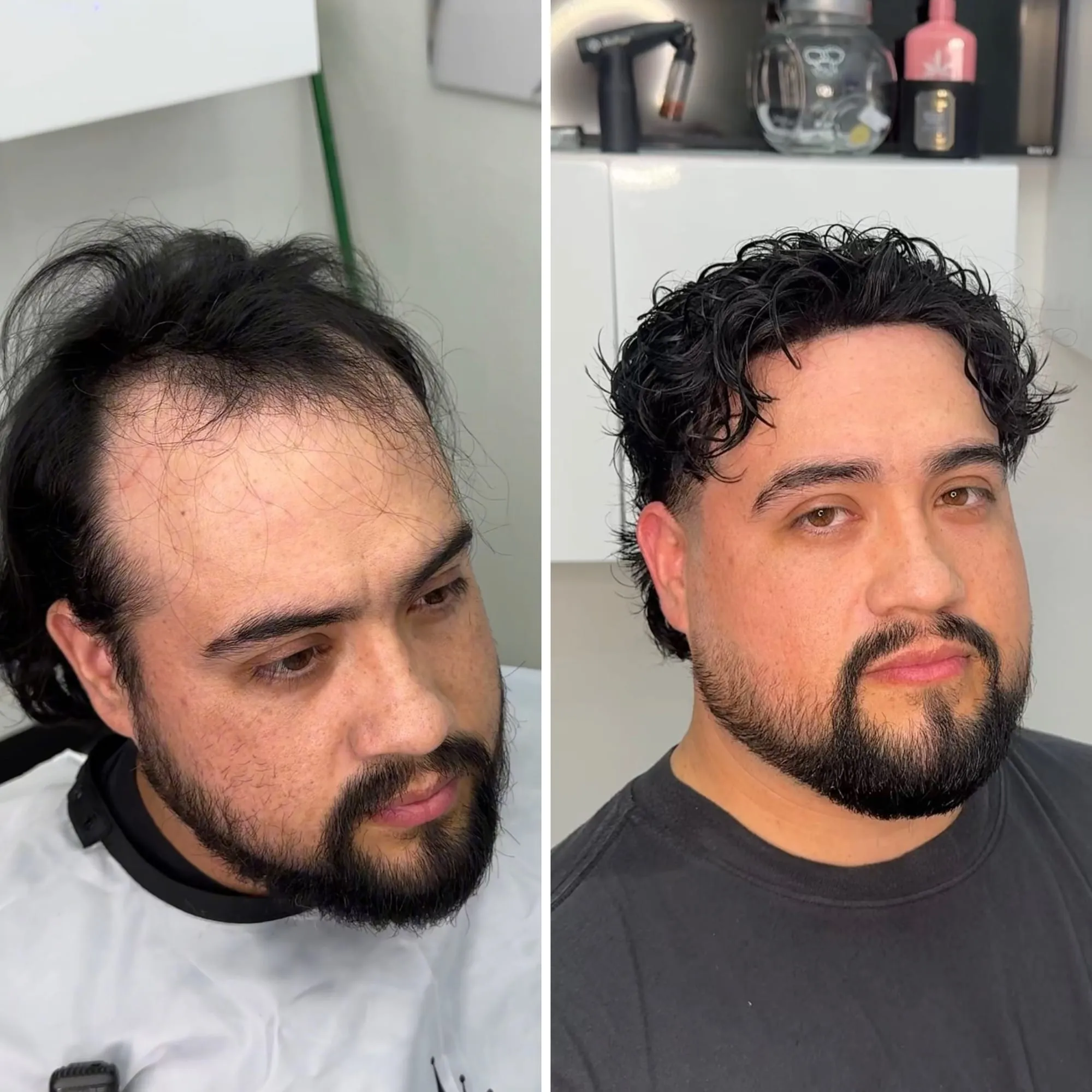
This is what it looks like.
A real client from our chair, photographed before and after his hair system was installed and cut in.
Questions, answered.
Do I need a template for every hair system?
No. A stock unit uses a standard base size and shape, so a measurement is enough. A template is for custom units, where the base is built to the exact outline and curvature of your scalp. If you want the most precise fit and hairline, that is a custom order, and it needs a template.
Does making a template hurt or damage my hair?
No. It is painless. We lay down a clear barrier film first so nothing sticks to your own hair, then build the mold over the protected area and lift it off cleanly. Nothing is cut, and your existing hair is not affected.
How is a template different from measuring my head?
A measurement gives length and width, which describes a flat rectangle. A template is a physical copy of your scalp, so it also captures curvature, the front contour, and temple recession that numbers cannot record. That shape is what lets a custom base lay flush instead of bubbling or lifting.
How long does the template appointment take?
It is a short part of your consultation, usually done in one sitting at our Peoria, Arizona or Eighty Four, Pennsylvania studio. We mark the area, build and set the mold, trace your perimeter and hairline onto it, and note your other specifications, then it travels with your order.
Can I reuse an old template for a new unit?
We recommend a fresh template for a new build. A template reflects your head and the coverage you wanted at the time it was made. If your needs, hairline, or coverage area have changed, a new template makes sure the next unit is built to where things are now.
Keep reading
Related guides.
Reading the Order Form
Every field on a custom hair system order form explained in one place: base size, material, density, color, grey, curl, length, origin, and more.
What Is a Hair System
A hair system is a custom hair unit fitted and blended into your own hair for a full, natural look. Here is how non surgical hair replacement works.
Attachment Methods
Tape, bonding, and clip attachment for hair systems compared by hold, comfort, and how they suit your routine. How to attach a hair system.
Glossary
Plain English definitions for hair replacement: hair systems, hair units, bases, densities, attachment methods, and more.