

Last updated September 28, 2026
What a knot is, and what bleaching changes
Every strand on a knotted hair system is tied to the base with a small knot. On dark hair those knots sit at the surface as a field of tiny dark points, and up close, in hard light, a dense row of them at the very front can read as a faint dark line where you least want one. That line is the single most common tell on an otherwise well built unit.
Bleaching is a targeted lightening step done to the knots only, not the length of the hair. A ventilation technician paints a lightening agent onto the underside of the base over the front zone, lets it lift the knot color a few shades toward blond or clear, then neutralizes and washes it out. The strand you see keeps its color. Only the anchoring point at the base is lightened, so instead of a dark dot against scalp, the knot disappears into your skin tone.
The invisibility you gain at the hairline
The payoff is front-and-center realism. A bleached front lets your scalp color carry straight through the base with no dark speckle interrupting it, so the first row of hair looks like it is emerging from skin rather than sitting on a mesh. On a lace front this is the difference between good and undetectable, because lace already lets scalp show through and the only thing left to hide is the knot itself.
The effect is strongest exactly where it counts, in the front half inch to one inch that people look at hardest. Combined with a soft, irregular hairline and a lower knot density at the very edge, bleached knots let us build a front that holds up to a side-on glance in daylight. It is one of a small set of finishing choices, alongside single knots and a graduated density, that separate a natural front from an obvious one.
The honest cost, weakened strands and faster shedding
Bleach is an oxidizer. When it lifts the color of a knot it also breaks down the protein structure of the hair at that exact point, which is the most mechanically stressed spot on the strand to begin with. A weakened knot holds the hair less securely, so bleached zones shed noticeably faster than the unbleached body of the unit. This is physics, not a defect, and any studio that tells you bleached knots have no downside is not being straight with you.
In practice the front band is the first area to thin on a bleached unit, and it thins while the rest of the hair is still full. The heavier the bleach lift and the higher the knot density in that zone, the faster it goes. This is why we build the front with restraint: lighter density at the edge means fewer knots to bleach, less overall strand loss, and a hairline that thins gracefully instead of gapping. It also means a bleached front is a wear item, and factoring in a slightly shorter usable life at the hairline is part of an honest plan, not a surprise.
There is a real cost driver here too. Because bleaching is skilled hand work done under magnification, a fully bleached custom front adds labor to a build, and any spec beyond a standard bleached front row is a ranked cost driver we walk through at your consultation rather than quote blind.
Bleached knots versus the alternatives at the front
Bleaching is one way to hide a knot, not the only way. Knot type, density, and knotless methods all move the same two dials: how invisible the front looks, and how well the hair stays anchored there. The table below is how we weigh them for the front zone specifically. It works with any knot type, so bleaching stacks on top of these choices rather than replacing them.
| Front approach | Hairline invisibility | Anchor strength at front | Best suited to |
|---|---|---|---|
| Bleached knots | Highest, knot fades into scalp tone | Reduced, bleached strands shed sooner | Men who want a maximally undetectable front and accept faster front wear |
| Unbleached single knots | High, small knots read light already | Strong, no chemical weakening | Lighter hair, or men prioritizing front durability |
| Unbleached double knots | Lower, knots read as dark points up close | Strongest hold per strand | Interior and back of the unit, away from the hairline |
| V-loop or injected front | Very high, no knot to hide | Depends on base, no bleach involved | Thin skin fronts where a knotless look is possible |
Where we bleach, and where we leave it alone
We bleach the band that gets seen, and no more. On most units that is the front half inch to one inch of hairline, occasionally out to one and a half inches on a high, exposed forehead or a slicked-back style where the front zone is on full display. Everything behind that stays unbleached, because the hair under a layer of other hair never shows its knots and there is no reason to trade its strength for invisibility it will never need.
The base material shapes the call. Lace fronts benefit most from bleaching because the open mesh already passes scalp color and the knot is the last thing to hide. On a thin skin front we often reach for a knotless method such as V-loop or injected hair instead, so the strand is looped into the film with no knot to bleach at all. On any base, we pair a bleached front with a lower edge density and an irregular hairline so the zone thins slowly and evenly rather than showing a hard bleached line as it wears.
How we decide in our chair
We start with how you wear your hair, not with the finishing menu. If you push your hair back off the forehead, sleep and train hard, and stand under bright light every day, a fully bleached front buys you realism you will actually notice, and we plan around the faster front wear openly. If you wear a little length over the hairline or your natural color is already light, unbleached single knots may get you most of the invisibility with none of the shedding penalty.
That conversation is what a consultation is for. Nico Rigano, Ivette Rigano, and Denisse Diaz build these fronts by hand at our studios in Peoria, AZ and Eighty Four, PA, and we would rather set the right expectation about the tradeoff up front than sell you a flawless hairline and stay quiet about the zone that thins first. For the wider set of front-zone choices, see our pages on knot types and the hair system hairline.
Real work
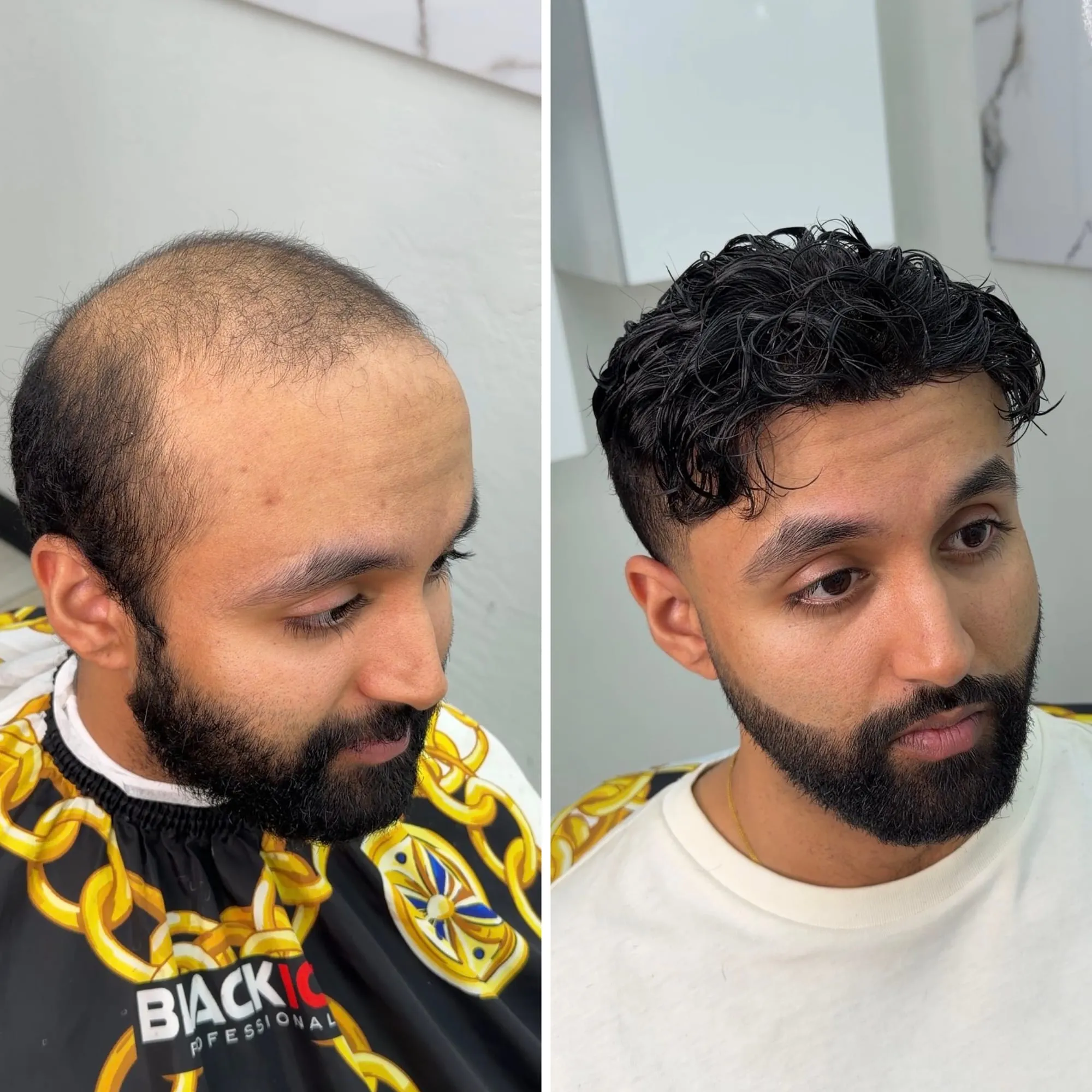
This is what it looks like.
A real client from our chair, photographed before and after his hair system was installed and cut in.
Questions, answered.
Do bleached knots really make the hairline more invisible?
Yes. Lightening the knot removes the dark tie-off point at the base of each front hair, so your scalp color reads through and the first row looks like it grows from skin. The effect is strongest on a lace front, where the knot is the last visible tell.
What is the downside of bleached knots?
The bleach that lightens the knot also weakens the hair at that exact point, so bleached zones shed faster and thin sooner than the rest of the unit. The front band is usually the first area to lose density. We build a lighter edge density to make that thinning slow and even.
Do bleached knots work with any knot type?
Yes. Bleaching is a finishing step applied on top of single or double knots, so it works with any knot type. We most often bleach single knots at the front, since small knots plus bleaching give the cleanest, most durable front we can build.
Is the whole hair system bleached?
No. We bleach only the visible front band, usually the front half inch to one inch, occasionally out to one and a half inches. The hair behind that sits under other hair, never shows its knots, and keeps its full strength unbleached.
Is there a way to get an invisible front without bleaching?
Yes. On a thin skin front we can use a knotless method such as V-loop or injected hair, where the strand loops into the film with no knot to hide or bleach. Unbleached single knots on lace also get you close, especially with lighter hair.
Keep reading
Related guides.
Reading the Order Form
Every field on a custom hair system order form explained in one place: base size, material, density, color, grey, curl, length, origin, and more.
Knot Types Explained
Single knots sit flatter and read more natural but shed sooner; double knots hold harder and sit more visible, so they run through the mid and back.
The Hairline
A natural hair system hairline is built from irregularity, a soft density gradient, and careful placement. Here is how we design one that reads as yours.
Frontal Hair System
A frontal hair system covers the front and top where hair recedes, blending into the hair you still have. Here is who it suits and how it differs.