

Last updated September 28, 2026
What each word actually means
Every strand of human hair has a cuticle, the outer layer of overlapping scales that all point the same way, from root to tip, like shingles on a roof. When hair is collected, keeping every strand pointing the same direction is difficult and expensive, so cheaper hair gets its cuticles stripped off in an acid bath and then recoated in silicone to feel smooth. Remy hair is the hair that skips that shortcut. In true Remy hair the cuticles are intact and aligned, root to tip, across the whole bundle.
Virgin is a separate claim entirely. Virgin hair has never been touched by a chemical process, meaning it has not been dyed, bleached, permed, or color-treated in any way. It is the hair exactly as it grew, in its natural color and texture. That is the whole definition, and it says nothing at all about cuticle direction.
So the two words answer two different questions. Remy answers, are the cuticles intact and aligned? Virgin answers, has the hair ever been chemically processed? A single bundle can be yes to one and no to the other, which is exactly where the confusion comes from.
Why they are not synonyms
Here is the point most sellers gloss over: Remy hair can be processed. You can take hair with a perfectly intact, aligned cuticle and still dye it, tone it, or perm a wave into it. It is still Remy, because the cuticle is still there and still aligned, but it is no longer virgin, because it has been through a chemical process. Remy virgin and Remy processed are both real, and they are not the same product.
The reverse combination is rarer but worth naming. Truly virgin hair almost always keeps its cuticle, so most virgin hair is also Remy. What you will not find is quality non-Remy virgin hair, because the acid bath that strips the cuticle is itself a chemical process, so once the cuticle is gone the virgin claim is gone too. That is why non-Remy hair is always processed hair.
Treat them as two independent switches rather than one label. Cuticle: intact and aligned, or stripped. Chemistry: untouched, or processed. Four theoretical boxes, three of them real, and the grade you want to know about a hair unit is the specific box, not a single marketing word.
The definitive comparison
This table settles the difference. Read it as three real grades along the two switches above, from the untouched top end to the coated economy end. The percentages are cuticle retention, the grey figures are how salt-and-pepper hair is coded on an order form, and the length range is what human hair units are typically ordered at. No amounts appear because hair type is a ranked cost driver whose figure is set to your specification at consultation, not published.
| Property | Remy virgin | Remy processed | Non-Remy processed |
|---|---|---|---|
| Cuticle direction | Aligned root to tip | Aligned root to tip | Stripped, then silicone coated |
| Cuticle retained | About 90 to 100 percent | About 80 to 100 percent | About 0 percent |
| Chemical processing | None | Dyed, toned, or permed | Acid bath plus silicone |
| Natural color | As grown, uncolored | Color altered by dye | Color set by dye |
| Grey coding on the order form | As harvested, coded in 10 percent steps from 0 to 100 | Set to a target grey by dye | Set to a target grey by dye |
| Typical order length | Roughly 4 to 18 inches | Roughly 4 to 18 inches | Roughly 4 to 18 inches |
| Tangle resistance | Highest, aligned cuticle resists matting | High while the cuticle is intact | Smooth until the silicone wears, then tangles |
| How long the hair keeps looking natural | Longest, holds color and hand | Shorter, dyed color fades over roughly 3 to 6 months | Shortest once the coating breaks down |
| Cost driver rank | Highest | Middle | Lowest |
Why the cuticle direction matters day to day
The reason Remy commands a higher grade is not marketing, it is friction. When every cuticle points the same way, strands slide past each other cleanly, so the hair combs out, lies flat, and resists the matting that makes a unit look tired. When cuticles point in opposite directions, the scales catch on each other and the hair knots against itself, especially at the nape and anywhere it rubs a collar.
The silicone coating on non-Remy hair hides that problem at first, which is why a cheap unit can look convincing in the box and for the first few washes. The trouble is that the coating is temporary. As it washes and wears off, the stripped cuticles underneath start to grab, and the hair tangles and dulls faster than a Remy unit of the same length and color. You are not paying more for Remy to look good on day one, you are paying so it still looks right months in.
Where virgin actually earns its place
Virgin hair matters most for color and for texture that has to hold up. Because it has never been chemically opened up, the strand is stronger and the color is its own, so it takes a custom match cleanly and does not carry a dye that will drift or fade on its own schedule. For a natural, lived-in look that stays consistent, an untouched strand is the honest starting point.
That said, virgin is not automatically the right call for every order. Most men do not grow a single flat color, so some level of coloring is almost always part of matching a unit to your real hair, and a skilled color match on Remy hair can look completely natural. The practical question is rarely virgin or nothing. It is how much processing is needed to hit your color and grey percentage, done on hair whose cuticle is still intact and aligned.
- Want the most durable, tangle-resistant hair and a color that stays put: Remy virgin leans your way
- Need a specific color or grey blend and want it to look natural for a good while: Remy processed, matched carefully, is the common answer
- Shopping purely on the lowest sticker: non-Remy is what you are being sold, and it is why cheaper hair units age fast
- Confused by a listing that says Remy without saying virgin: ask whether the color is natural or dyed, because Remy alone does not tell you
How to read a listing without getting fooled
Because the two words are independent, a listing that shouts one and stays quiet on the other is telling you only half the story. Remy on its own means the cuticle is aligned, but it can still be dyed. Virgin on its own means it was never processed, but a careless seller can still misrepresent alignment. The pair you actually want to confirm for a premium human hair unit is both, Remy and virgin, and then any coloring done to it on purpose to match you.
Watch the branding too. Some vendors bury one of these words inside a product name so the listing reads as a guarantee when it is really just a label. Ask three plain questions and you cannot be misled: is the cuticle intact and aligned, has the hair been chemically processed, and if so, what was done and why. Honest answers to those three settle the grade completely, and they are exactly the questions we answer out loud for every unit we build.
What we specify at consultation
Hair type is one of the larger cost drivers on a unit, and Remy virgin human hair sits at the higher end while non-Remy processed sits at the lower end, with Remy processed in the middle. It interacts with the other drivers too, base construction, hair origin, length over about six inches, and any custom template, so two men ordering what sounds like the same hair can need very different builds. Every one of those figures is quoted against your actual specification, with no obligation, rather than published as a blanket number.
What we will always tell you plainly is which grade of hair is going into your unit and why. In most cases the right answer is Remy hair, virgin where the color allows it and carefully processed only as far as your match requires, because that is the combination that looks natural on day one and still looks natural months later. Bring your natural color and your grey pattern to the consultation and we will map the honest grade to both.
Real work
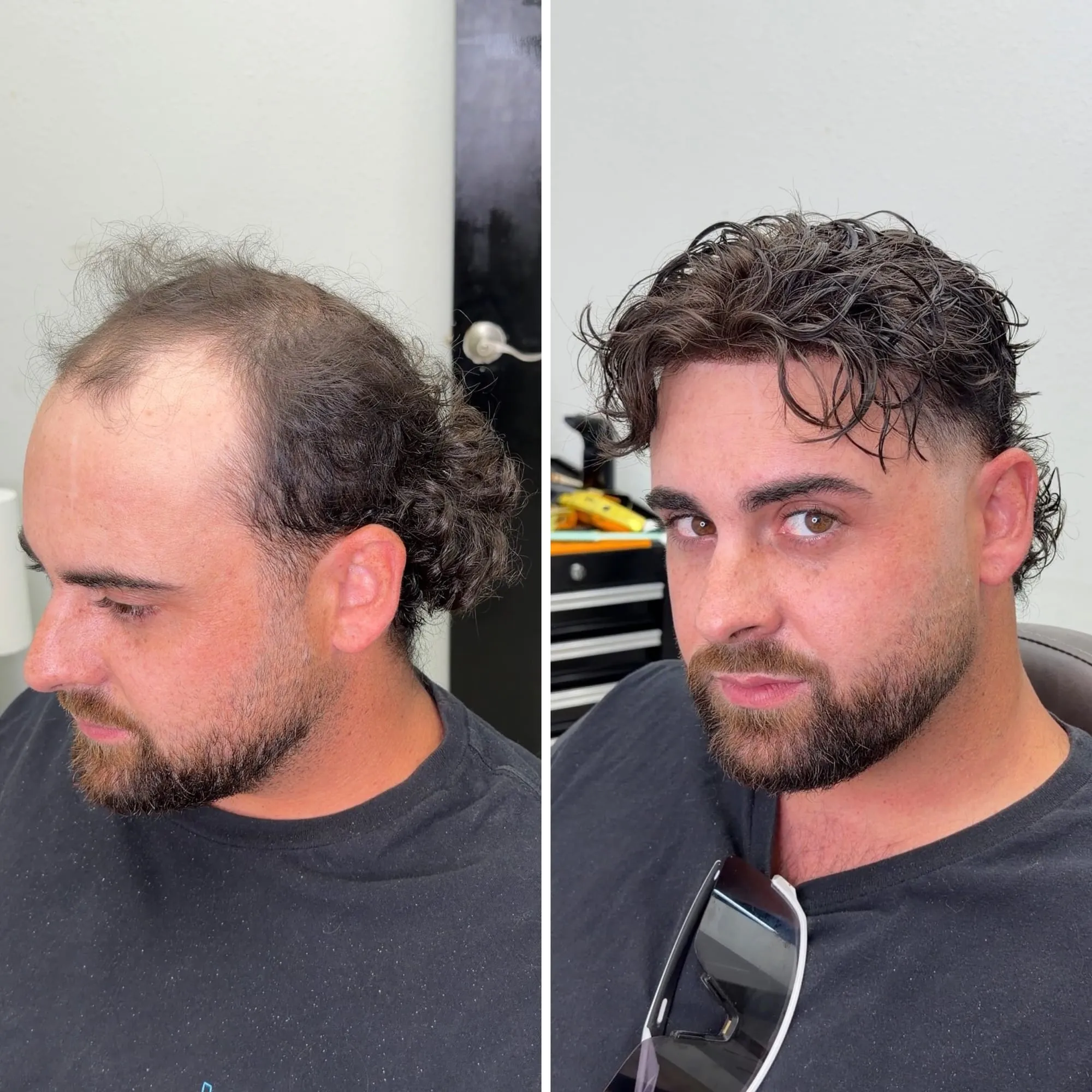
This is what it looks like.
A real client from our chair, photographed before and after his hair system was installed and cut in.
Questions, answered.
Is Remy hair the same as virgin hair?
No. Remy means the cuticles are intact and aligned root to tip, which stops tangling. Virgin means the hair has never been chemically processed. They describe different things, so Remy hair can still be dyed or permed and remain Remy while no longer being virgin.
Can Remy hair be processed?
Yes. You can dye, tone, or perm hair while keeping its cuticle intact and aligned, so it is still Remy but no longer virgin. Remy virgin and Remy processed are both real grades, which is exactly why the two words are not interchangeable.
Is non-Remy hair ever virgin?
In practice, no. Stripping the cuticle takes an acid bath, and that is itself a chemical process, so once the cuticle is gone the virgin claim is gone with it. That is why non-Remy hair is always processed and coated hair.
Why does non-Remy hair tangle sooner?
Its cuticles are stripped and the strands are coated in silicone to feel smooth. The coating hides the problem at first, but as it wears off over the first weeks the stripped cuticles grab against each other, so the hair mats and dulls faster than aligned Remy hair.
Which should I choose for a hair unit?
For most men, Remy hair, kept virgin where the color allows and processed only as far as a natural match requires. That combination looks natural on day one and stays natural months later. We tell you the exact grade going into your unit at consultation.
Keep reading
Related guides.
Reading the Order Form
Every field on a custom hair system order form explained in one place: base size, material, density, color, grey, curl, length, origin, and more.
Human vs Synthetic
Human hair vs synthetic hair systems compared by look, styling, longevity, and care, with the honest tradeoffs we walk through in our chair.
Color Codes Explained
Hair system color codes run 1 (darkest) to 60 (lightest), R means one shade lighter, and a percentage sets grey. Here is how a full code parses.
How Long Hair Systems Last
How long a hair system lasts depends on the base, your routine, and maintenance. Here is what to expect and how to make yours last longer.