

Last updated September 28, 2026
What front contour actually means
When you order a hair system, the base has an outline, and the front of that outline is what frames your face. Contour is the name for the shape of that front edge. It is not the hairline itself, which is built with knotting and graduated density inside the base, but the shape of the boundary the hairline is worked into. Get the contour right and the hairline has the correct canvas to sit on. Get it wrong and even a beautifully knotted hairline is placed in the wrong shape for your face.
Stock hair systems come with a handful of preset contours named by letter, because most faces fall into a few broad shapes. The letters are shorthand a factory and a studio both understand, so when we write A or CC on an order form, the maker cuts the front to a known template. That is why decoding the codes matters. They are the difference between a front that mirrors how your hair used to grow and one that looks generic.
The contour codes decoded
Here are the standard front contour codes, the shape each one produces, and the face and hair-loss pattern each one tends to suit. Doubling a letter, as in AA or CC, means a stronger version of that same shape. These are the definitive stock options across the industry. Where none of them matches your face, the answer is freestyle, covered below.
| Code | Front shape | Corner and temple recession | Who it tends to suit |
|---|---|---|---|
| A | Slightly recessed front with softened corners | Mild setback at the temples | Men wanting a mature, age-appropriate front rather than a straight juvenile line |
| AA | More recessed front, corners pulled well back | Stronger temple setback than A | Men with a naturally receded or M-shaped pattern who want the system to echo it |
| B | Pointed front that preserves a center peak | Moderate corner recession around a kept peak | Men who had, or want, a defined widow peak in the middle of the hairline |
| BB | More pronounced point with a sharper center peak | Deeper corner recession framing a stronger peak | Men wanting an obvious widow peak as a signature front feature |
| C | Fuller, rounded front that sits lower and squarer | Minimal recession, corners kept forward | Younger men or those with a naturally low, full, rounded hairline |
| CC | Fullest, most rounded and squared front | Least recession of all the codes | Men wanting maximum coverage and the lowest, fullest front available |
| Freestyle | Fully custom outline drawn to your template | Set exactly to your face and pattern | Anyone whose front does not match a stock letter, or who wants an exact match to old photos |
A and AA: the recessed fronts
The A family pulls the front corners back so the hairline reads as mature rather than juvenile. A gives a gentle setback at the temples, the kind of quiet recession most men develop naturally in their late twenties and thirties. AA takes that further, with the corners drawn well back into a more clearly receded or M-shaped front.
These are often the most convincing codes for adult men, because a dead-straight, low hairline is one of the fastest ways to make a hair system look unnatural. Choosing A or AA is usually about matching your actual age and bone structure rather than chasing the lowest possible line. If your temples had already started to recede before your hair loss, an A or AA front will look like a continuation of your own pattern instead of a reset to your teenage hairline.
B and BB: the widow peak fronts
The B family keeps a point in the center of the front, the shape most people call a widow peak. B gives a moderate peak with the corners recessed around it, while BB sharpens that peak and deepens the recession on either side so the point becomes a defining feature of the face.
These codes suit men who genuinely had a widow peak, or who want one built in as a distinctive front. A peak is a strong choice, so it works best when it reflects how your hair actually grew. If you are matching a system to old photographs and you can see a point in the middle of your former hairline, a B or BB contour is how we reproduce it. If your natural front was rounded or straight, forcing a peak onto it tends to look added on rather than real.
C and CC: the full, rounded fronts
The C family is the opposite of the A family. Instead of pulling the corners back, it keeps them forward for a fuller, lower, more rounded and squared-off front. C gives a full rounded shape, and CC pushes it to the fullest and lowest of all the stock codes, with the least recession at the temples.
These contours give the most coverage and the most youthful line, which is why younger men often lean toward them. The honest caution is that the lower and squarer you go, the more a hairline has to be softened with careful knotting and graduated density to stay believable, because very few adult men keep a ruler-straight low front into their thirties and beyond. A C or CC front can look excellent when it matches your face and your age. It looks least natural when it is chosen purely to maximize coverage against what your hairline would realistically be doing.
Freestyle: the fully custom front
Freestyle is not a shape at all. It is the instruction to ignore the stock letters and cut the front to a template we make from your own head. When you order freestyle, the front follows a line you and your stylist agree on, mapped to your face, your former hairline, and the pattern of any hair you still have.
This is the route for men whose front simply does not fall into an A, B, or C shape, for anyone blending a system into existing hair around the temples, and for anyone who wants to match specific old photographs exactly. A freestyle front is a ranked cost driver, because a custom template and hand-cut outline take more work than pulling a stock shape, and that added work is quoted at your consultation rather than published as a set figure. For many men the realism is worth it, especially on the front third where the eye lands first.
- Want a mature, age-appropriate front with softened corners: A or AA
- Want a defined center peak that matches how your hair grew: B or BB
- Want a full, low, rounded front and it suits your face and age: C or CC
- Want an exact match to your own head or old photos: freestyle
How contour works with the rest of the front
Contour is one setting among several that decide how the front reads. It works alongside the base material at the front, since a lace or fine skin front gives the most undetectable edge, and alongside hairline density, since a front that fades from sparse to full looks more natural than a solid wall of hair at the very edge. The contour sets the shape, the base sets the invisibility, and the density gradient sets the softness.
It also works with where the front sits on your head, the setback. A natural adult male hairline usually sits roughly one to one and a half inches, about two and a half to four centimeters, above the top crease of the brow, and it rises further at the temples. We place the front behind your juvenile hairline by that kind of margin so it reads as a real, mature front rather than one drawn on too low. Contour shapes the edge, setback decides how high that edge sits, and the two are agreed together.
How we choose your contour
At a consultation we look at three things. First, any old photographs, because the most convincing front is usually the one you actually had. Second, the pattern of the hair you still have at the temples and crown, because the system has to blend into it seamlessly. Third, your face shape and age, because the contour has to look right on you today, not only in a photo from years ago.
For a first unit we often start with an A or a soft B, because a slightly mature front is forgiving and almost always reads as real, then move to freestyle on later units once we know exactly how you wear it. If you are unsure which letter is yours, that uncertainty is itself the reason to book a consultation. Bring photographs if you have them, and Nico, Ivette, or Denisse will map the right contour to your face before anything is ordered.
Real work
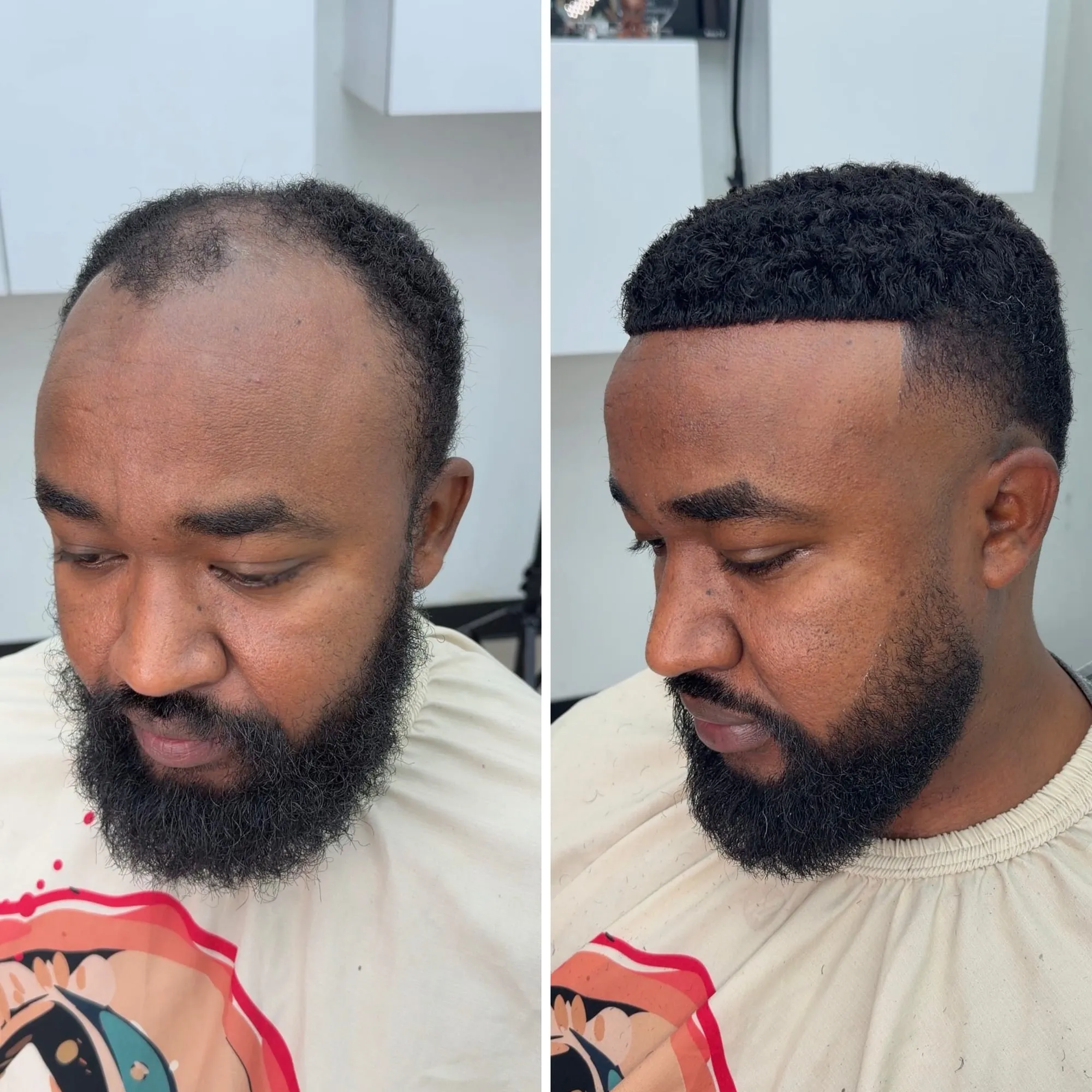
This is what it looks like.
A real client from our chair, photographed before and after his hair system was installed and cut in.
Questions, answered.
What do the hair system contour codes A, B, and C mean?
They name the shape of the front edge. A and AA give a more recessed, mature front with the corners pulled back, B and BB keep a center point like a widow peak, and C and CC give a fuller, lower, rounded front. Doubling a letter means a stronger version of that same shape.
Which front contour looks the most natural?
For most adult men, an A or a soft B, because a slightly mature front with softened corners matches how hair actually grows past the late twenties. A very low, straight C front can look natural too, but only when it genuinely suits your face and age.
What is a freestyle front contour?
Freestyle means we ignore the stock letters and cut the front to a custom template made from your own head. It is the choice when your hairline does not match a standard shape or when you want an exact match to old photographs. It is a ranked cost driver, quoted at consultation.
Can I match my old hairline exactly?
Usually yes, with a freestyle contour. Bring photographs to your consultation and we map the front to the line you actually had, including a widow peak or specific temple recession, rather than approximating it with a stock code.
Does the contour affect the price?
A stock letter is included in a standard build, while a freestyle custom front takes more work and sits as a cost driver alongside things like a custom template. The exact figure is quoted against your specification at consultation, not published as a set price.
Keep reading
Related guides.
Reading the Order Form
Every field on a custom hair system order form explained in one place: base size, material, density, color, grey, curl, length, origin, and more.
The Hairline
A natural hair system hairline is built from irregularity, a soft density gradient, and careful placement. Here is how we design one that reads as yours.
Base Size Chart
Standard hair system base sizes are small 6 by 8, medium 7 by 9, and large 8 by 10 inches, with 8 by 10 the stock default.
Frontal Hair System
A frontal hair system covers the front and top where hair recedes, blending into the hair you still have. Here is who it suits and how it differs.