

Last updated September 28, 2026
What blending actually means
Almost every man who wears a hair system still grows some of his own hair, usually a horseshoe around the back and sides. Blending is the work of making that native hair and the unit agree with each other, so the eye never catches a border. Two things have to match at the join: how much hair is there (density) and how long it is (the taper into the skin or into shorter hair below).
If the unit is denser than the hair around it, you get a visible shelf where the thicker hair sits on top of the thinner. If it is longer at the edge than the hair below, you get a flap that lifts and shows the base. Good blending removes both problems by feathering the perimeter down so the transition is gradual instead of abrupt. This is why a fresh install almost always includes a cut, and why we ask you not to trim the unit yourself before your first shaping.
Why a system haircut is not a normal haircut
A standard barber cuts hair that grows out of a scalp in a known direction, and mistakes grow back. A hair system does not grow. Every hair on the unit is knotted or injected into the base by hand, so a hair cut too short at the front does not return for weeks or months, and only when the unit is replaced. That single fact changes how the cut is approached.
The barber also has to read two densities and two hairlines at once and cut so they converge. Because the knots sit on top of the base rather than emerging from skin, cutting too bluntly can expose those knots or leave a hard line, so system work leans on point cutting, thinning shears, and razor feathering rather than clippers straight across. This page is the consumer view of what happens in the chair and how to hold it between visits. The cutting method itself is a trained skill, and if you attach your own unit at home we still recommend the shaping cut be done by someone who works on systems.
The perimeter is where blends succeed or fail
The perimeter is the edge of the unit all the way around: front hairline, the temples, over the ears, and the back where the unit meets your growing hair. At the front, blending is about softening the hairline so it looks like hair emerging from skin, using an irregular, feathered edge rather than a straight line. At the sides and back, blending is about marrying the unit's hair into your own so the two densities become one.
In our chair we treat the back and side seam as the make or break zone. Your own hair there is real, growing hair, and it has to be cut and thinned to meet the unit at the same length and weight. When a client tells us an old unit always looked obvious, the culprit is usually a hard perimeter that was never properly feathered into the hair below it.
Matching density so there is no shelf
Density is how much hair sits in a given area. A brand new unit is often ordered slightly denser than you will wear it, because thinning down is easy and adding hair is not. Part of the first cut is removing that extra weight so the unit matches the density of your own hair and of a natural head for your age.
The transition matters as much as the overall amount. A young hairline is not uniformly dense, and neither is the crown or the temples, so a good blend varies the density across the unit to mimic that. Thinning shears remove interior bulk without shortening the surface, which is how the barber drops density at the perimeter while keeping length on top. The goal is that if someone runs a hand back through the hair, there is no sudden step up in thickness.
What you can keep up at home, and what you cannot
Between shaping visits there is a small amount you can safely do to keep the blend looking clean, and a larger amount best left to a scheduled cut.
- Safe at home: style and part the hair, use a light hold product, and keep your own perimeter hair tidy with the same trimmer setting your barber used, staying well away from the unit itself
- Safe at home: gently trim a single obvious stray on your own growing hair, not the unit, with scissors and good light
- Leave for a professional: any cutting into the unit's hairline, temples, or perimeter, because a mistake there does not grow back
- Leave for a professional: thinning or reshaping the unit's density, which needs shears and an eye for the transition
- Book a shaping cut when your own back and side hair has grown enough to sit longer than the unit's edge, which is what breaks the blend first
Common blending problems and how we fix them
Most blend complaints trace back to one of a few causes, and each has a straightforward fix at a maintenance visit.
- Visible shelf at the sides or back: the unit is denser than your own hair below it. Fix is thinning the perimeter down to match and feathering the edge
- A hard, straight front line: the hairline was cut too bluntly or has grown out evenly. Fix is point cutting an irregular, softer edge
- Your own hair sticking out past the unit: native hair has grown longer than the unit's edge. Fix is a quick perimeter trim of your growing hair to the unit's length
- The whole unit looks too thick or helmet like: density was never reduced from the ordered amount. Fix is an overall thinning pass to a natural weight
- Color looks slightly off at the seam: your own hair has grown out or lightened against the unit. Fix is a color match at the studio, never guesswork at home
How we handle blending at your fitting
When we install a unit at our Peoria, Arizona or Eighty Four, Pennsylvania studios, the shaping cut is part of the appointment. We look at your own hair, your growth pattern, and how you part and wear it, then cut the unit and your perimeter together until the two read as one. We also set your maintenance rhythm there, because a blend drifts as your own hair grows, not because anything is wrong with the unit. Coming in on schedule to re match the perimeter and density is the single biggest thing that keeps a system looking undetectable. Our page on whether a hair system looks natural walks through what a good blend achieves.
Real work
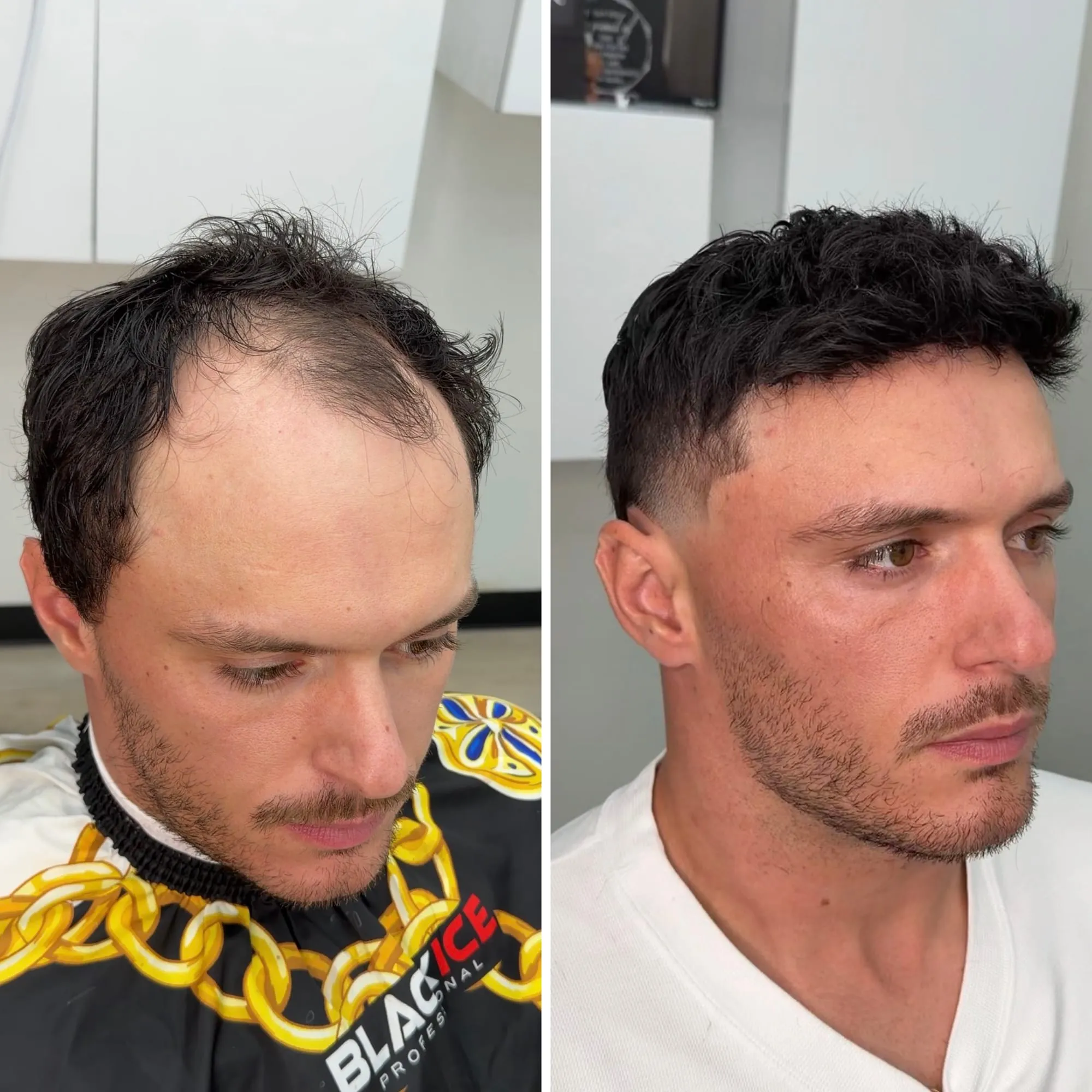
This is what it looks like.
A real client from our chair, photographed before and after his hair system was installed and cut in.
Questions, answered.
Can I cut and blend a hair system myself?
You can keep your own growing perimeter hair tidy and style the unit, but the actual blending cut into the unit's hairline, temples, and density should be done by someone who works on systems. Unit hair does not grow back, so a mistake at the edge stays until the unit is replaced.
Why is a hair system haircut different from a regular haircut?
The barber is joining two separate heads of hair, your own and the unit, into one seamless line, and the unit's hair does not regrow. It calls for point cutting, thinning shears, and razor feathering rather than clippers straight across, with the most care spent on the perimeter where the two meet.
How often does the blend need redoing?
The blend drifts as your own hair grows longer than the unit's edge, so most men book a shaping and perimeter cut on a regular maintenance schedule. We set your rhythm at your fitting based on how fast your hair grows and how you wear it.
Why does my hairline look like a hard straight line?
The front was likely cut too bluntly or has grown out evenly, which reads as a border. A natural hairline is irregular and feathered, so the fix is point cutting a softer, uneven edge and letting your scalp read through the front rather than a solid line.
What causes a visible shelf where the unit meets my own hair?
The unit is denser or longer than the hair around it, so the thicker hair sits on top of the thinner and casts a step. We fix it by thinning the perimeter down to match your own density and feathering the edge so the transition is gradual.
Keep reading
Related guides.
Does It Look Natural
A well fitted, well cut hair system blends into your own hair and hairline. Here is what makes a hair system look natural and undetectable.
Styling a Hair System
Style a hair system with a light hold product, gentle heat, and a soft touch at the perimeter. Which products work and which to avoid.
Hair System Maintenance
How to keep a hair system clean, secure, and natural: your at home routine, the maintenance schedule, and what a studio visit covers.
Can You Dye It
Yes, a hair system can be colored and toned, but it is not the same as dyeing your own hair. Here is what is safe and why we do it in the chair.