

Last updated September 28, 2026
How rod size becomes wave
Human hair in a hair system is not naturally holding the shape you see on the shelf. It is processed, meaning it is wound onto a perm rod of a specific diameter and set, and the diameter of that rod is what fixes the finished curl or wave. A narrow rod wraps the hair into a small, tight circle, so the strand keeps a tight curl. A wide rod wraps the hair into a large, lazy circle, so the strand keeps only a loose wave or almost no movement at all.
That is why rod size, quoted in millimeters, is the most honest way to talk about wave. It is a real measurement of the tool, not a vague adjective, and it maps cleanly onto the result. When you read a spec sheet, the wave line is often written as a plain millimeter number, and that number is the rod diameter. The smaller the number, the tighter the curl. The larger the number, the straighter the look.
The rod-size to wave chart
Here is the full range we work from, smallest rod to largest, with the wave each one produces and where it tends to fit. These rod diameters are the industry-standard sizes, and the description in each row is how that setting reads once the hair is cut in and styled. The 28 to 30mm end is the most common stock option, and it is the setting most men should start from unless they are matching a naturally curly or textured head of hair.
| Rod size | Resulting curl or wave | How it reads | Where it fits |
|---|---|---|---|
| 6 mm | Very tight curl | A small, springy coil that holds its shape | Matching tightly curled or afro-textured natural hair |
| 8 mm | Tight curl | Defined coils, a touch looser than 6mm | Curly hair that is not quite the tightest texture |
| 10 mm | Firm curl | A strong, rounded curl pattern with clear definition | Men who want a distinct, curly finished look |
| 12 mm | Loose curl | A curl that relaxes into a soft spiral | The transition point between curl and wave |
| 20 mm | Pronounced wave | A visible S-shaped movement rather than a curl | Thick, wavy hair with obvious bend |
| 22 mm | Medium wave | Natural body with movement you can see | The most common request for a clearly wavy result |
| 25 mm | Soft wave | Gentle body that reads as healthy, full hair | A subtle wave without looking styled |
| 28 mm | Very light wave | Close to straight, with just enough bend to look alive | Most common stock setting for straight to slightly wavy hair |
| 30 mm | Barely-there wave | The loosest setting on the chart, essentially straight with a whisper of movement | The straightest option that still reads natural |
Why 28 to 30mm is the common stock setting
Stock hair units, the ones that are already made and ready to fit, are overwhelmingly permed on 28 to 30mm rods. There is a good reason for it. That setting sits at the quiet end of the chart, close to straight but not dead straight, which suits the largest share of men who wear hair replacement and blends with the most common natural European and Indian hair textures. It gives the finished unit a little life and body without committing it to a curl that only some heads of hair actually have.
It is also the most versatile starting point for styling. A 28 to 30mm setting can be worn as-is for a clean, slightly-textured look, or it can be pushed straighter or given a bit more shape with product and heat once it is cut in. Starting from a very tight curl is far harder to walk back, so the loose end of the chart is where most people get the most flexible result. When we fit a first unit at our Peoria, AZ or Eighty Four, PA studios, this is usually where we begin unless your own hair tells us to go tighter.
Why a truly straight setting reads wrong
It is tempting to ask for the flattest, straightest hair possible, on the theory that straight is the safest, most neutral choice. In practice a truly straight setting is the one that most often gives a unit away. Real hair almost never falls in a perfectly straight sheet. It has cowlicks, a natural fall, and a small amount of irregular movement, and the eye reads a curtain of dead-straight, uniform strands as artificial before it can say why. That flat, glassy fall is one of the classic tells.
This is why even men with genuinely straight hair are usually set at 28 or 30mm rather than left unprocessed. That whisper of wave restores the tiny irregularity that natural hair has, so the unit moves and catches light the way growing hair does. Denisse and Ivette will often talk a client out of the straightest possible order for exactly this reason. The goal is not the flattest hair in the room, it is hair that reads as yours, and a hint of movement is what sells it.
- Tight curl or coil, matching textured hair: the 6 to 10mm rods
- A clearly curly look: 10 to 12mm
- Visible, wavy movement: 20 to 22mm
- Subtle body and a natural everyday look: 25 to 28mm
- Straight to almost-straight hair: 28 to 30mm, never fully unprocessed
Matching your wave to the hair you already have
The right setting is the one that matches the hair around it, not the one that sounds best on paper. If you still have hair at the sides and back, the unit has to blend into it, so we look at how your own hair actually falls and pick the rod size that meets it. A wave that is a little tighter or a little looser than your natural texture is one of the quickest ways for a unit to look separate from the rest of your head, especially where the two meet above the ears.
Texture also interacts with density and hair length. A tighter curl adds visual fullness, so a curlier unit can look denser than a straight one at the same hair count, which matters if you want a full look without ordering heavy density. Longer hair carries a wave differently than short hair, and the way you plan to style day to day changes what setting will hold. Nico works all of this out at the consultation by looking at your hair rather than guessing from a form, because the number that reads right on you is a match to what is already there.
How the wave is set and how long it holds
The wave is processed into the hair before the unit is built, so it is baked into the order rather than styled in afterward. On a human hair unit that setting is durable, but it is not permanent for the life of the hair. Heat styling, repeated washing, sun exposure, and time will gradually relax a curl or wave, so a unit that started tighter tends to loosen slightly as it ages. That is normal, and it is one more reason not to over-tighten at the order stage, because the hair will ease off on its own with wear.
You can restyle within reason. A wave can be worn straighter with a brush and a little heat, and a looser setting can be given a bit more shape with product, but you cannot reliably add a tighter permanent curl than the rod it was set on. That is why the rod size on the order is the real decision. Match it to your own texture, lean toward the looser end when you are unsure, and you will have a unit that blends now and stays believable as it wears.
What is decided at consultation
Curl and wave is one line on the spec, and it works alongside hair origin, density, color, and length to make the finished look. The wave setting itself does not carry an extra cost the way some drivers do, but the choices it sits next to can: longer hair over about six inches, European hair, and fully custom processing all sit at the higher end of the cost drivers, with the figure deferred to consultation against your actual specification. The rod size is a match decision, not a price decision, and we treat it that way.
What we can commit to before you sit down is the logic on this page. Rod size sets the wave, smaller means tighter and larger means straighter, 28 to 30mm is the sensible default, and a truly straight setting almost always reads wrong. Bring the way your own hair falls to your consultation at Peoria or Eighty Four, and we will match the rod size to it rather than to a guess.
Real work
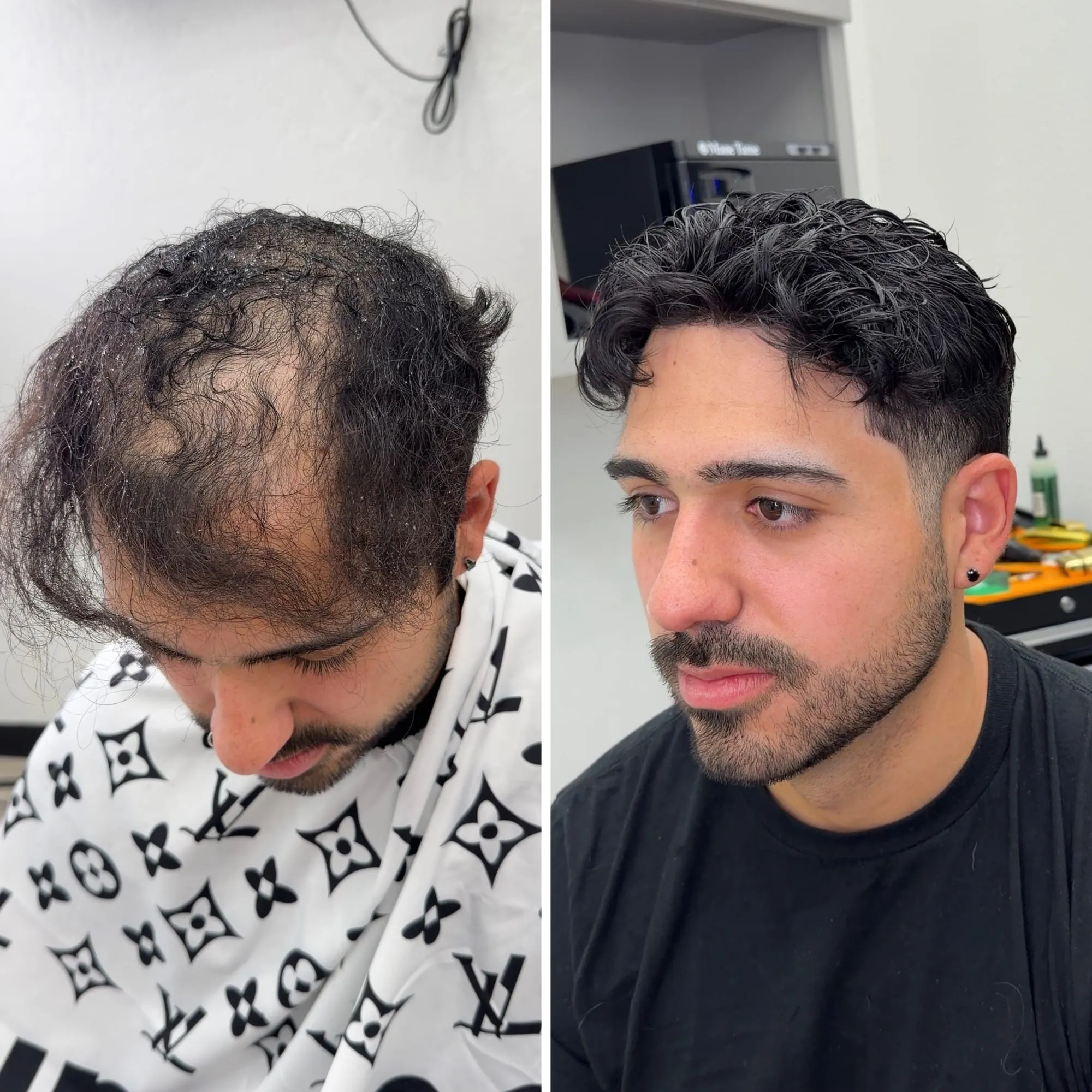
This is what it looks like.
A real client from our chair, photographed before and after his hair system was installed and cut in.
Questions, answered.
What rod size gives a natural, mostly straight look?
A 28 to 30mm rod. That is the most common stock setting, and it reads as straight to slightly wavy with just enough movement to look natural. It is where most men should start unless they are matching genuinely curly or textured hair.
Should I order my hair system completely straight?
Usually no. A truly straight, unprocessed setting is one of the classic tells, because real hair almost never falls in a perfectly flat sheet. Even men with straight hair are normally set at 28 or 30mm so the unit has the small irregular movement natural hair has.
What rod size do I need for curly or textured hair?
The smaller rods. A 6mm rod produces a very tight curl suited to tightly curled or afro-textured hair, 8 to 10mm gives a firm curl, and 12mm sits at the loose-curl transition. The tighter your natural texture, the smaller the rod you match to it.
Can I change the wave after the unit is made?
Within limits. You can wear a wave straighter with heat and a brush, or add a little shape to a loose setting with product, but you cannot reliably add a tighter permanent curl than the rod it was processed on. That is why the rod size on the order is the real decision.
Does the wave loosen over time?
Yes, on a human hair unit. Heat styling, washing, sun, and time gradually relax a curl or wave, so a unit tends to loosen slightly as it ages. That is normal, and it is a reason not to over-tighten at the order stage.
Keep reading
Related guides.
Reading the Order Form
Every field on a custom hair system order form explained in one place: base size, material, density, color, grey, curl, length, origin, and more.
Color Codes Explained
Hair system color codes run 1 (darkest) to 60 (lightest), R means one shade lighter, and a percentage sets grey. Here is how a full code parses.
Human vs Synthetic
Human hair vs synthetic hair systems compared by look, styling, longevity, and care, with the honest tradeoffs we walk through in our chair.
Styling a Hair System
Style a hair system with a light hold product, gentle heat, and a soft touch at the perimeter. Which products work and which to avoid.