

Last updated September 28, 2026
The standard base sizes
Base size is the flat dimension of the unit before any hair is added and before anything is trimmed. It is written as front to back by side to side, so 8 by 10 means eight inches from the hairline toward the crown and ten inches ear to ear. Three sizes cover the large majority of orders, and almost every stock unit is built to the largest of them so it can be reduced to fit rather than come up short.
The reason the biggest size is the default is simple. You can always cut a base down, but you cannot add material back. Starting oversized and trimming to your template guarantees full edge-to-edge coverage of the area you need, which is why a stock 8 by 10 is the safe universal blank even for a man who will only wear a fraction of it.
| Size name | Base dimensions (front to back by side to side) | Typical coverage | Stock or custom |
|---|---|---|---|
| Small | 6 by 8 inches | Crown or a contained top area, or a smaller head | Available stock in some lines, often ordered custom |
| Medium | 7 by 9 inches | Top and front for moderate loss, an average head | Available stock in many lines |
| Large (stock default) | 8 by 10 inches | Full top, front, and crown, or a larger head, then trimmed to fit | The default stock size, cut down to your coverage area |
Why 8 by 10 is the stock default
Stock units are made in volume before anyone orders them, so a supplier cannot know whose head each one will land on. Building them all at 8 by 10 solves that. The largest standard blank fits the widest range of heads and coverage needs, and the excess is removed at the studio to match the individual, so one universal size serves nearly everyone off the shelf.
That is also why the number on a stock order rarely matches the finished unit you actually wear. A stock 8 by 10 that only needs to cover a receded front and thinning top gets trimmed well inside its raw dimension, sometimes by a full inch or two on a side, so the base that ends up bonded to your scalp is meaningfully smaller than the size you ordered. On the spec sheet you are reading the blank, not the result.
How much a stock base is cut down
As a working rule, expect a stock base to lose roughly one to two inches off the raw dimension once it is contoured to your coverage area. How much comes off depends on how much of your own hair remains and how far your loss has progressed. A man with a strong permanent horseshoe of native hair needs the base to sit only where the hair is gone, so more gets trimmed, while advanced or total loss keeps more of the base in play.
The trim is not just about the outline either. The perimeter is thinned and tapered so the edge disappears against your skin and into any surrounding hair, which is part of why the finished footprint reads smaller and more natural than the blunt rectangle on the order form. None of this changes the size you order. It changes what that size becomes in the chair.
- More native hair remaining usually means more of the base is trimmed away
- Advanced or total loss keeps more of the raw base in the finished unit
- The perimeter is tapered as well as cut, so the visible edge shrinks further
- The ordered size is the starting blank, not the footprint you wear
Stock size versus a custom template
When one of the three standard sizes, trimmed to fit, covers your loss cleanly, a stock unit is the fast and sensible route. The 8 by 10 blank is cut to your area and you are wearing hair the same day in many cases. This is where most first units start, and it is why stock is the lower end of the size-related cost drivers.
A custom template is the answer when your head or your loss pattern falls outside what a trimmed standard base can flatter. We take an exact mold of your scalp so the base is built to your outline from the start rather than reduced to approximate it. A larger or fully bespoke base is a genuine cost driver, ranked alongside base construction and hair type, and the figure for it is set at your consultation against your real measurements rather than published as a flat number. Bigger bases use more material and more hand-ventilated hair, so size and cost move together.
Getting your own size right
You do not need to guess the size from a chart. The right footprint comes from a template of your head and an honest look at how far your loss reaches now and where it is likely to go, so the base covers today's area with a little margin for the natural progression around it. Order too small and the edge can sit inside your loss where it shows. Order the standard oversized blank and trim it well, and the edge lands in secure territory.
If you are between two sizes, the practical move is to start from the larger standard base and let the cut-in bring it to your outline, because trimming down is routine and adding back is not possible. Bring your measurements, or better yet come in for a template, and we will map the base to your head rather than the other way around.
Real work
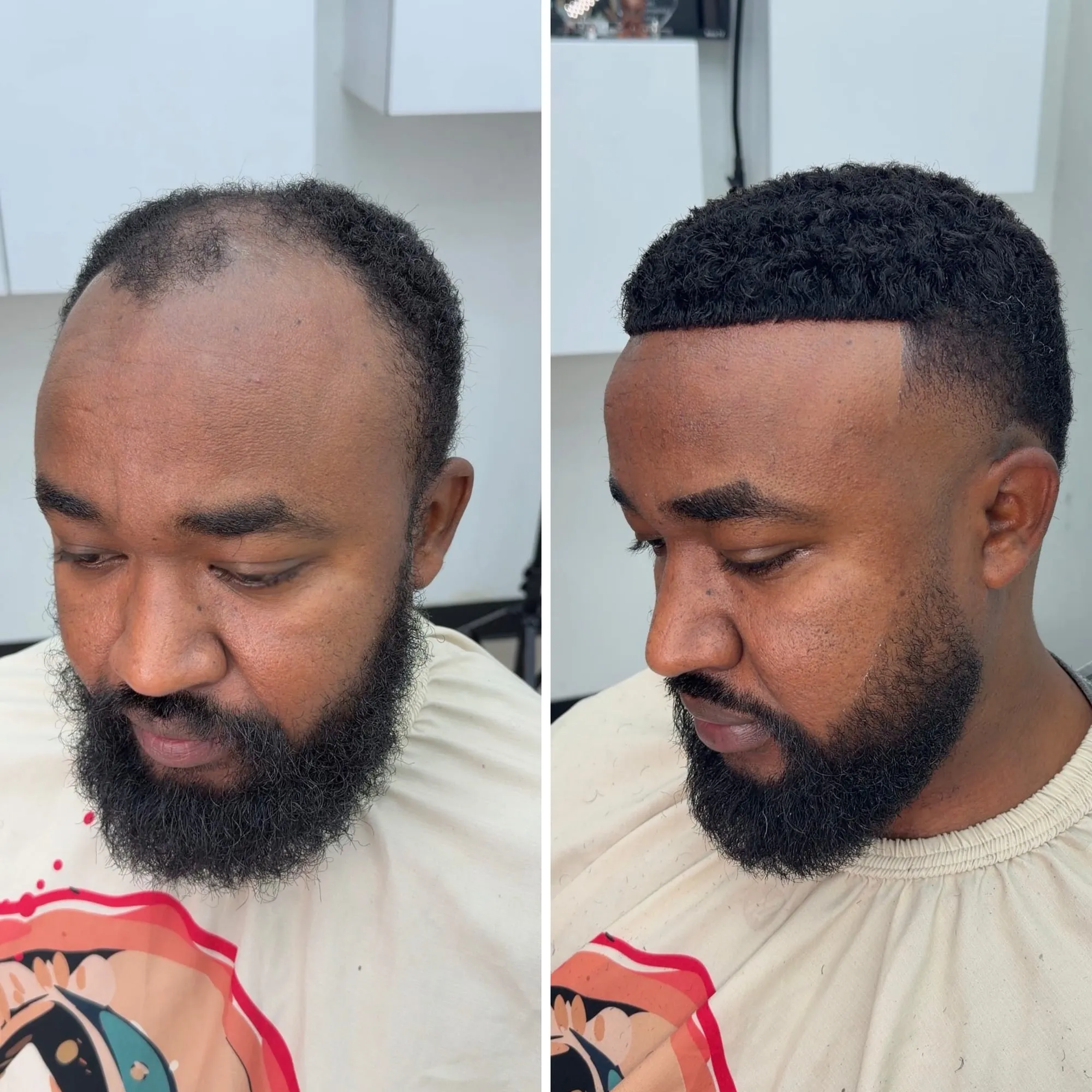
This is what it looks like.
A real client from our chair, photographed before and after his hair system was installed and cut in.
Questions, answered.
What are the standard hair system base sizes?
The three standard sizes are small at 6 by 8 inches, medium at 7 by 9 inches, and large at 8 by 10 inches, measured front to back by side to side. The 8 by 10 base is the stock default because it is the largest and can be trimmed to fit almost any head.
Why is 8 by 10 the default stock size?
Stock units are made before anyone orders them, so they are built at the largest standard size to fit the widest range of heads. You can always cut a base down to your coverage area, but you cannot add material back, so oversized is the safe universal blank.
Is the ordered base size the size I actually wear?
No. The ordered size is the raw blank. A stock base is typically cut down by roughly one to two inches to match your coverage area, and the perimeter is tapered, so the finished footprint on your scalp is smaller than the size on the order form.
When do I need a custom base instead of a standard size?
When your head or loss pattern falls outside what a trimmed standard base covers cleanly, a custom template is built to an exact mold of your scalp. A larger or fully bespoke base is a size-related cost driver, quoted at consultation against your real measurements.
What size should I order if I am between two sizes?
Start from the larger standard base and let the cut-in bring it to your outline. Trimming down is routine and adding material back is not possible, so the oversized blank is the safer choice. A template of your head settles it precisely.
Keep reading
Related guides.
Reading the Order Form
Every field on a custom hair system order form explained in one place: base size, material, density, color, grey, curl, length, origin, and more.
How to Measure
Measure a hair system with a flexible fabric tape: length front to crown, width temple to temple one inch back. Take every reading three times.
Stock vs Custom
Stock hair systems are ready made and fast. Custom units are built to your head, color, and hairline. Here is how the two differ and when each makes sense.
Cost by Base Type
Skin bases are usually cheaper to build than lace, but they wear out faster. Cost per month of wear is the honest way to compare bases.