

Last updated September 28, 2026
How the three layers are built
The word silk describes the top layer, not the whole unit. Underneath that top sits a stack of materials, and it is the stack, not any single sheet, that creates the effect. Most silk tops we work with are a three-layer sandwich, and each layer has one job.
The knots are tied on the middle lace layer. They are then hidden by the silk mono on top and supported by a fine net beneath, so what shows on the surface is a clean strand of hair and nothing else. That is the whole trick, and it is why the technique is also called injected lace: the hair is effectively injected up through the top layer rather than knotted on the surface where you would see it.
- Silk mono on top: a fine, closely woven layer the hair is pulled through, so no knot reaches the surface
- Lace in the middle: the working layer where each hair is actually knotted, kept out of sight below the silk
- Diamond net beneath: a fine, durable net that adds strength and holds the three layers in register
Why hidden knots look so natural
On a standard lace or skin base, every hair is tied with a knot, and that knot is a tiny dark dot at the root. Builders reduce it two ways: they bleach the knots to lighten the dot, or they use a single-knot method to make it smaller. Both help, and both have limits. Bleaching lightens the knot but can weaken it slightly over time, and even a small knot is still a point of color at the base of the hair.
A silk top sidesteps the problem instead of managing it. Because the knot lives on the lace layer under the silk, there is no dot to bleach and nothing dark sitting at the surface. Up close, along a part or across the crown, the hair reads as if it is growing out of scalp. That is the single reason most men ask for a silk top: they want to be able to part the hair and have someone look right at the part without seeing a base.
Heat performance and styling
The layered top does two useful things under heat. First, because the knots are buried, they are shielded from the direct contact of a blow dryer or iron, so the anchor points are not being cooked the way exposed bleached knots can be. Second, the silk surface carries the hair color evenly, so a part looks consistent rather than showing lighter knot points against darker hair.
Heat still needs respect. Human hair on any base handles a warm dryer and a moderate iron well, and the color and knot durability of a silk top hold up better than a fine bleached-knot lace under the same styling. What silk does not do is breathe like open lace. The closely woven top and the net below move less air than a French or Swiss lace, so in a Phoenix summer or a humid Pennsylvania August a full silk base can feel warmer against the scalp. We weigh that against how much you value the hidden-knot part, and we often build silk only where the part shows.
Durability and wear life
The extra layers make a silk top one of the tougher bases in the lace family. Where a single sheet of fine French lace is delicate and can fray at the knots and edges within a few months, the silk-and-net stack resists that wear and typically carries a longer service life, often on the order of several months to a year with disciplined care. It is not as bulletproof as a thick poly perimeter, but for a fine, natural-looking surface it holds up well.
Two things shorten that life. The first is the density you order: a very high density packs more hair and more knots into the same lace layer, which stresses it faster. The second is cleaning, because residue works into the woven top and net, and aggressive scrubbing frays the material. For a fuller breakdown of what determines lifespan, see our page on how long hair systems last.
Where a silk top fits, and where it does not
Silk shines on the top, the part, and the crown, the zones where people look down at the base of the hair and where a hidden knot pays off most. That is why a lot of the units we fit are hybrids: silk top through the middle for the grow-from-skin part, with a different material at the perimeter and hairline.
The front hairline is the one place we usually keep silk off. A silk top has a defined top layer with a real edge, and the most undetectable hairlines come from a graduated lace or an ultra-thin skin front where the edge can vanish against the forehead. Putting silk right at the hairline trades the front edge you look hardest at for a benefit you mostly need farther back. So the common build is a fine lace or thin skin front that melts into the skin, flowing into a silk top for the part and crown. We settle the exact map at your consultation once we have seen your part, your density, and how you wear it.
Reading a silk top on a spec sheet
On an order form, a silk top shows up as a base construction choice, sometimes written as silk top, injected, or injected silk, and it is usually paired with a note about which zones get it. Alongside it you will see the base size in inches, the density as a percentage, the curl or wave code, and the hair type. A silk top is a construction decision that rides on top of all of those, not a replacement for them.
It also carries real cost drivers, which we rank honestly and price at consultation rather than on a page. The added labor of the layered, injected build is the first driver. Choosing European hair over other origins is the second. A fully custom template for your exact part and crown is the third, and any hair length over six inches adds material on top of that. We walk the whole spec sheet with you so you know exactly what each line does before anything is ordered. For the full field-by-field walkthrough, see our guide on how to read a hair system order form.
| Attribute | Silk top (injected lace) | French or Swiss lace | Thin skin |
|---|---|---|---|
| Knot at the surface | None, knots hidden under the top layer | Visible unless bleached or single-knotted | Visible but softened under the clear film |
| Breathability | Lower, woven top plus net move less air | Highest, open mesh passes heat and sweat | Low, solid film breathes least |
| Typical service life | Longer for a fine surface, months to about a year with care | Shorter, fine mesh frays at knots and edges | Varies, thinnest films wear through soonest |
| Best zone | Part, top, and crown where the base shows | Front and top for realism and airflow | Front hairline for a vanishing edge |
| Hairline use | Kept off the front edge in most builds | Excellent at the hairline | Excellent at the hairline |
| Upkeep note | Clean gently, residue works into the weave | Gentle cleaning, most delicate material | Wipes clean fast, simplest routine |
Real work
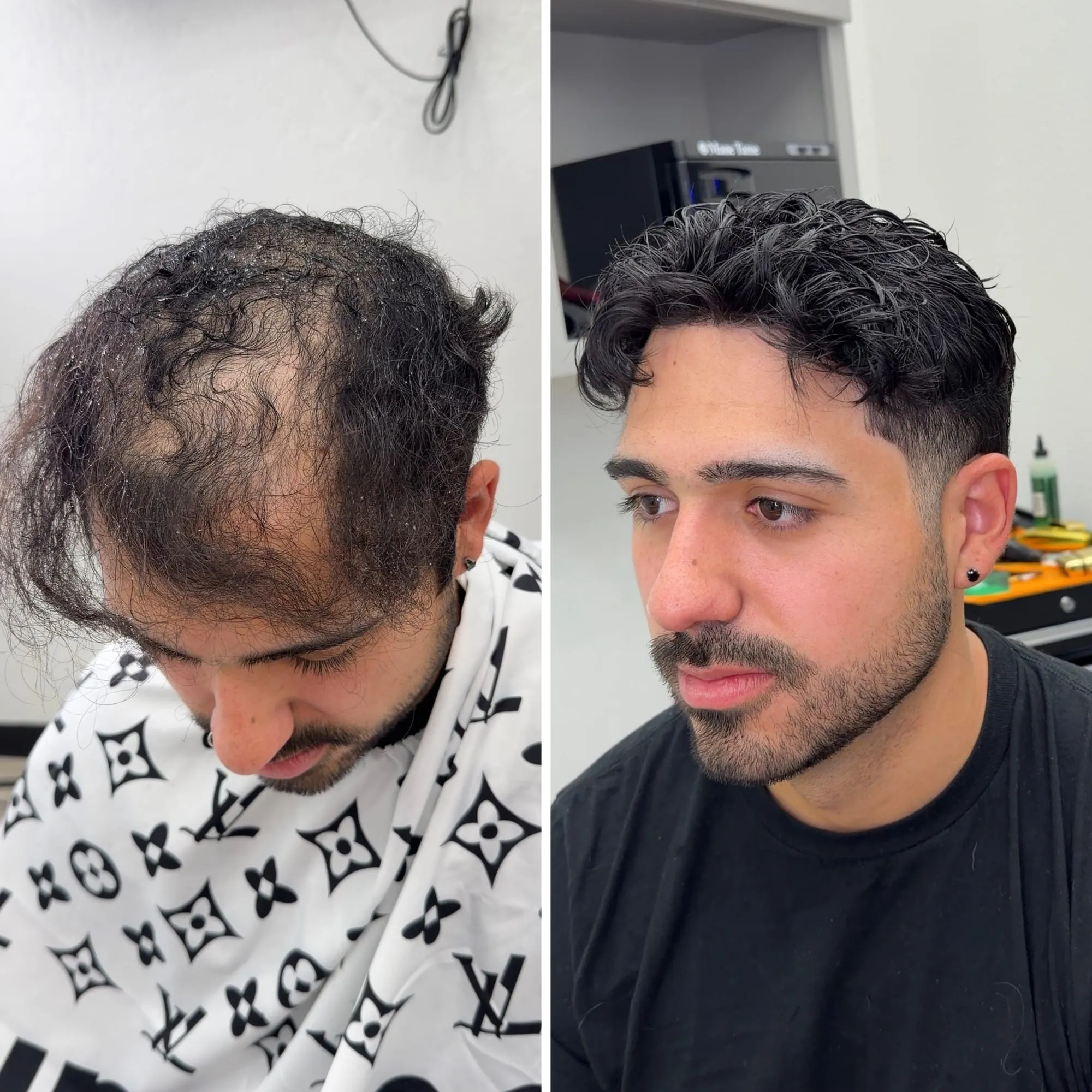
This is what it looks like.
A real client from our chair, photographed before and after his hair system was installed and cut in.
Questions, answered.
What is a silk top hair system?
It is a hair system built on a multi-layer base, usually a fine silk top over a lace layer over a diamond net. The hair is knotted on the hidden lace layer and pulled up through the silk, so no knot shows at the surface. It is also called injected lace, and it gives a natural grow-from-skin look along the part and crown.
Why choose silk top over bleached knots?
Bleached knots lighten the dark dot at each root but leave a small point of color and can weaken the knot over time. A silk top removes the dot entirely by hiding the knot under the top layer, so there is nothing to bleach and nothing dark at the surface. For a part you look straight down at, that is the more convincing result.
Does a silk top handle heat and styling well?
Yes, within reason. The buried knots are shielded from direct dryer and iron contact, and the color reads evenly across the part, so it holds styling better than a fine bleached-knot lace. The trade is breathability: the woven top and net move less air than open lace, so a full silk base can feel warmer in hot weather.
Is a silk top good for the front hairline?
Usually not at the very edge. A silk top has a defined top layer with a real edge, while the most undetectable hairlines come from graduated lace or ultra-thin skin that vanishes against the forehead. The common build pairs a lace or thin skin front with a silk top through the part and crown.
How long does a silk top last?
Longer than a single sheet of fine lace, often on the order of several months to about a year with careful, gentle cleaning. Higher density and rough handling shorten that. It is more durable than plain lace but less rugged than a thick poly perimeter, which is why hybrids are common.
Keep reading
Related guides.
Reading the Order Form
Every field on a custom hair system order form explained in one place: base size, material, density, color, grey, curl, length, origin, and more.
Swiss vs French Lace
Swiss lace has the finer net and zero shine but shorter life. French lace is more durable, holds higher density, and is the usual first base.
Lace, Poly, or Skin
Lace breathes and looks natural, skin is invisible and easy to clean, poly holds longest. How we pick a hair system base by realism and upkeep.
Bleached Knots
Bleached knots lighten the dark tie-off at the base of each front hair for an invisible hairline, at the cost of faster shedding in that zone.