

Last updated September 28, 2026
What ventilation actually means
Ventilation is the process of adding hair to a base, one small group of strands at a time, so the finished hair unit looks like it is growing out of your scalp. It is done by hand with a fine needle for knotted work, or by injecting hair directly into a skin membrane. The base material decides which methods are even possible, because you can only knot onto something with holes to knot through, and you can only inject into something solid enough to hold the hair without a knot.
That single physical fact is why this page exists. A lace or monofilament base is a mesh, so hair has to be tied to it, which means knotting. A skin or poly base is a smooth polyurethane film with no mesh to tie to, so hair is looped or injected into the material itself. Mixing that up is the most common ordering mistake we see: asking for a V-loop lace front is asking for something that cannot be built, because there is nothing solid for the loop to sit in.
The four methods and where they work
Here is how the common ventilation methods compare on the three things that matter: which base they can be used on, how invisible the roots look, and how well the hair resists shedding and daily handling. The hard constraint in the base column is not a preference, it is a physical limit of the material. Skin base thicknesses below are typical working ranges for each method, not fixed rules, and they move with the brand and the build.
| Method | Base compatibility | Root visibility | Durability and hold |
|---|---|---|---|
| Single knotting | Swiss, French, or full lace and monofilament (mesh bases only) | Very high once the knots are bleached, since one strand per knot leaves the smallest dot | Moderate, one strand per knot sheds a little more freely than a double |
| Double knotting | Lace and mono, usually kept to the perimeter and crown | Good, the knot is slightly larger so it is normally kept back from the front hairline | Highest knot security, two strands per knot resist shedding and rough handling best |
| Splitting (split knot) | Fine lace only, front third and hairline | Highest of the knotted options, the split knot is nearly invisible at the skin | Lower, the split reduces anchoring so it is reserved for the hairline, not the whole unit |
| V-loop (looped, knotless) | Thin skin and poly only, roughly 0.03 to 0.08 mm works best | Highest overall, no knot at all so hair appears to grow straight from the scalp | Lower, the folded loop can pull free over time, so units shed faster and wear on the shorter end |
| Injection (injected) | Skin and poly only, holds better on thicker poly around 0.08 to 0.12 mm | High, hair emerges from the membrane and the growth direction is controllable | Moderate to good on thicker poly, weaker on ultra-thin where there is less material to grip |
Knotting: single, double, bleached, and split
Knotting ties hair to a lace or monofilament mesh with a fine ventilating needle, and the number of strands per knot is the first lever. A single knot uses one strand and leaves the smallest possible dot at the base, which is why the most natural fronts are single-knotted. A double knot uses more strands and holds far more securely, so it is the workhorse for the crown and perimeter where security matters more than a flawless close-up. Denisse and Ivette will often single-knot the front third and double-knot everything behind it on the same unit, so you get an undetectable hairline and a base that survives daily wear.
The dark dot a knot leaves is the giveaway, so knots across the front are usually bleached. Bleaching lightens the knot so it disappears against most skin tones, at the cost of a little strand strength, which is one reason bleached-knot fronts can shed slightly sooner. Splitting goes one step further at the very hairline: the knot is split so almost nothing sits on the surface, giving the closest thing to hair growing from bare skin. Because a split knot anchors less firmly, it is used only in that first row or two, never across the whole unit.
- Single knot, one strand, smallest dot, most natural, sheds a little more
- Double knot, more strands, most secure, kept off the front hairline
- Bleached knot, lightened to hide the dot, slightly weaker strand
- Split knot, near-invisible, hairline only because it anchors less
V-loop and injection: skin bases only
V-loop and injection are the two knotless methods, and both need a solid skin (poly) membrane to work. In V-loop, a single strand is folded into a V shape and the fold is pushed into the underside of the skin so no knot ever forms on the surface. The result is the most undetectable ventilation there is, because there is nothing to see at the root at all, just hair emerging cleanly from what reads as scalp. That is why ultra-thin skin fronts around 0.03 to 0.06 mm are so convincing. The trade is durability: with no knot locking it in, a looped strand can work free over time, so V-loop units tend to shed more and land on the shorter end of a skin base's wear life.
Injection pushes hair through the poly from one side to the other so it sits in the material with a controllable growth direction, which is what lets an injected skin base part naturally and lie the right way. It holds better than a bare loop, especially on thicker poly closer to 0.08 to 0.12 mm where there is more material to grip the strand, and it weakens on ultra-thin skin where there is barely any membrane to hold it. Neither method can be used on lace or mono, full stop, because there is no solid film for the loop or the injected strand to sit in. If you want a knotless, no-dot front, you are choosing a skin base by definition.
Matching method to base and zone
In practice a single hair unit rarely uses one method everywhere, because no single method is best at both invisibility and durability. The front third, where anyone looks closest, gets the most invisible option the base allows: single bleached knots or splitting on lace, V-loop or fine injection on skin. The crown and perimeter, which take the most tension from tape and glue and daily removal, get the most secure option: double knots on a mesh base, or a thicker injected poly on a skin base. Nico maps that zoning to how you actually live before we order, so a man who is hard on his hair does not get a delicate split-knot hairline that will not survive his routine.
The base you have already chosen narrows the menu for you. On lace and mono your only real question is knot style and where to bleach, because knotting is the only option a mesh accepts. On a skin base your question is V-loop versus injection and how thick to run the poly, because those knotless methods are the only ones a solid membrane accepts. If you are still deciding between base families, that decision comes first, and the ventilation method follows from it, not the other way around.
What is set at consultation
Ventilation is one of the labor-heavy parts of a build, so it does carry a cost component, and we defer the figure to your consultation rather than publishing a blanket number. Ranked by how much they move the labor, the drivers are the method itself (a fully V-looped or single-knotted-and-bleached front is far more hand work than a mostly double-knotted unit), the density you want ventilated, and how much of the unit uses the most delicate, most invisible technique. A whole-unit V-loop skin build and a bleached single-knot lace front sit at the higher end of ventilation labor, standard double-knotting at the lower end. All of that is quoted against your actual specification, because two men can ask for what sounds like the same front and need very different ventilation maps.
What we can tell you before you sit down is the logic on this page: the method is chosen for each zone, the base decides which methods are even possible, and the most invisible root is usually the least durable one, which is exactly why it is reserved for the front and paired with something sturdier behind it. Bring your base preference and your daily routine to the consultation and we will map the ventilation to both.
Real work
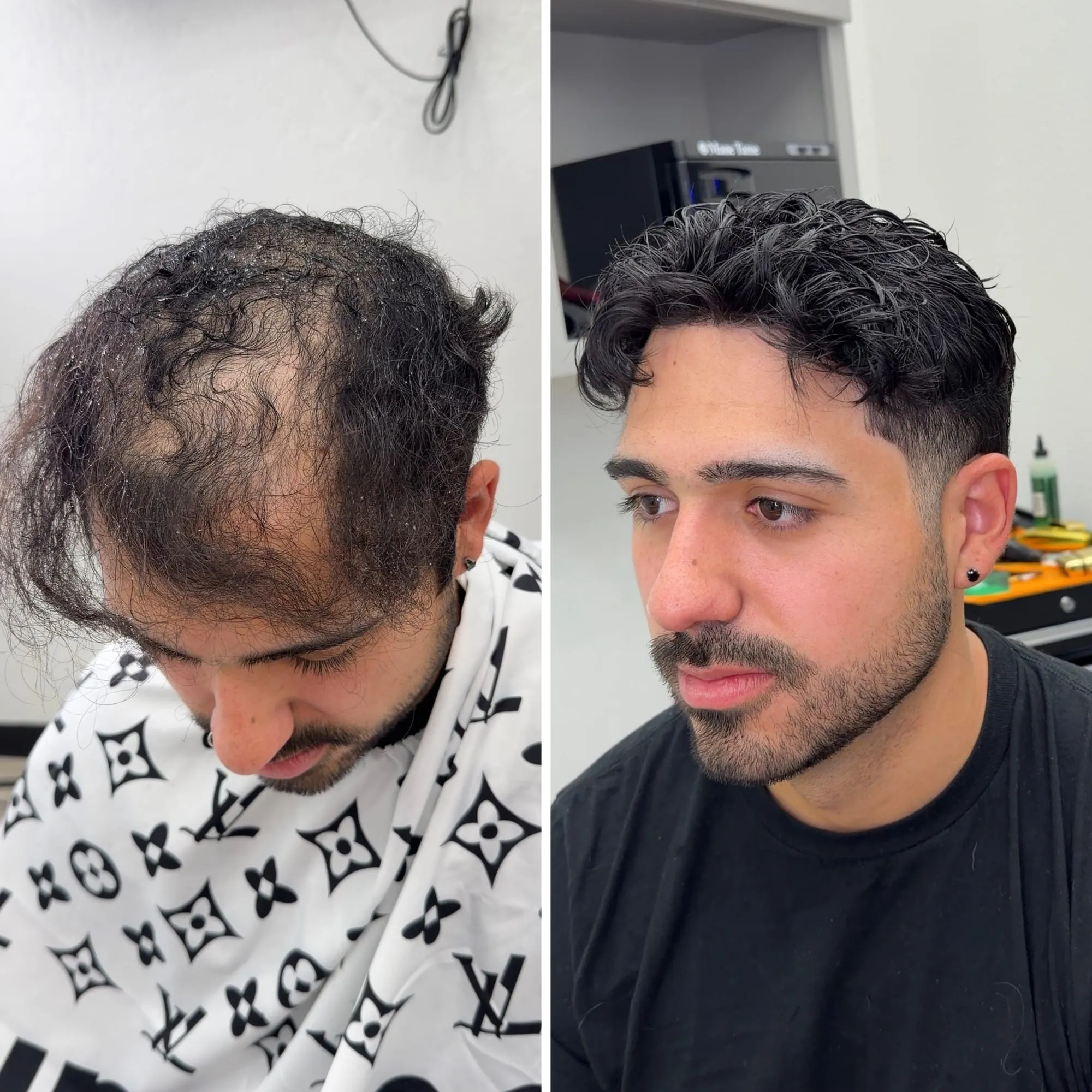
This is what it looks like.
A real client from our chair, photographed before and after his hair system was installed and cut in.
Questions, answered.
Can you use V-loop on a lace hair system?
No. V-loop and injection only work on a solid skin (poly) membrane, because the loop or injected strand needs material to sit in. Lace and monofilament are open meshes, so hair has to be tied to them, which means knotting. Asking for a V-loop lace front is asking for something that cannot be built.
Which ventilation method is the most natural looking?
V-loop on a thin skin base is the most undetectable, because there is no knot at all, just hair emerging from what reads as scalp. On lace, a single bleached knot or a split knot at the hairline comes closest. The most invisible methods are also the least durable, so they are usually reserved for the front third.
Why do knots need to be bleached?
A knot leaves a small dark dot at the base, which is the main giveaway across a hairline. Bleaching lightens that dot so it disappears against most skin tones. It costs a little strand strength, which is one reason bleached-knot fronts can shed slightly sooner, so bleaching is usually limited to the front where visibility matters most.
What is the difference between single and double knots?
A single knot ties one strand and leaves the smallest dot, so it looks the most natural and is used at the front. A double knot uses more strands and holds far more securely, so it is used at the crown and perimeter where tension is highest. Many units single-knot the front and double-knot the back on the same base.
Does the ventilation method affect how long a hair system lasts?
Yes. Knotless V-loop looks the most natural but sheds faster because nothing locks the strand in, so it tends to land on the shorter end of a skin base's wear life. Double knotting resists shedding best. That is why front zones and wear zones are usually ventilated with different methods on the same unit.
Keep reading
Related guides.
Reading the Order Form
Every field on a custom hair system order form explained in one place: base size, material, density, color, grey, curl, length, origin, and more.
Knot Types Explained
Single knots sit flatter and read more natural but shed sooner; double knots hold harder and sit more visible, so they run through the mid and back.
Bleached Knots
Bleached knots lighten the dark tie-off at the base of each front hair for an invisible hairline, at the cost of faster shedding in that zone.
V-Loop
V-loop loops each hair into a skin base with no knot, the most undetectable ventilation there is. An honest look at its wear life and upkeep.