

Last updated September 28, 2026
How the code is built: base level, then grey percentage
Every hair system color code answers two separate questions at once. The first part of the code is the base color, the underlying shade the hair would be with no grey at all, written on the standard level scale where lower numbers are darker. The last two digits are the grey percentage, meaning how much white hair is mixed through that base. Read them as a pair and the whole code becomes plain: base color first, grey amount second.
So in 1B30, the 1B is the base (a soft, natural black rather than a harsh jet black) and the 30 means about 30% of the strands are white. In 410, the 4 is a medium brown base and the 10 is a light 10% grey. Once you see that the trailing pair is always the grey figure, codes that looked cryptic become easy to compare at a glance, because only two variables are ever moving.
The reason grey gets its own number is that greying is not a single shade. Two men can share the exact same base color and look completely different because one is lightly peppered and the other is mostly white. Separating base from grey percentage lets us match your actual head instead of forcing you into a fixed off-the-shelf color, and it is why the grey figure matters as much as the base level.
Worked examples: real color codes decoded
Here are the common codes decoded into their two parts. The base color level uses the standard scale, and the grey percentage is the trailing pair of digits. The look column describes how each blend reads in normal light. No amounts appear here, because grey percentage is a specification, not a price, and the final figure is set to your match at consultation.
| Code | Base color level | Grey percentage | How it reads |
|---|---|---|---|
| 1B10 | 1B, soft natural black | About 10% white | Soft black with a light scatter of grey, barely there up close |
| 1B20 | 1B, soft natural black | About 20% white | Soft black starting to read as light salt-and-pepper |
| 1B30 | 1B, soft natural black | About 30% white | Clear salt-and-pepper on a black base, a very common request |
| 330 | 3, dark brown | About 30% white | Dark brown with visible grey woven through it |
| 410 | 4, medium brown | About 10% white | Medium brown with a faint touch of grey at the surface |
| 420 | 4, medium brown | About 20% white | Medium brown lightly flecked with grey |
| 440 | 4, medium brown | About 40% white | Medium brown reading strongly grey, approaching an even mix |
The grey percentage bands, 10% to 80%
Grey is not ordered as any number you like. It comes in set bands, usually in steps of ten, from about 10% at the lightest to about 80% at the greyest. The band you choose changes the whole character of the unit far more than most people expect, so it is worth understanding what each step looks like before you commit. The percentages below are the industry-standard bands, not exact strand counts, because real hair does not distribute in perfect tens.
| Grey code suffix | Grey percentage | Typical read |
|---|---|---|
| 10 | About 10% white | A few grey strands, youthful with just a hint of maturity |
| 20 | About 20% white | Light salt-and-pepper, noticeable up close but not dominant |
| 30 | About 30% white | Salt-and-pepper, the most requested band for men in their forties |
| 40 | About 40% white | Strongly grey, though still more base color than white overall |
| 50 | About 50% white | An even split between base color and white |
| 60 | About 60% white | Predominantly grey, base color now the minority |
| 70 | About 70% white | Mostly white with a base-color undertone still visible |
| 80 | About 80% white | Nearly white, with only a small amount of base color left |
Why a small grey change reads so large
The jump between neighboring bands is only ten points on paper, but it does not look small on a head. White hair is far more visible against a dark base than the same amount of white against a light one, so on a 1B soft black, moving from 1B20 to 1B30 is an obvious step up in grey, while on a light brown the same ten points is much subtler. This is why we always read the grey band together with the base level, never on its own.
It also explains a mistake men make when ordering by memory. People consistently overestimate their own grey, because the white strands are the ones they notice in the mirror. A man who feels quite grey is often closer to a 20 or 30 band than the 50 he would have guessed. Ordering a band too high is one of the more common reasons a first unit looks slightly older than the man wearing it, and it is easily avoided by matching against your real hair rather than your impression of it.
Higher grey at the temples
Men do not grey evenly. For most, grey appears at the temples and the sideburn line first, then spreads back and up across the years, so a head that is 30% grey overall can be noticeably greyer at the temples than at the crown. A single flat percentage across the whole unit can miss this and look slightly artificial, because it does not match how real greying is distributed.
To match that pattern, a unit can be specified with a higher grey concentration in the temple zone than the body, for example a 30% blend through the main area with a heavier band worked into the temples. This is a custom instruction rather than a stock code, and it is one of the small details that separates a convincing match from a merely close one. If your natural greying is temple-led, tell us at the consultation and we build the gradient in rather than settling for a uniform figure.
- Order the band that matches your real hair, not the greyer number you picture in the mirror
- Read the grey band against the base level, because white shows more on dark bases
- Ask for a heavier temple concentration if your grey is temple-led
- Plan to nudge the band up over the years as your natural grey advances
Matching your grey at consultation
Grey percentage is one of several attributes on a hair system order, alongside base construction, hair type and origin, density, and curl. It carries no separate cost of its own in the way length over about six inches or a fully custom template can, so grey is a matching decision rather than a cost driver. The work is getting the band and the base level right against your actual hair, which is done best in person or from good daylight photos, not from a code chosen in the abstract.
In practice we match the base level first, then hold grey samples against your hair to land the band, then decide whether the temples need a heavier concentration. We also plan slightly ahead, because your own grey keeps advancing, so a band that is a touch on the lighter side today often blends more naturally for longer than one set exactly to this month's mirror. Bring your natural hair, or clear photos of it, and we will translate it into the right code with you.
Real work
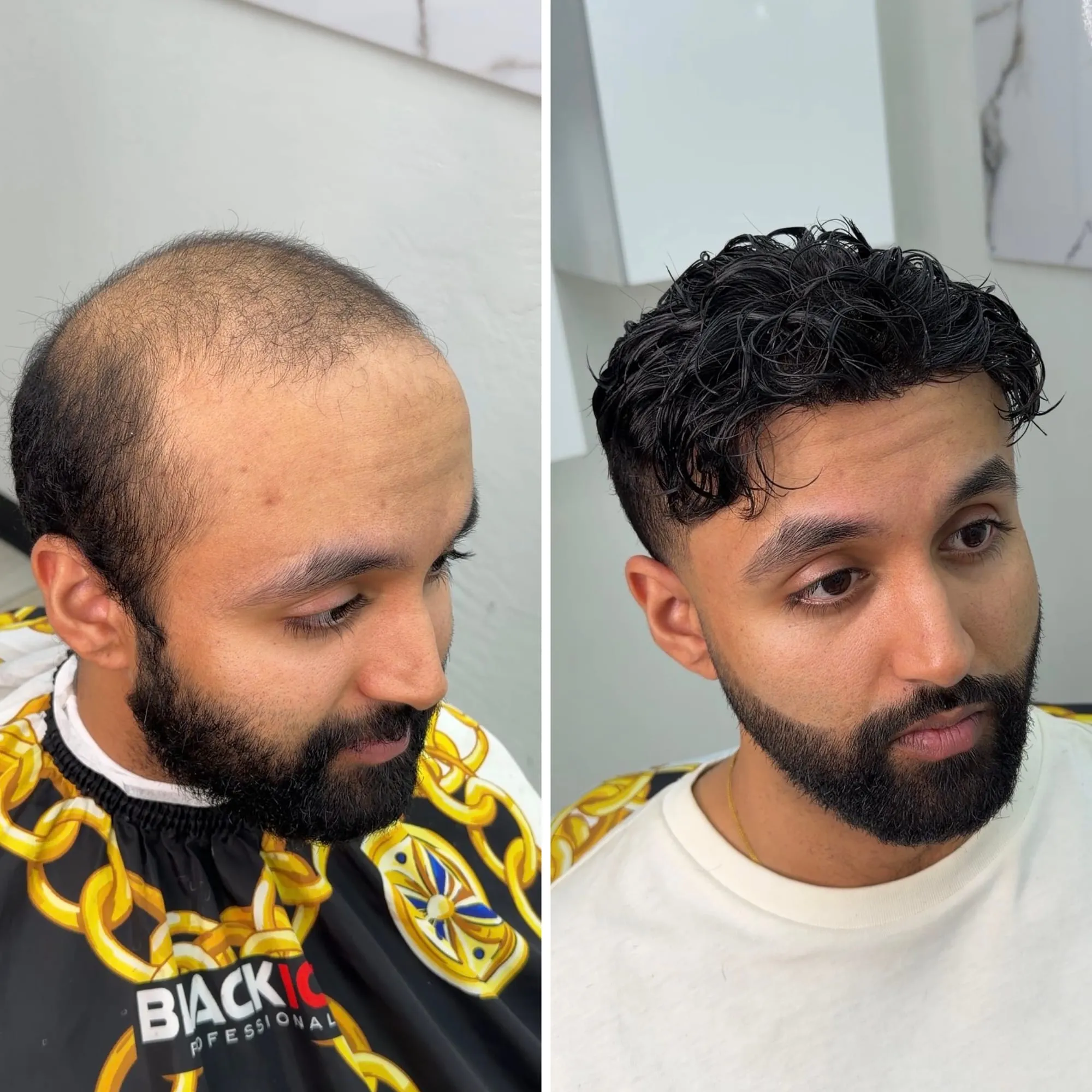
This is what it looks like.
A real client from our chair, photographed before and after his hair system was installed and cut in.
Questions, answered.
What does the number after a hair system color code mean?
The last two digits are the grey percentage, meaning how much white hair is blended through the base color. In 1B30 the 1B is the base (soft black) and the 30 means about 30% grey. In 410 the 4 is a medium brown base and the 10 is about 10% grey.
What grey percentages can I actually order?
Grey comes in set bands, usually in steps of ten, from about 10% at the lightest to about 80% at the greyest. The 30% band, a true salt-and-pepper, is one of the most requested. Real hair does not distribute in perfect tens, so treat the numbers as bands, not exact strand counts.
Can I have more grey at the temples than the rest?
Yes. Most men grey at the temples first, so a unit can be built with a higher grey concentration in the temple zone than the body, for example a 30% blend overall with a heavier band at the temples. It is a custom instruction rather than a stock code, and it makes the match more convincing.
How do I know which grey band matches me?
Match against your real hair in good daylight rather than your impression of it, because most men overestimate their own grey. We hold grey samples against your hair at consultation to land the band, and we often set it slightly lighter so it blends naturally as your own grey advances.
Why does the same grey percentage look different on different bases?
White hair shows far more against a dark base than a light one, so 30% grey reads as an obvious salt-and-pepper on a soft black but much more subtly on a light brown. That is why we always read the grey band together with the base level, never on its own.
Keep reading
Related guides.
Reading the Order Form
Every field on a custom hair system order form explained in one place: base size, material, density, color, grey, curl, length, origin, and more.
Color Codes Explained
Hair system color codes run 1 (darkest) to 60 (lightest), R means one shade lighter, and a percentage sets grey. Here is how a full code parses.
Color Matching
How color matching works for a hair system, and how salt-and-pepper and grey are blended so it stays believable as you age.
Curl and Wave Chart
Rod size sets the wave: 6mm gives a tight curl, 28 to 30mm reads almost straight. See the full rod-to-wave chart and why dead straight looks wrong.