

Last updated September 28, 2026
Why the base sets the density ceiling
Density on a hair system is the amount of hair packed into a given area of base, and it is limited by one physical fact: every strand has to be anchored to the base somehow, and each base material tolerates a different amount of anchoring before it fails. On lace and mono the hair is tied on with knots, and past a certain point the knots either tear the mesh or crowd together into a visible dark mass. On skin the hair is injected or looped into the membrane, and the thinner that membrane is, the less hair it can hold without splitting.
That is why the same density request behaves differently on different bases. A medium-heavy build that a French lace or a monofilament base carries comfortably will shorten the life of a fine Swiss lace and will simply not sit right on an ultra-thin skin. The base is the constraint, and the density has to live inside it. This page maps the real ceilings so you know what is actually achievable before you order, rather than discovering the limit after the unit is built.
Density ceiling by base material
Here are the definitive ceilings by base, with the density each material realistically holds, the approximate percentage band it maps to, and the reason it caps where it does. Percentages are relative to a full natural head of hair, where roughly 90 to 110 percent reads as a normal full head. The exact figure a vendor prints varies a little, but the relationship between the bases does not.
| Base material | Typical base spec | Density ceiling it holds | Approx density band | Why it caps there |
|---|---|---|---|---|
| Ultra-thin skin (poly) | About 0.03mm membrane | Light to medium | About 80 to 100% | Hair is injected or V-looped, not knotted, and the thinnest membrane splits if packed dense, so it holds the least of any base |
| Standard thin skin (poly) | About 0.06 to 0.12mm | Medium | About 100 to 120% | A thicker membrane anchors more hair, but pushed too high the roots read as darkness under the translucent skin |
| Swiss lace | Finest, most delicate lace | Medium-light | About 70 to 100% | The most invisible mesh is also the most fragile, so heavy knotting tears it; density is held back to protect the hairline and the wear life |
| French lace | Stronger, slightly coarser lace | Up to medium-heavy | About 100 to 140% | A more durable weave takes more knots without tearing, so it carries noticeably more density than Swiss while staying breathable |
| Monofilament | Durable polyester or nylon mesh | Highest, up to heavy | About 120 to 160%+ | The strongest knotting surface holds single and double knots densely without tearing, so it takes the most hair of any base |
Reading the density percentages
The percentage figures only mean something once you know what a full head is. Density on a hair system is quoted against a natural head of hair, so 100 percent is not maximum, it is normal. Most men want to land in the light-to-medium band, because that reads as a real, age-appropriate head of hair rather than a deliberately thick one. Younger men with coarse native hair sometimes go heavier to match what they had; older men often go lighter to match how their hair has thinned around the sides.
| Density band | Approx % of a full head | How it reads | Who it tends to suit |
|---|---|---|---|
| Extra light | About 50 to 60% | Visibly sparse, you can see the base through it | Older clients or a deliberately thin, mature look |
| Light | About 65 to 80% | Airy and mature, softer coverage | Older men matching hair that has thinned |
| Light to medium | About 90 to 110% | Reads as a normal full head of hair | Most men, the natural default |
| Medium to heavy | About 120 to 140% | Thick and youthful, obvious fullness | Younger men or those with coarse native hair |
| Heavy | About 150 to 160% | Very full, can look dense if the base is not right | Specific styles and men matching thick, coarse hair |
Swiss lace and French lace
Lace wins on the hairline. A knotted lace front against your skin is about as undetectable as hair replacement gets, which is why the front third of many units is lace even when the body is something sturdier. The trade is that lace is knotted, and knots are exactly what caps its density. Swiss lace is the finest and most invisible mesh, and that fineness is why it caps near medium-light: pack too many knots into it and you both tear the mesh and shorten the life of the unit. Its beauty and its limit are the same property.
French lace is the practical middle ground. It is a slightly coarser, stronger weave, marginally less invisible than Swiss up close but able to take more knots without failing, so it carries up to roughly medium-heavy. For a man who wants a natural front and a bit more fullness than fine Swiss will safely hold, French lace across the front is often the honest answer. If you are choosing between the two purely on density, French lace gives you more headroom; if you are choosing on the very last degree of invisibility at the hairline, Swiss leads but keeps you in the lighter bands.
Monofilament: the highest ceiling
Monofilament is a breathable mesh built for strength rather than for the last ounce of invisibility at the front. Because it is the toughest knotting surface, it holds single and double knots at the highest densities of any base without tearing, which is why it sits at the top of the ceiling table. If your priority is genuine fullness, a thicker, more youthful head of hair that stays put through daily handling, mono carries it where fine lace cannot.
The reason mono is not simply the answer for everyone is the front. A mono knot is not quite as invisible as a fine lace knot right at the hairline, so many units pair a mono or reinforced body, where the density lives, with a lace or skin front, where invisibility matters most. That combination lets the durable part of the base carry the density while the delicate part carries the illusion. If you want maximum density and are willing to blend a more natural front onto a strong body, mono is the base that makes it possible.
Thin skin: capped by thickness, not knots
Thin skin behaves differently from lace and mono because there are usually no knots at all. The hair is injected into or looped through a polyurethane membrane, so the limit is not knot tolerance, it is how much hair the membrane can physically anchor before it splits or before the injected roots start to read as darkness under the translucent surface. That makes base thickness the whole story: the thinner the skin, the more invisible the scalp look and the tape-friendly finish, but the less density it can hold.
An ultra-thin skin at around 0.03mm gives the most realistic scalp but holds the least, sitting in the light-to-medium band. A standard skin around 0.06 to 0.12mm anchors more hair and reaches genuine medium density, at the cost of a slightly less delicate front. So if you love the skin look but want real fullness, you are choosing thickness, and thickness trades a little realism for the density and durability you are after. This is the same tension that runs through the whole base decision, just expressed in millimeters rather than in knots.
Matching density to the base and to you
The mistake to avoid is picking a density in the abstract and then being surprised that your preferred base cannot hold it, or that forcing it wrecks the wear life. Start from how you live and what your native hair looks like, choose the base that fits that, and then set the density to sit comfortably inside that base's ceiling. Done in that order, the unit looks right and lasts as long as the base is capable of lasting.
- Want the most invisible hairline and a natural, not-too-thick look: Swiss lace front, density in the light to medium bands
- Want a natural front with a bit more fullness: French lace, up to about medium-heavy
- Want maximum density and durability: monofilament body, blended with a finer front where it shows
- Want the most realistic scalp look and will accept lighter density: thin skin, with thickness chosen to match how much fullness you want
- Not sure and want the safest all-round choice: a hybrid base puts density on a strong body and invisibility on a fine front
What we confirm at consultation
Density is one line on the order form, but it only works when it is matched to the base, the hair caliber, and the knotting method beneath it. Fine hair packed dense reads differently from coarse hair at the same percentage, single knots sit flatter than double knots, and bleached knots at the front soften how the density reads right at the hairline. We set all of those together so the finished unit reads as a natural head rather than as a number.
Very high density and European hair sit among the drivers that move the build, and those figures are quoted against your actual specification at consultation rather than published as a blanket number, because two men asking for the same density on paper can need very different builds underneath it. Bring a photo of your hair at its fullest, or your native hair if you still have it around the sides, and we will map a base and a density that match it honestly. This page is the constraint chart; the live density guide walks through choosing your number, and the order-form guide shows where density sits among every other spec.
Real work
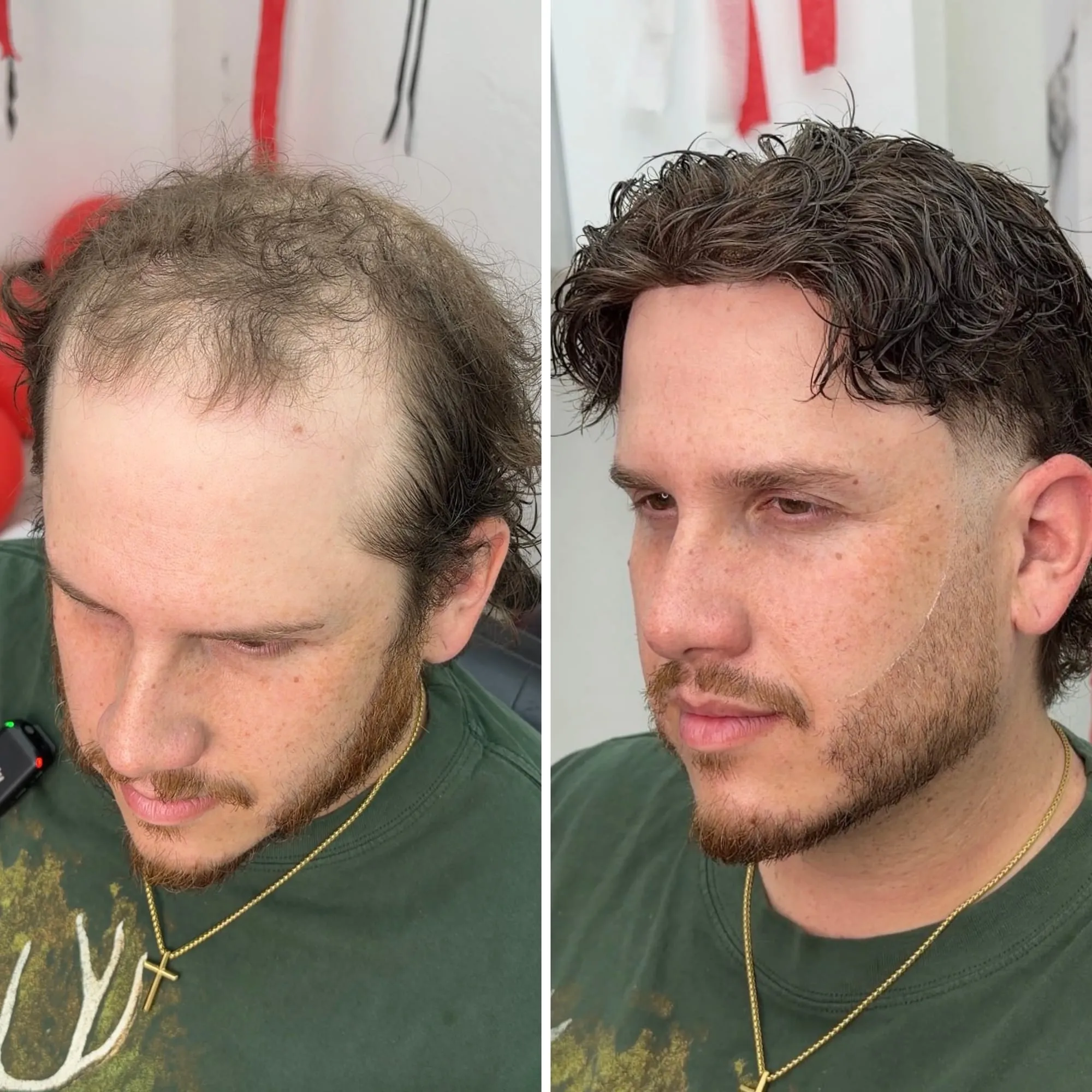
This is what it looks like.
A real client from our chair, photographed before and after his hair system was installed and cut in.
Questions, answered.
Which hair system base holds the highest density?
Monofilament. Its strong mesh takes single and double knots at the highest densities without tearing, up to a heavy band. Fine lace and thin skin both cap lower, which is why high-density units often use a mono or reinforced body with a finer front where invisibility matters.
Why can't Swiss lace hold heavy density?
Because the fineness that makes Swiss lace so invisible is also what makes it fragile. Packing heavy knots into that delicate mesh tears it and shortens the unit's life, so density is held back to medium-light to protect both the hairline and the wear life. French lace is stronger and carries more.
What limits density on a thin skin base?
The thickness of the membrane, not knots. Skin hair is injected or looped rather than knotted, so the limit is how much hair the polyurethane can anchor before it splits or the roots read as darkness under the translucent surface. An ultra-thin 0.03mm skin holds the least; a thicker skin holds more.
What does 100 percent density mean?
It means a full natural head of hair, not the maximum possible. Density is quoted against a natural head, so 100 percent is normal fullness. Most men land in the light-to-medium band, roughly 90 to 110 percent, which reads as a real age-appropriate head rather than a deliberately thick one.
Can I get high density and an invisible hairline on the same unit?
Yes, with a hybrid construction. You put the high density on a durable mono or reinforced body and a finer lace or skin front where the hairline shows, so the strong part carries the density and the delicate part carries the illusion. We map that split to your specification at consultation.
Keep reading
Related guides.
Reading the Order Form
Every field on a custom hair system order form explained in one place: base size, material, density, color, grey, curl, length, origin, and more.
Density Guide
How much density actually reads as real hair by age and face, and why over-dense systems look fake. A practical density guide from our chair.
Lace, Poly, or Skin
Lace breathes and looks natural, skin is invisible and easy to clean, poly holds longest. How we pick a hair system base by realism and upkeep.
Thin Skin Systems
A thin skin hair system is a fine polyurethane base that gives the most invisible scalp look. Here is how thin and ultra thin skin bases feel and wear.