

Last updated September 28, 2026
What monofilament actually is
Monofilament, mono for short, is a fine mesh made from single strands of polyester or nylon, woven far more tightly and uniformly than lace. Hold a piece up and it reads as a soft, semi sheer gauze rather than the open honeycomb of a lace net. Each hair is hand knotted through that mesh, and because the strands are strong and evenly spaced, the base can carry a heavy count of knots and take repeated adhesive and removal cycles without giving way.
The mesh is thin enough to sit flat against the scalp and, when the hair is split knotted correctly, your scalp color reads through the tiny gaps so the parting looks like hair leaving skin. That combination, real durability plus a convincing scalp read at the part, is what makes mono its own base category rather than a variation on lace.
Why mono is the durability base
Lace is prized for how it looks and breathes, but the fine net frays at the knots and edges over time, which is the price of that delicacy. A thin skin film is easy to clean but the thinnest, most invisible versions wear through soonest. Monofilament mesh sits at the tough end of the scale. The woven polyester or nylon resists tearing, tolerates being bonded and lifted again and again, and tends to be the longest lasting foundation of the common builds.
With a routine maintenance schedule, a mono centered unit commonly holds up for several months of daily wear, often in the range of six to twelve months before the base itself is spent, longer than a comparable all lace build under the same conditions. Wear life always depends on your skin chemistry, how hard you sweat, and how carefully the unit is removed, so we give you a real expectation for your build at consultation rather than a number off a page.
How mono carries the highest density
Density is the amount of hair tied into a given area, and it is the single spec that most changes how a unit looks and how long it lasts. A fragile base limits how much hair you can safely knot in before the material is stressed. Mono removes that ceiling. The strong, evenly woven mesh gives every knot a secure anchor, so mono comfortably supports the fuller densities without the base breaking down early.
We build mono units across a wide density range, from a light, age appropriate look up through a full, youthful head of hair, and mono holds the top of that range better than any other single base. Heavier density reads as more hair but also adds weight and can look less natural if it outruns your age and face, so we choose a target with you rather than defaulting to the maximum. Our hair system density guide walks through where on that scale most men land.
The hairline and perimeter question
Mono has one honest limitation. The mesh, durable as it is, is not the most invisible material right at the very front edge where people look hardest. A raw mono edge can be detectable up close, so we almost never run mono all the way to the hairline.
Instead we combine bases. The most common mono build is a monofilament crown and top for durability and density, a Swiss or French lace front so the hairline disappears into skin, and a thin skin or poly perimeter around the edge to take adhesive and hold the bond. That hybrid gives you the strengths of each material exactly where each one matters, and it is the build we reach for most often when a client wants a unit that lasts and still looks undetectable at the front.
Breathability, comfort, and cleaning
The mesh carries micro openings, so mono breathes better than a solid skin or poly film, though not as freely as open lace. For most men that is a comfortable middle ground, and it matters in both climates we work in, a Phoenix summer in Peoria and a humid August in our Eighty Four studio. If overheating is your primary concern we weight the build toward lace through the middle, and if durability leads we weight it toward mono.
Cleaning a mono base is straightforward. Adhesive lifts off the mesh cleanly with the right remover, and the material tolerates a gentle scrub better than delicate lace. As with any base, residue that works into the mesh is what shortens its life, so we teach you the exact removal and cleaning routine for your unit before you leave with it.
How mono compares on the spec sheet
When you read a hair system order form, the base material line tells you most of what to expect from the unit before you ever touch it. Here is how monofilament stacks against the other two common bases across the specs that actually change your day to day.
| Spec | Monofilament | Lace | Thin skin |
|---|---|---|---|
| Base material | Fine polyester or nylon mesh | Swiss or French woven net | Thin polyurethane film |
| Durability | Highest of the three | Most delicate, frays over time | Middle, thinnest wears soonest |
| Typical wear life | Often 6 to 12 months | Shortest under equal wear | Short to medium |
| Density it supports | Highest, holds full builds | Moderate to high | Moderate |
| Breathability | Good, micro openings in the mesh | Best, open net | Least, solid film |
| Hairline realism at the edge | Needs a lace or skin front added | Most invisible front | Clean, shaved-down edge |
| Best suited to | Durability and high density | An undetectable, breathable front | An invisible, easy-clean scalp |
Who a monofilament build suits
Mono is a strong pick if you want the most life out of each unit, if you carry a fuller density and need a base that can hold it, or if you are rough on your hair and want a foundation that forgives daily wear. Because mono handles repeated bonding well, it also suits men who reattach the unit themselves and want a base that stands up to the routine.
It is a weaker pick as a standalone if your single priority is the most invisible possible hairline with maximum airflow, in which case a lace led build serves you better at the front. The honest answer for most clients is the hybrid, a mono core with a lace front and a bonding perimeter, and which zones get which material is a decision we make together once we have seen your scalp, your hair, your climate, and how you actually live. Nico, Ivette, and Denisse each spec this build for clients across our Peoria and Eighty Four studios.
Real work
This is what it looks like.
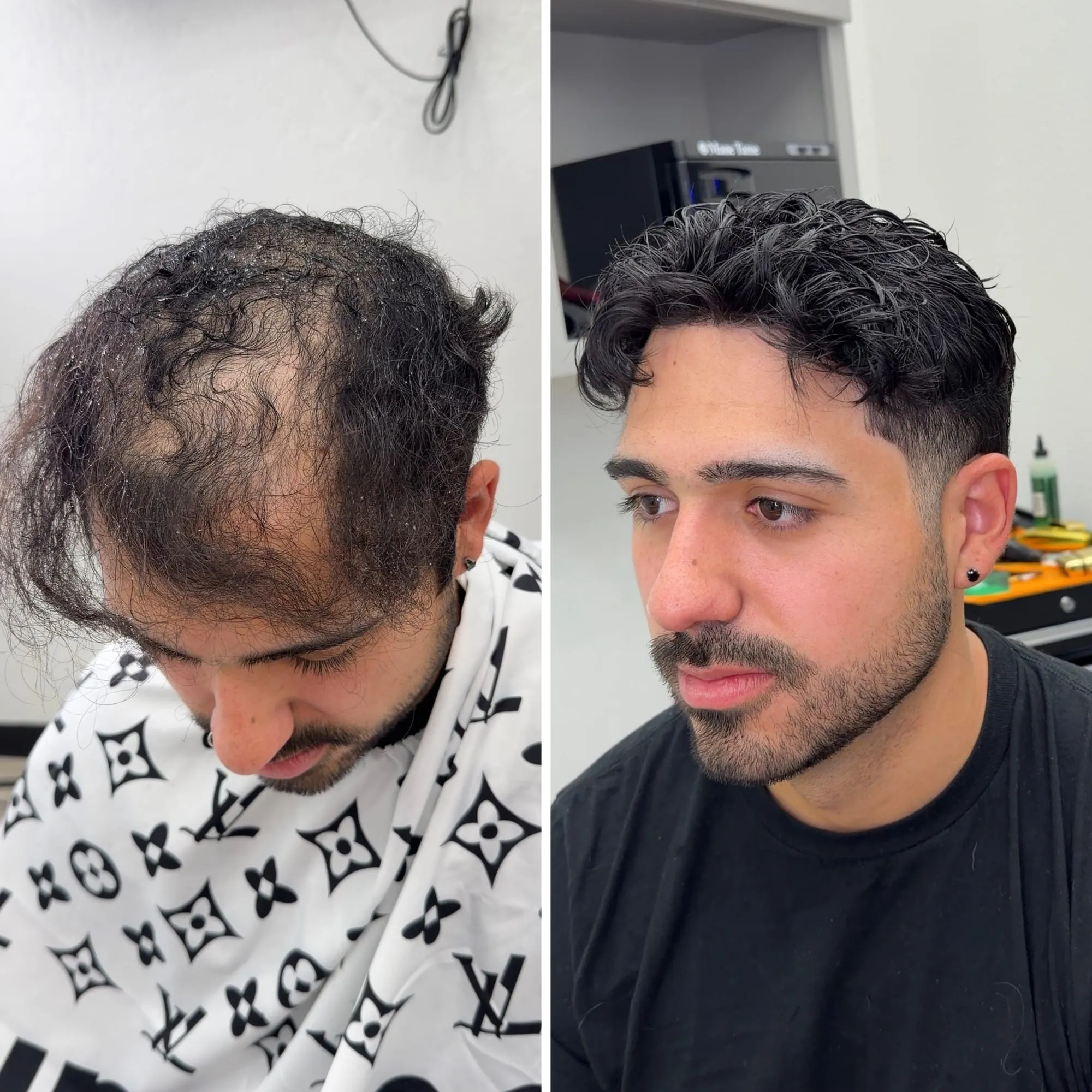
A real client from our chair, photographed before and after his hair system was installed and cut in.
Questions, answered.
What is a monofilament hair system?
It is a hair system built on a fine polyester or nylon mesh base, the most durable base category and the one that holds the highest density. In practice a mono unit is usually a hybrid, with a mono crown, a lace front for an undetectable hairline, and a skin or poly perimeter for the bond.
Is a monofilament base more durable than lace?
Yes. The woven polyester or nylon mesh resists tearing and tolerates repeated adhesive and removal cycles, so it outlasts a comparable all lace build under the same wear. Lace looks and breathes beautifully but the fine net frays at the knots and edges over time.
Can a monofilament base hold high density?
Better than any other single base. The strong, evenly woven mesh anchors a heavy count of knots without breaking down, so mono supports the fuller densities. We still choose a density target with you rather than defaulting to the maximum, since more hair adds weight and can look less natural if it outruns your age.
Does a monofilament front look natural?
The mesh is durable but not the most invisible material right at the very front, so we rarely run mono to the hairline. We add a Swiss or French lace front instead, which disappears into skin, and keep the mono through the crown and top where its durability and density matter most.
Does a mono base carry a higher cost?
The base material, the density you choose, and any custom template are the main cost drivers on any unit, and a fuller mono build with a lace front sits toward the higher end because it combines materials. We hold the actual figure for your consultation, where we quote the exact build rather than a generic price.
Keep reading
Related guides.
Reading the Order Form
Every field on a custom hair system order form explained in one place: base size, material, density, color, grey, curl, length, origin, and more.
Mono vs Lace Base
Mono bases last longer and carry more density; lace breathes better and hides the hairline best. A spec-by-spec durability versus airflow comparison.
Lace, Poly, or Skin
Lace breathes and looks natural, skin is invisible and easy to clean, poly holds longest. How we pick a hair system base by realism and upkeep.
Density Guide
How much density actually reads as real hair by age and face, and why over-dense systems look fake. A practical density guide from our chair.