

Last updated September 28, 2026
The one difference that drives everything
Swiss and French lace are the same idea built at two different weights. Both are a knotted lace mesh that hair is tied into strand by strand, and both give a hairline that reads as growing out of your own scalp. The single variable that separates them is how fine the net is woven. Swiss lace uses a finer, thinner thread with smaller holes, so there is less material between you and the world and the base all but disappears against skin. French lace is woven a touch heavier, with slightly thicker strands and a tighter structure.
That one difference in weave cascades into every other spec. A finer net is less visible but also weaker, so Swiss looks better and tears sooner. A heavier net is fractionally more visible up close but far tougher, so French survives more attach and detach cycles and holds more knots without stressing. Everything below, wear life, the density it can carry, how the knots sit, even shine, traces back to net fineness. There is no free lunch here: the property that makes Swiss look the best is the same property that makes it wear out the fastest.
Swiss vs French lace, spec by spec
Here is how the two materials compare on the attributes that actually change what you see in the mirror and how long the unit lasts. The wear-life ranges are typical for daily use and move with your climate, how often you reattach, and how carefully you handle the base. Density is given on the common scale where roughly 100 percent reads as a natural medium head of hair, lighter values sit below that, and heavier values above. No amounts appear here because the build figure is set to your specification at consultation. What is definitive is the relationship between the two nets.
| Attribute | Swiss lace | French lace |
|---|---|---|
| Net fineness | Finest weave, smallest holes, thinnest thread; the least visible lace against skin | Slightly heavier weave, thicker strands, more structure; still fine but a touch more visible up close |
| Typical wear life | Roughly 1 to 3 months in daily wear | Roughly 3 to 6 months in daily wear |
| Density it carries cleanly | Light to medium-light, roughly 80 to 100 percent, before the fine net starts to show stress | Medium to higher, comfortably around 100 to 130 percent |
| Knotting at the hairline | Takes the smallest single, bleached knots; they sit almost invisible on the fine net | Takes single knots too, but they read slightly more against the sturdier net |
| Shine under direct light | Effectively none; the front reflects almost nothing | Very low, marginally more than Swiss under harsh light |
| Handling and durability | Delicate; snags, stretches, and tears if handled roughly | Tolerates daily attach and detach and general handling far better |
| Best zone to use it | The very front hairline band, roughly the front 1 to 3 cm, where invisibility matters most | The full front third of the base, or the whole base, where durability matters |
| First-unit recommendation | For experienced wearers who want the most invisible front and will baby it | The standard first-time base: forgiving, durable, and natural |
Why Swiss lace wins on invisibility
When people describe a hairline that is impossible to catch even at conversation distance, they are usually describing Swiss lace. The finer the net, the less there is to see, and the smaller the knots you can tie into it, so a bleached single knot on Swiss lace nearly vanishes where the same knot on a heavier net leaves a faint dot. The material also reflects almost no light, which is why Swiss reads as scalp under office lighting and bright sun alike where a shinier front would give itself away.
That performance is real, and for a wearer who has learned the routine it is worth the trade. The cost of it is fragility. A net that fine cannot take rough removal, aggressive brushing, or a heavy hand at the sink, and it will not carry a dense head of hair without the knots pulling and the net breaking down early. Swiss is a specialist front, not an everyday tank. It looks the best of any lace and it asks for the most care in return.
Why French lace is the first-timer default
French lace is what we hand most new wearers, and it is not a compromise. It is a hair unit base that is still fine enough to give an honest, undetectable hairline, but woven with enough backbone to survive the learning curve. First units get handled a lot: you are learning to attach, to remove, to wash, to sleep in it, and every one of those actions is gentler on a French net than on a Swiss one. A base that lasts three to six months instead of one to three also lowers what the unit costs you over a year, because you replace it less often.
French lace carries higher density too, so if you want a fuller look, or you are covering more area than a front hairline, the heavier net holds those extra knots without straining. The only thing you give up against Swiss is a sliver of invisibility that most people, including you after a week, will never notice in the mirror. For a first hair system, and for plenty of experienced wearers who value a base that simply holds up, French is the confident starting point.
- Want the single most invisible hairline and will handle it gently: Swiss leans your way
- Want a durable, natural base that survives daily learning: French is the default
- Want a fuller, higher-density look: French carries the knots more comfortably
- Want the best of both: many units run Swiss across the front hairline on a French or stronger body
You do not always have to choose one
The two nets are not mutually exclusive within a single unit. A common build puts Swiss lace only across the very front hairline band, where the last centimeter or two has to be flawless, and switches to French lace or a stronger material through the rest of the base where durability and density matter more. You get the near-invisible front of Swiss exactly where eyes land, and the toughness of French everywhere the unit takes daily stress.
That split does add a little to the build because it is a more involved construction, and like every other cost driver it is quoted at consultation against your actual order rather than published as a flat figure. The bigger drivers on any lace unit are the base construction itself, the hair type and origin, and any custom template, with add-ons such as extra length or a larger base sitting behind those. If you love the idea of a Swiss front but worry about how quickly it will wear, a hybrid front is often the move that gives you the look without shortening the life of the whole unit.
How to read this on an order form
On a spec sheet the base material is usually written as Swiss lace or French lace, sometimes abbreviated, and paired with a density value and a front-contour choice. Read those three together. Swiss with a light-to-medium density and a natural front contour is a front-first, invisibility-first build that will need attentive care and more frequent replacement. French with a medium density is the durable, everyday build. If you see Swiss listed only for the front section and French or another material for the body, that is the hybrid split described above, and it is usually a smart order.
If a form lists a density on Swiss that runs into the heavier range, question it, because a fine net loaded with knots tends to break down early and you may be buying a look the material cannot hold for long. Nico Rigano and the team at our Peoria, Arizona and Eighty Four, Pennsylvania studios will walk your spec sheet line by line at consultation and map the net, the density, and the contour to how you actually live, so the unit you order is the unit you will still be happy wearing months in.
Real work
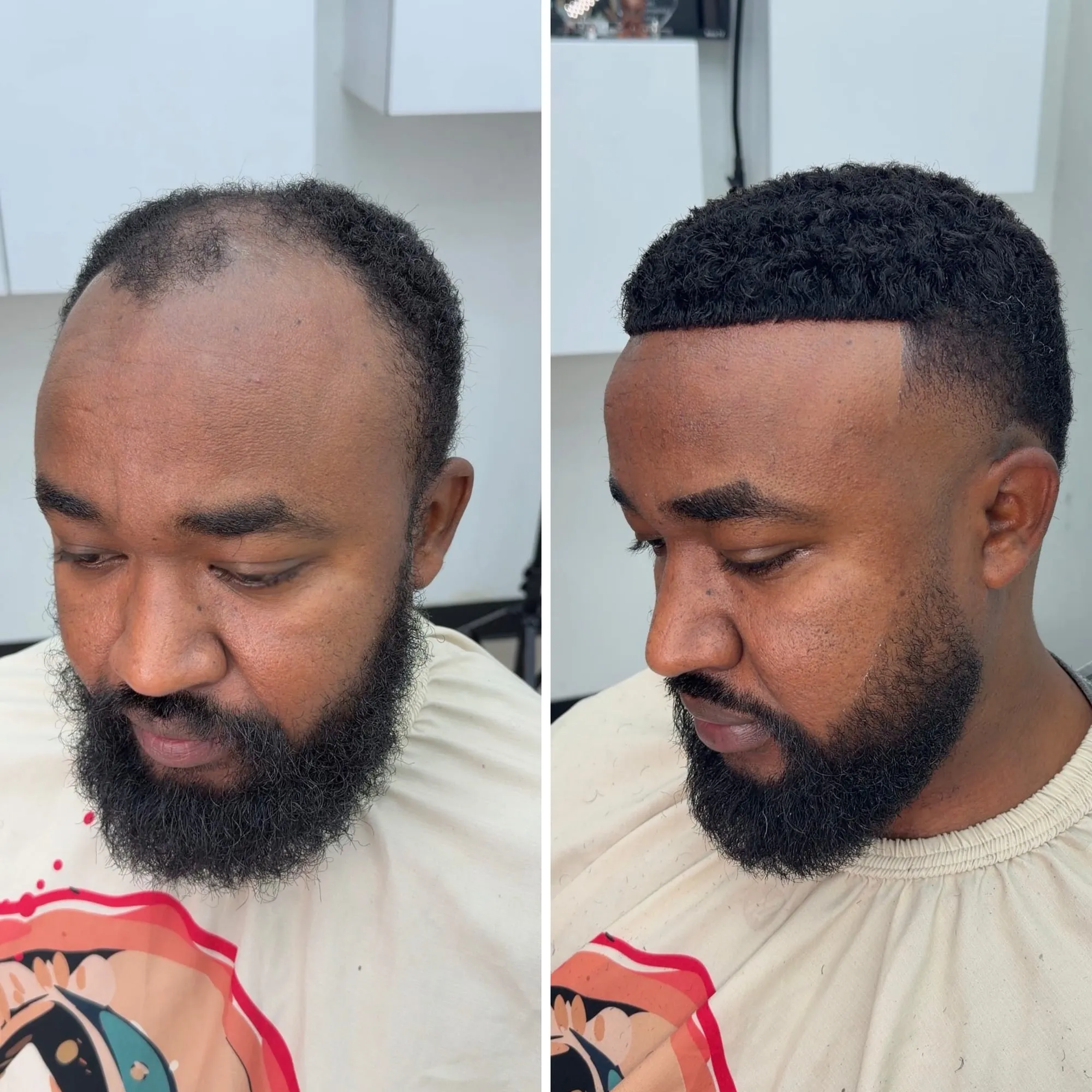
This is what it looks like.
A real client from our chair, photographed before and after his hair system was installed and cut in.
Questions, answered.
Is Swiss lace or French lace more natural looking?
Swiss lace is marginally more natural because its finer net and smaller knots are harder to see and it reflects almost no light. French lace is still undetectable at conversation distance, so most wearers cannot tell the difference in the mirror after the first week. Swiss wins on paper; the gap is small in real life.
Which lace lasts longer?
French lace, by a clear margin. It typically lasts roughly 3 to 6 months in daily wear against roughly 1 to 3 months for the more delicate Swiss net. Because it is replaced less often, French usually costs less to own over a year even though it is the tougher material.
Why do you recommend French lace for a first hair system?
Because a first unit gets handled constantly while you learn to attach, remove, wash, and sleep in it, and French tolerates all of that far better than fragile Swiss lace. It also carries higher density for a fuller look. You give up only a sliver of invisibility that most people never notice.
Can I have Swiss lace only at the front?
Yes, and it is a popular build. A unit can run Swiss lace across the very front hairline band, where invisibility matters most, on a French or stronger body that handles daily stress. You get the near-invisible front without shortening the life of the whole unit.
Does Swiss lace hold high density?
Not comfortably. The fine net carries light to medium-light density well, roughly 80 to 100 percent, but loading it heavier tends to stress the knots and break the net down early. If you want a fuller look, French lace holds the extra knots far better.
Keep reading
Related guides.
Reading the Order Form
Every field on a custom hair system order form explained in one place: base size, material, density, color, grey, curl, length, origin, and more.
Lace, Poly, or Skin
Lace breathes and looks natural, skin is invisible and easy to clean, poly holds longest. How we pick a hair system base by realism and upkeep.
Density Guide
How much density actually reads as real hair by age and face, and why over-dense systems look fake. A practical density guide from our chair.
The Hairline
A natural hair system hairline is built from irregularity, a soft density gradient, and careful placement. Here is how we design one that reads as yours.