

Last updated September 28, 2026
What hair direction actually means
When a strand is tied into the base, the person ventilating it points that strand a specific way before locking the knot. Do that across the whole base and you have set a direction map: every strand leans the way it was tied. That map is what your comb follows. It is why a good unit falls into place the moment you run your fingers through it, and why a mismatched one fights you no matter how you style it.
Direction is a separate decision from density and from the hair itself. You can have the right color, the right curl, and the right base, and still end up with a unit that will not sit right if the direction was ordered wrong. It is the quiet spec that makes everything else look natural.
The three common direction patterns
Most units are ventilated in one of three ways. Which one you want depends entirely on how you plan to wear the hair, so this is a conversation we have before anything is ordered.
- Freestyle: strands are angled so the hair can be combed in more than one direction, back, to a side, or off the face. This gives the most styling flexibility and reads the most natural because real hair does not all grow one way.
- All-forward: every strand points toward the front. This suits men who wear the hair pushed forward or in a textured crop, and it keeps a consistent, low-fuss fall, but it limits you to that one look.
- Fixed direction: the hair is ventilated to lie a single set way, for example straight back or to one side. Predictable and easy to manage, at the cost of flexibility if you later want to restyle.
Direction and whether you can part the hair
A part is only possible where the hair is ventilated to fall away from a line. If you want a defined part, we build the direction to open cleanly at that spot, often paired with a lighter knotting or a specific base at the parting so scalp reads through and the split looks real.
This is why a part cannot be added to a finished unit. The strands on either side of a part have to lean away from each other, and that lean is tied into the knots. If the unit was ventilated freestyle or all in one direction, there is no line for the hair to break along, and forcing one just exposes the base. Decide on a part before the unit is built, not after.
How direction connects to a crown and cowlick
Natural hair has movement built in. Most men have a crown where the hair spirals out from a point, and many have a cowlick near the front that pushes hair up or to one side. A unit ordered as a flat, uniform direction can look slightly too perfect, which is one of the tells people pick up on without knowing why.
When realism at the top of the head matters, we can specify a crown swirl and account for a cowlick in the direction map so the hair breaks the way real hair does. This is a build-time instruction, so it belongs on the order form alongside the rest of the direction call.
Why direction cannot change after the build
Ventilation is the act of knotting each strand to the base at a set angle. Once those thousands of knots are tied and, on many bases, bleached or sealed to hold, the direction is physically locked. There is no way to re-aim a strand without pulling the knot and re-tying it, which is not something done to a whole finished unit.
You can style against the grain temporarily with product or heat, and a stylist can cut and blend to soften a direction, but the underlying lean always returns. Cutting changes length, not direction. The honest way to get the fall you want is to order the direction correctly the first time.
- Symptom: the hair keeps flipping back to one side no matter how you comb it. Cause: fixed or all-forward direction fighting the style you want. Fix: order freestyle next time; for now, blow-dry the fall you want and set it with a light product.
- Symptom: a part will not stay and shows base when you make one. Cause: no parting line was ventilated in. Fix: skip the hard part on this unit and specify a part on the next order.
- Symptom: the crown looks flat or too uniform. Cause: no swirl in the direction map. Fix: add a crown detail to the next order form.
Getting direction right on the order form
Direction is one line among many on a hair system order form, but it carries a lot of weight. We talk through how you actually wear your hair, whether you want a part, and how much flexibility you want, then translate that into the ventilation instruction before anything is knotted. Bring photos of a style you like if you have them, because a picture settles the direction question faster than words.
If you are learning the rest of the spec sheet, our guide on how to read a hair system order form walks through every field, and our page on ventilation methods explains how the knotting itself is done. Direction and ventilation are two sides of the same build step, so it helps to understand both before you order.
Real work
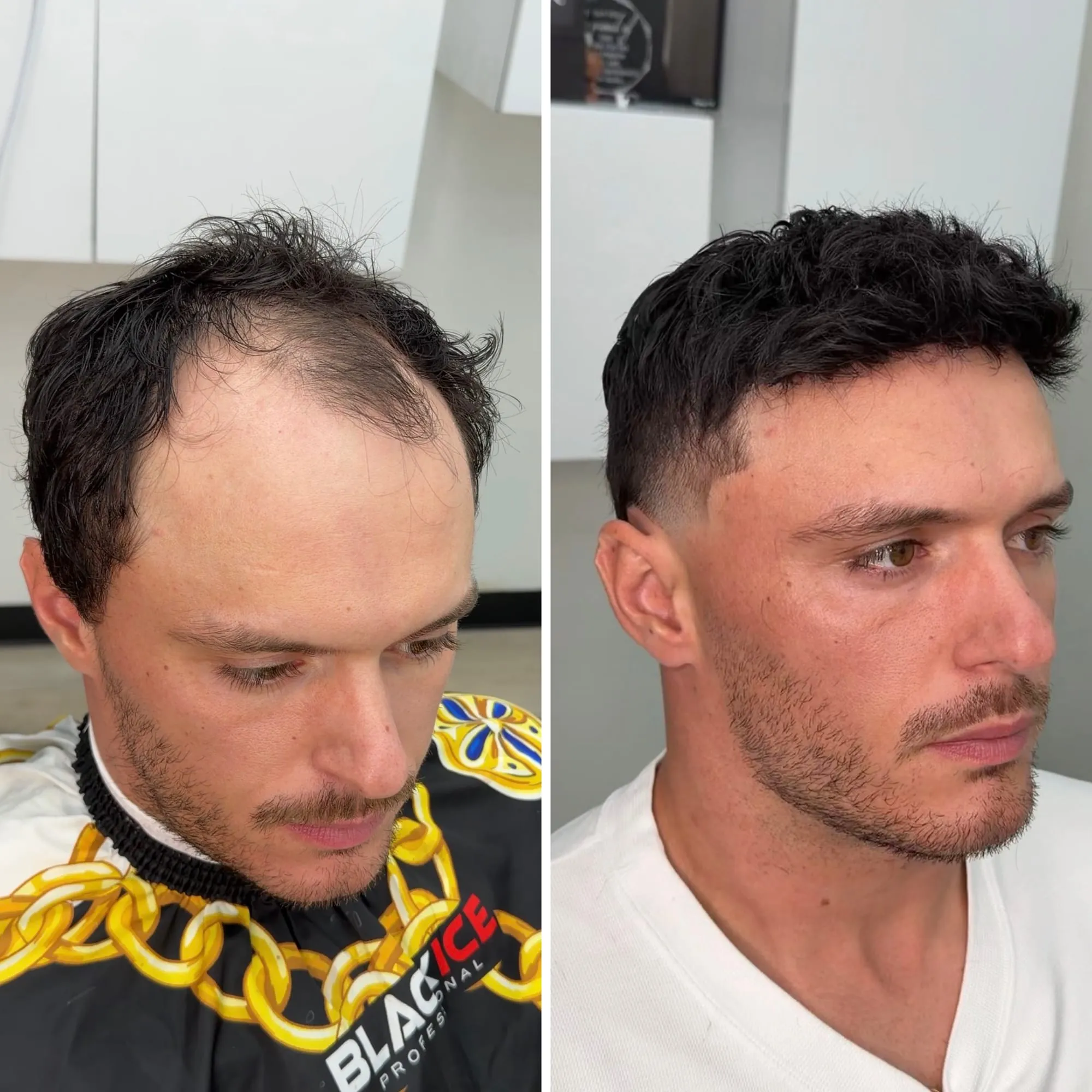
This is what it looks like.
A real client from our chair, photographed before and after his hair system was installed and cut in.
Questions, answered.
Can hair direction be changed after the unit is made?
No. Direction is tied into each knot during ventilation, so it is locked once the unit is built. You can style against it temporarily with heat or product, and a stylist can cut to soften it, but the built-in lean always returns. Order the direction you want up front.
What is the difference between freestyle and fixed direction?
Freestyle ventilates strands at varied angles so the hair can comb more than one way, which looks the most natural and gives the most flexibility. Fixed direction points the hair one set way, which is predictable and low-fuss but limits you to that single look.
Can I have a part in my hair system?
Yes, but it has to be built in. A part needs the hair ventilated to fall away from a set line, often with lighter knotting there so scalp shows through. It cannot be added to a finished unit, so decide on a part before the unit is ordered.
Why does my hair system not fall the way I want?
Usually the direction was set differently from the style you are aiming for. If it was ventilated all-forward or in a single fixed direction, it will resist other looks. You can manage the fall with a blow-dry and light product, and order freestyle next time for more range.
Do I choose the direction or does the studio?
We decide it together at your consultation. You tell us how you wear your hair and whether you want a part, and we translate that into the ventilation instruction on the order form. Photos of a style you like make the call easier and more accurate.
Keep reading
Related guides.
Ventilation Methods
Knotting works on lace and mono, V-loop and injection only on skin. Ventilation method sets how invisible roots look and how well hair resists shedding.
Reading the Order Form
Every field on a custom hair system order form explained in one place: base size, material, density, color, grey, curl, length, origin, and more.
Styling a Hair System
Style a hair system with a light hold product, gentle heat, and a soft touch at the perimeter. Which products work and which to avoid.
Does It Look Natural
A well fitted, well cut hair system blends into your own hair and hairline. Here is what makes a hair system look natural and undetectable.