

Last updated September 28, 2026
What a V-loop actually is
Ventilation is the term for how each hair gets fastened into the base of a hair system. Most methods tie the hair off with a tiny knot, which is secure but leaves a small dark point you have to bleach or camouflage. V-loop skips the knot entirely. A single hair is folded in half and both ends are pulled through the base, so the strand forms a small V shape and the fold sits on the surface with nothing underneath.
That only works on a solid film. There is no knot doing the holding, so the polyurethane itself has to grip the looped hair. On a lace mesh there is nothing solid to hold a knotless loop, which is why you never see a true V-loop on lace. V-loop lives on skin, the very thin transparent poly film that reads as bare scalp. The technique and the base are a package deal.
Why no knot means the most undetectable result
Look closely at almost any hair unit and the giveaway is the knots, the little grid of dark dots where each hair is tied. Builders fight that with bleached knots, single split knots, and light density, and those help a great deal. But even the best knot is still a knot, and it can catch the light or show against fair skin at close range.
A V-loop has nothing to show. There is no knot, no seal, and no dot, just a hair emerging from a clear film that is already sitting invisibly on your scalp. When men ask us for the single most convincing option at the front, where people look hardest, this is it. The realism is the whole reason the technique exists, and it is genuinely a step beyond a well knotted front.
The base it lives on
V-loop is a skin technique, so the base thickness matters more than almost anything else. Thinner film is more invisible and more flexible, but it also wears out faster and tears more easily. Thicker film lasts longer and holds a bond better, but it is less transparent and moves less naturally.
In practice V-loop is done on the thinner end of the skin range, commonly from about 0.03mm to 0.10mm. The 0.03mm ultra thin film gives the most undetectable result and the shortest life. Around 0.06mm to 0.08mm is a more balanced middle ground that still hides well while surviving handling better. We keep the density on the lighter side too, because looped hair that is packed in too heavily loosens and sheds faster.
How V-loop compares to other ventilation
This is the honest picture across the common ways to fasten hair into a base. V-loop wins clearly on invisibility and loses just as clearly on durability. The right choice depends on whether your priority is the most convincing possible hairline or the longest possible life per unit.
| Method | Base it works on | Knot visible | Typical wear life | Shedding tendency |
|---|---|---|---|---|
| V-loop | Skin only, roughly 0.03mm to 0.10mm | None, no knot at all | 3 to 6 months | Higher |
| Injected | Skin or poly | None, hair sealed under the film | 4 to 8 months | Moderate |
| Single split knot | Lace or poly | Very small point | 6 to 10 months | Low to moderate |
| Bleached knot | Lace or poly | Lightened, faint at close range | 6 to 12 months | Low |
The honest trade-off on durability
Because there is no knot locking each hair in place, a V-loop hair relies on the grip of the film, and that grip is not permanent. Every wash, every removal, and every brush stroke works a little against it, so V-loop units shed more over their life than a knotted unit does. That is not a defect. It is the direct cost of removing the one thing, the knot, that shows.
Expect a V-loop skin unit to give roughly 3 to 6 months of good looking wear, with the thinnest bases at the low end of that and a slightly thicker film reaching the top of it. A knotted lace or poly unit can run longer, often 6 to 12 months. If you want the most life per unit, V-loop is not the pick. If you want the most convincing front and you accept replacing the unit sooner, it earns its keep.
Maintenance demand
V-loop asks more of you day to day. The ultra thin film is fragile, so removal has to be gentle and patient, adhesive residue has to come off without scrubbing, and combing and styling reward a light hand. Heavy heat tools, harsh cleaners, and rough towel drying all shorten the life of a looped skin unit noticeably.
Reattachment tends to come around more often too, frequently every one to two weeks depending on the adhesive and how hard you sweat, because thin skin does not hold a bond as long as thicker bases. None of this is complicated once you have done it a few times, and we walk every client through the exact routine for the base they leave with. But it is fair to go in knowing that a V-loop is a higher upkeep choice, not a set and forget one.
What drives the cost, and who it suits
V-loop is hand work. Looping each hair without a knot is slower and more skilled than standard knotting, so the technique itself is the first cost driver, and it is deferred to your consultation like everything else. Ranked after that come European hair if you want the finest texture, a fully custom template rather than a stock base, and the thinnest 0.03mm film, each of which adds to the build.
We usually steer men toward V-loop when an undetectable front is the entire point, when they are comfortable with a shorter replacement cycle, and when they will put in the careful handling it needs. If your life is hard on a unit, if you sweat heavily and train daily, or if you simply want the longest lasting option with the least fuss, a knotted lace center with a poly perimeter is often the smarter fit. We make that call together once Nico, Ivette, or Denisse has looked at your scalp, your hair, and how you actually live, at our Peoria, Arizona or Eighty Four, Pennsylvania studio.
Real work
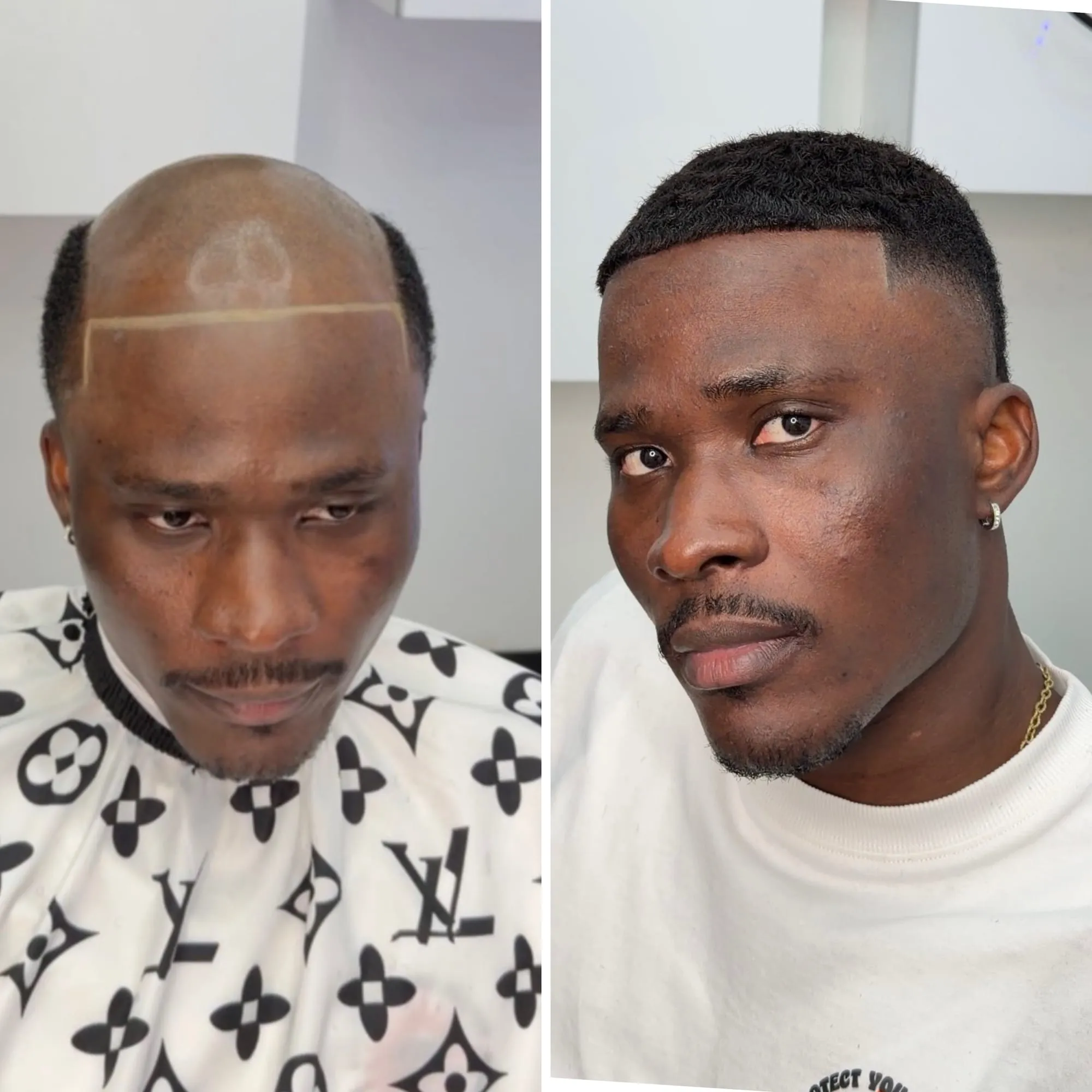
This is what it looks like.
A real client from our chair, photographed before and after his hair system was installed and cut in.
Questions, answered.
What makes a V-loop hair system so undetectable?
There is no knot. Each hair is looped into a thin skin base and held by the film itself, so there is no dark point where the hair is tied. That removes the last close-range giveaway, which is why V-loop is the most undetectable ventilation method available.
How long does a V-loop hair system last?
Typically about 3 to 6 months of good looking wear. The thinnest 0.03mm bases sit at the low end and a slightly thicker film reaches the top. Because no knot locks each hair in, V-loop units shed sooner than knotted lace or poly, which can run 6 to 12 months.
Can a V-loop be done on a lace base?
No. A knotless loop needs a solid film to grip the hair, and lace is an open mesh with nothing to hold it. V-loop is a skin technique, done on very thin polyurethane, usually in the 0.03mm to 0.10mm range. Lace bases use knots instead.
Is a V-loop harder to maintain?
Yes, and we say so plainly. The ultra thin film is fragile, so removal, cleaning, and styling all need a gentle hand, and reattachment often comes around every one to two weeks. It rewards careful handling and is not a set and forget option.
Should I choose V-loop or a knotted base?
Choose V-loop if an undetectable front is your top priority and you accept a shorter replacement cycle and more upkeep. Choose a knotted lace or poly build if you want the longest life per unit and the least maintenance. We match the technique to your scalp, climate, and routine at your consultation.
Keep reading
Related guides.
Reading the Order Form
Every field on a custom hair system order form explained in one place: base size, material, density, color, grey, curl, length, origin, and more.
Thin Skin Systems
A thin skin hair system is a fine polyurethane base that gives the most invisible scalp look. Here is how thin and ultra thin skin bases feel and wear.
Lace, Poly, or Skin
Lace breathes and looks natural, skin is invisible and easy to clean, poly holds longest. How we pick a hair system base by realism and upkeep.
How Long Hair Systems Last
How long a hair system lasts depends on the base, your routine, and maintenance. Here is what to expect and how to make yours last longer.