

Last updated September 28, 2026
Why hair systems use a number scale, not a color name
A color name like medium brown means something slightly different to every person and every manufacturer, so hair replacement runs on a shared number scale instead. The base number is the anchor. It fixes where your shade sits on a single line from darkest to lightest, and every other part of the code adjusts it from there. Once you know the base number, the R modifier, and the grey percentage, you can read almost any color spec on an order form without guessing.
The scale itself is close to the standard human hair charts used across the industry, so a base number on one order form usually lands in the same place on another. Naming at the edges shifts a little between suppliers, which is why we always confirm against a physical color ring at consultation rather than trusting a screen. The numbers get you to the right neighborhood; the ring settles the exact house.
The base color scale, 1 to 60
Here is the base number scale from darkest to lightest, with the shade each number typically names. Lower is darker, higher is lighter, and the jump from one number to the next is roughly one shade. The most common natural shades for men cluster between 1B and 8, which is why those get ordered far more often than the blonde and platinum numbers at the top of the scale. Names at the lightest end vary most between manufacturers, so treat those as directional.
| Base code | Typical shade | Where it sits |
|---|---|---|
| 1 | Jet black | Darkest on the scale, a true flat black |
| 1B | Natural black | Soft off-black, the most common dark base |
| 2 | Darkest brown | Reads black indoors, brown in daylight |
| 3 | Dark brown | Deep neutral brown |
| 4 | Medium dark brown | Chestnut brown, a very common base |
| 5 | Medium brown | Mid-point of the brown range |
| 6 | Light medium brown | Lighter neutral brown |
| 7 | Light brown | Brown starting to lift toward dark blonde |
| 8 | Lightest brown | Ash-leaning light brown, top of the browns |
| 10 to 18 | Blonde range | Dark blonde up to ash and light blonde |
| 22 to 27 | Golden blonde range | Golden through strawberry blonde |
| 60 | White to palest blonde | Lightest on the scale |
The R modifier: one shade lighter
When you see an R attached to a base number, it means the hair is finished one shade lighter than the base number on its own would give you. So a 4R is a medium dark brown taken up a step, sitting between a straight 4 and a 5. The R is not a different color family, just a controlled lift within the same family, which is useful when a plain base number reads a touch too dark against your skin in daylight.
The reason this matters on an order form is that R and non-R versions of the same number are genuinely different builds, so 4 and 4R should never be treated as interchangeable. If your natural hair sits between two base numbers, the R version of the darker one is often a closer match than jumping a full number up. This is the kind of half-step call we make against the ring at consultation, because a photo on a phone will not show it reliably.
| Modifier | Meaning | Effect on the code |
|---|---|---|
| R | One shade lighter than the base | Lifts the base number up by roughly one step |
| B | Blend or 'off' variant, as in 1B | Softens a flat shade, most often black |
| A | Ash tone, as in 5A | Cooler, less warm version of that number |
| # | Denotes the base number itself | A code written as #4 simply means base 4 |
The grey percentage: how much white is blended in
The number that usually follows the base code is a percentage, and it is how much grey hair is mixed into the unit. Grey hair is actually white hair sitting among your pigmented hair, so the percentage is really the share of white fibers blended through the base shade. A code of 1B30 is a natural black base with 30 percent white blended in, which reads as lightly salted. Push that to 1B60 and it reads as heavily grey.
Percentages are ordered in steps, most commonly in increments of ten. Zero means no white at all, a fully pigmented base. The right percentage is the single easiest color detail to get wrong, because most men underestimate how much grey they actually carry, especially at the temples. We count it against the ring rather than from memory, since the difference between 20 and 40 percent changes how mature the finished hair looks.
| Percentage code | Share of white hair | How it reads |
|---|---|---|
| 0 | No white, fully pigmented | Solid base color, no grey |
| 10 | About 1 in 10 fibers white | A trace of grey, mostly subtle |
| 20 | About 1 in 5 fibers white | Lightly salted, natural for many men |
| 30 | Roughly 3 in 10 fibers white | Clearly greying but still base-dominant |
| 40 to 50 | Close to half white | Salt and pepper, balanced |
| 60 to 70 | Majority white | Predominantly grey |
| 80 to 90 | Almost all white | Near-white with a little base shade left |
How a full color code parses
Put the pieces in order and a full color code reads left to right: base number first, then any modifier, then the grey percentage. So a code written as 4R 20 parses as a medium dark brown base (4), lifted one shade lighter (R), with 20 percent white blended in. A code of 1B parses as a natural black base with no lift and no grey. The grammar is consistent even when the spacing or punctuation on the order form is not.
The color code is only the color portion of the full unit specification. On a complete order form it sits alongside separate fields for base construction, hair type and origin, density, curl or wave, and length, and each of those is its own code. Reading the color block correctly is step one; the order-form guide walks the rest of the fields in the same left-to-right way. When any field carries a cost component, such as European hair, a longer length over about six inches, or a fully custom build, the figure is set to your specification at consultation, not printed on the code.
- Base number: where the shade sits from 1 (darkest) to 60 (lightest)
- Modifier: R lifts one shade lighter, A cools it, B softens a flat shade
- Percentage: how much white is blended, usually in steps of ten
- Read order: base, then modifier, then grey percentage, left to right
Why we still match against a physical ring
Codes get you most of the way, but hair color is not one flat tone. Your own hair carries warmth or coolness, it shifts between root and tip, and it looks different under a bathroom light than it does outdoors. A number on a screen cannot capture that, and monitors distort color badly, so a code chosen from a photo is a starting point, never a final answer. This is where the number scale hands off to a trained eye.
At the studio, Nico Rigano, Ivette Rigano, and Denisse Diaz match your base number, decide whether an R lift closes the last half step, and count the grey percentage against a real color ring held to your own hair in natural light. That combined reading is what goes on the order. The code makes the order precise and repeatable; the ring makes sure the code is the right one for you. Both our studios, in Peoria, Arizona and in Eighty Four, Pennsylvania, match the same way.
Real work
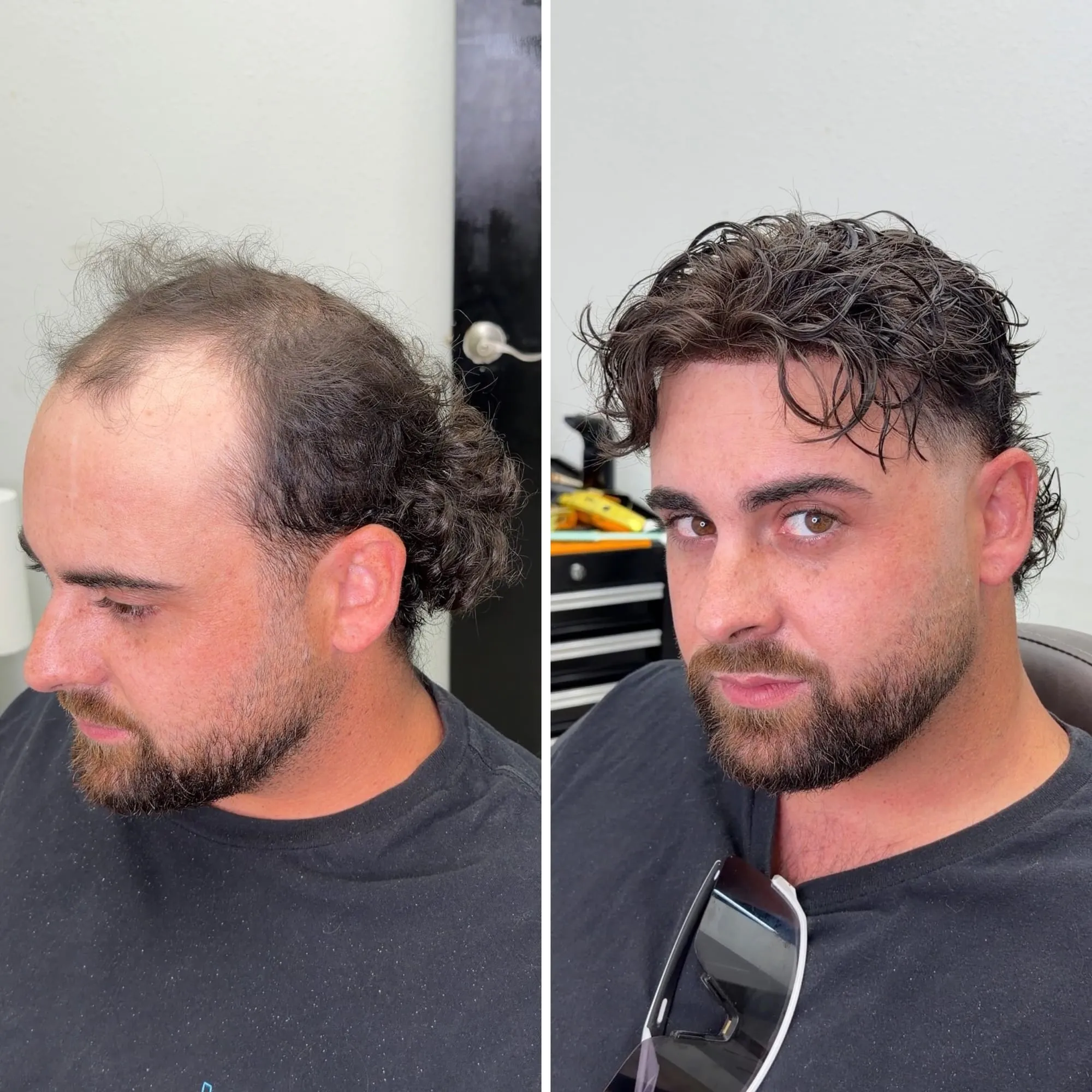
This is what it looks like.
A real client from our chair, photographed before and after his hair system was installed and cut in.
Questions, answered.
What does the number in a hair system color code mean?
It is the base shade on a scale that runs from 1 at the darkest to 60 at the lightest. Lower numbers are darker, higher numbers are lighter, and each step up is roughly one shade. The most common natural men's shades sit between 1B and 8.
What does R mean in a hair system color code?
R means the hair is finished one shade lighter than the base number alone. A 4R is a medium dark brown lifted one step, sitting between a straight 4 and a 5. R and non-R versions of the same number are different builds and should not be treated as the same.
What does the percentage in a color code refer to?
It is how much grey, technically white, hair is blended into the base shade. A 1B30 is a natural black base with 30 percent white mixed in. Percentages are usually ordered in steps of ten, and zero means a fully pigmented base with no grey.
How do I read a full color code like 4R 20?
Left to right: base number, then modifier, then grey percentage. So 4R 20 is a medium dark brown base (4), lifted one shade lighter (R), with 20 percent white blended in. The color code is one block on a full order form that also covers base, hair type, density, curl, and length.
Can I choose my color from the code alone?
Use the code as a starting point, not a final answer. Screens distort color and your own hair shifts between root and tip and changes under different light. We confirm the base number, any R lift, and the grey percentage against a physical color ring held to your hair in natural light at consultation.
Keep reading
Related guides.
Reading the Order Form
Every field on a custom hair system order form explained in one place: base size, material, density, color, grey, curl, length, origin, and more.
Color Matching
How color matching works for a hair system, and how salt-and-pepper and grey are blended so it stays believable as you age.
Grey Percentage Chart
Hair system color codes like 1B30 pair a base level with a grey percentage. Here is how to read the code and pick a grey band from 10% to 80%.
Curl and Wave Chart
Rod size sets the wave: 6mm gives a tight curl, 28 to 30mm reads almost straight. See the full rod-to-wave chart and why dead straight looks wrong.