

Last updated September 28, 2026
Why the knot type matters at all
A knot is the tiny loop that fastens each hair, or small group of hairs, to the lace or mesh of the base. It is the single smallest decision on the whole unit, and it pulls in two directions at once. A knot that is barely there reads as if the hair is growing straight out of your scalp, but the smaller and flatter it is, the less it grips, so it lets go sooner. A knot that grips for the full life of the unit is a little bigger, so it catches slightly more light at the surface. Every knotting choice on a hair system is a trade between how invisible it looks and how long it holds.
That trade is why a well built unit does not use one knot everywhere. It uses the most invisible knots exactly where you would notice a knot, which is the front hairline and the parting, and it uses the strongest knots everywhere your own eye never lands, which is the mid, the crown, and the back. Getting that map right is what separates a natural, durable unit from one that either sheds at the front too fast or shines under a knot you can see in the mirror.
The four knot types compared
Here is how the four common knots line up on the axes that actually matter: how hard they hold, how visible the knot reads at the surface, how quickly they tend to shed, and where each one belongs on the unit. The placements below are typical of how these knots behave in daily wear. Terminology varies a little between factories, so confirm on your order form which knot goes in which zone. No dollar figures appear here on purpose, because knotting is one line item among several and the number is set to your full specification at consultation.
| Knot type | Relative holding strength | Knot visibility | Shed tendency | Where it belongs |
|---|---|---|---|---|
| Single flat | Lowest of the four | Least visible, sits flattest against the base | Sheds soonest, often within the first several weeks to a couple of months in the front | The front hairline, roughly the first 1 inch (about 2.5 cm) |
| Single split | Low to moderate, more secure than a single flat | Very low, close to a single flat and often used for the most undetectable hairline | Sheds sooner than a double, but holds longer than a single flat | The front third, just behind the leading hairline |
| Double flat | Moderate to high | More visible than either single, still modest and usually bleached down | Low shed, holds through most of the unit's life | The mid section and crown |
| Double split | Highest of the four | Most visible of the four, almost always bleached in a lace base | Lowest shed, the most durable knot | The back and the dense mid-back |
Single knots: single flat and single split
A single knot loops the hair through the base once. Because that loop is small, the knot sits close to flat and catches very little light, which is why single knots give the most convincing look that hair is emerging from bare scalp. A single flat knot is the flattest and most natural of all four, and it is the reason a fine lace hairline can be almost impossible to spot at conversation distance.
The cost of that realism is grip. A single loop holds the hair the least securely of the four, so single flat knots are the first to release, and it is normal to see the front hairline thin a little sooner than the rest of the unit over the life of the hair system. A single split knot is the refinement: the hair is tied and split so the knot stays about as invisible as a single flat while gripping noticeably better. Many builds put single split knots across the front third for exactly that reason, keeping the undetectable look while buying back some of the durability a plain single flat gives up.
Double knots: double flat and double split
A double knot loops the hair through the base twice. That second pass roughly doubles the grip, which is why double knots hold through the full life of the unit and shed the least. The trade is size: two loops make a slightly larger knot that reads as a faint dot at the surface if you look closely and if it has not been lightened. A double flat sits moderately, a double split is the most secure and the most visible of the four.
Because double knots are more visible, they live where you never actually look at your own scalp, which is the mid, the crown, and the back. Placed there, the extra visibility is invisible in practice, and the extra hold means the bulk of the unit keeps its density long after the delicate front has started to thin. In a lace base the doubles are almost always bleached, which lightens the dark point of the knot so it reads as scalp rather than a speck. Knot visibility and knot strength are not enemies once each knot is put in the right zone.
How the knots map across the unit
Read front to back, a good hair system runs from the most invisible and least durable knots to the most durable and least invisible. The front hairline gets single knots so nobody can find the edge. The parting, if you wear one, also leans on single or single split knots for the same reason. Everything from the mid section back gets doubles so the density holds. The exact border between the zones is a build choice you can specify, and a skilled ventilation shifts it gradually rather than in a hard line, so the change in knot type is never something an onlooker could pick out.
- Front hairline, first 1 inch or so: single flat or single split for the most undetectable edge, at the cost of earlier shedding
- Front third and parting: single split to keep the invisible look while holding better than a plain single flat
- Mid section and crown: double flat for solid, low-shed density where you do not look at the scalp
- Back and dense mid-back: double split for the strongest hold and the longest life on the unit
Bleached knots and cutting visibility
Whatever the knot type, most of what your eye reads as a knot is the small dark point where the hair doubles back through the base. Lightening that point, called bleaching the knots, is the standard way to make even a double knot read as scalp rather than a dot. It is why a well finished unit can carry secure double knots through the mid and back and still look like an open scalp under bright light. Bleaching does slightly weaken the hair at the knot, so it is used with judgment, heavier where invisibility matters most and lighter where hold matters most.
This is also why knot type and base material are decided together. The finer the lace at the front, the more a single knot can hide inside it; a thin skin front hides the knot in the membrane instead. The knot map, the base at each zone, and the bleaching plan are three settings that only make sense as one design, which is what a consultation is for.
What we set at your consultation
Knotting is one of several lines on a hair system order, and it interacts with the base, the hairline design, the density, and any bleaching. The honest headline is simple: singles at the front for realism, doubles through the mid and back for hold, single split as the middle ground that keeps the look while buying back grip. Where exactly the border sits, how aggressively the knots are bleached, and how the transition is feathered are the details that separate a stock feel from a unit built for your head and your routine.
We map all of that with you against your actual specification rather than publishing it as a blanket setting, because two men can want what sounds like the same natural hairline and need different knot maps to get there. Bring how you part your hair, how visible your scalp is day to day, and how hard you are on the front, and we will set the knots to match. Book a consultation and we will walk your order form line by line.
Real work
This is what it looks like.
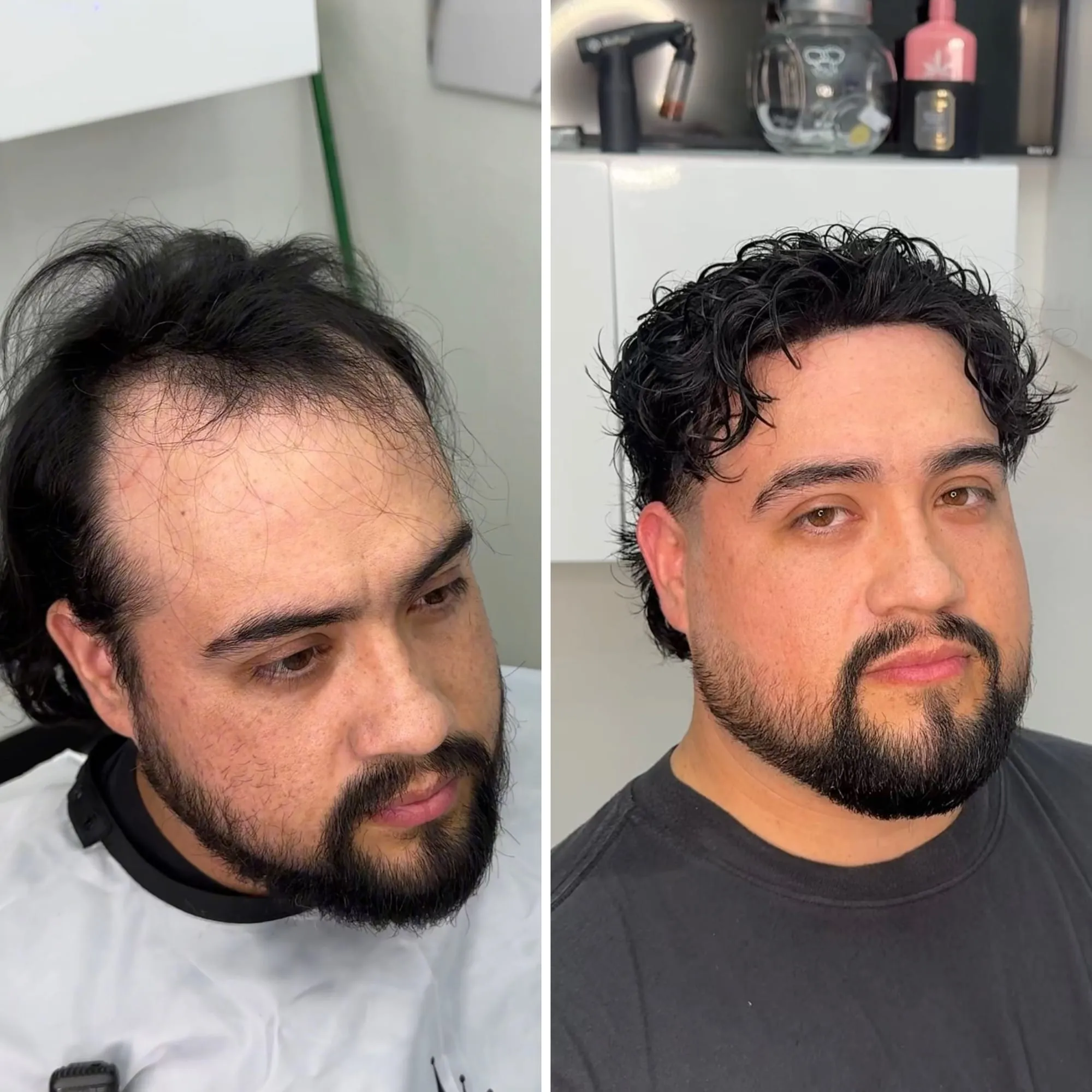
A real client from our chair, photographed before and after his hair system was installed and cut in.
Questions, answered.
What is the difference between single and double knots on a hair system?
A single knot loops the hair through the base once, sits flatter, and reads more natural, but it holds less and sheds sooner. A double knot loops twice, holds far better and sheds the least, but the knot is slightly more visible, so it is used through the mid and back rather than at the front.
Which knot type is used at the front hairline?
Single knots, either single flat or single split, across roughly the first inch. They sit the flattest and give the most undetectable edge. Single split is often preferred there because it stays nearly as invisible as a single flat while holding noticeably better.
Why do the front knots shed before the rest of the unit?
Because the front carries single knots, which grip the least by design, so they release sooner than the doubles through the mid and back. Some thinning at the very front over the life of a unit is normal, and it is the trade for an invisible hairline.
Are double knots visible on a hair system?
They read as a faint point if left dark and looked at closely, which is why they sit where you never see your own scalp and why they are bleached in a lace base. Lightening the knot makes it read as scalp, so a well finished unit with double knots through the back still looks like an open scalp.
Can I choose my own knot map?
Yes. The border between single and double zones, how the knots are bleached, and how the transition is feathered are all build choices we set with you against your specification at consultation. There is no single correct map, only the one that matches how visible your scalp is and how hard you wear the front.
Keep reading
Related guides.
Reading the Order Form
Every field on a custom hair system order form explained in one place: base size, material, density, color, grey, curl, length, origin, and more.
Bleached Knots
Bleached knots lighten the dark tie-off at the base of each front hair for an invisible hairline, at the cost of faster shedding in that zone.
Ventilation Methods
Knotting works on lace and mono, V-loop and injection only on skin. Ventilation method sets how invisible roots look and how well hair resists shedding.
The Hairline
A natural hair system hairline is built from irregularity, a soft density gradient, and careful placement. Here is how we design one that reads as yours.