

Why the hairline is the whole game
The rest of a system is forgiving. Density through the crown, color at the back, the way it sits under a hat, none of that is what makes a stranger do a double take. The front edge is different, because a real hairline is not a clean line at all. It is a scattered, uneven, slightly random transition from bare skin to hair, and the human eye has spent a lifetime learning what that looks like.
When a system is spotted, it is almost always the front. A hairline that is too low, too straight, or too dense is the single most common tell, and all three are decisions made by the person building and fitting the unit rather than faults in the hair itself.
Placement comes before anything else
The first decision is where the hairline sits, and it is a decision worth resisting the urge to rush. Most men instinctively want it lower than it should be, because they are picturing the hairline they had at twenty. A hairline set too low for your age and face fights every other thing we do to make the system convincing.
We map placement to your forehead, your bone structure, and roughly where your hair would sit now if it had thinned naturally rather than fallen back. A believable adult hairline usually has a little recession at the temples and a slightly softened front. That restraint is what lets the rest read as real.
Irregularity is what sells it
Look closely at any natural hairline and there is no edge. There are single hairs and small clusters standing ahead of the main body of hair, some finer, some pointing in slightly different directions, none of them lined up. That scatter is not an accident of nature we tolerate, it is the exact thing we are trying to recreate.
On a well built unit the front is worked so the very first hairs are sparse and broken up, with tiny gaps and stray hairs rather than a defined border. A hairline you could trace with a pen is the fastest way to make a system obvious, so we deliberately break that line up.
- Single hairs and small clusters set ahead of the main hair, not a solid front
- Gaps and uneven spacing rather than an even, continuous edge
- Hairs that sit at slightly varied angles, the way real ones grow
- A softened, slightly receded shape instead of a low, straight wall of hair
The density gradient
Real hair does not begin at full thickness. It fades in. At the very front there are only a few fine hairs, and density builds gradually over the first centimetre or so until it reaches the fullness of the rest of the hair. That gradient is what makes light pass through the hairline the way it should instead of hitting a solid block.
Bases built for the most convincing front, the finest lace and skin, let us tie in very light at the edge and increase density as we move back. This is also the trade worth understanding: the finest fronts look the most natural and wear the fastest, which is a conversation we would rather have with you honestly than gloss over.
The cut is the last mile
A hairline can be built beautifully on the unit and still look wrong if the cut does not finish it into your own hair. The install is where the front is refined against your face, blended into whatever hair you still have, and adjusted until the transition genuinely disappears. This is hands-on, done in the chair, and it is the step that turns a good base into an undetectable result.
It is also why the person matters more than the product. The same fine-lace unit can look flawless in one chair and cheap in another. In our chair the hairline is designed to your face rather than pulled off a template, and you can see how that plays out on real clients in our gallery.
Real work
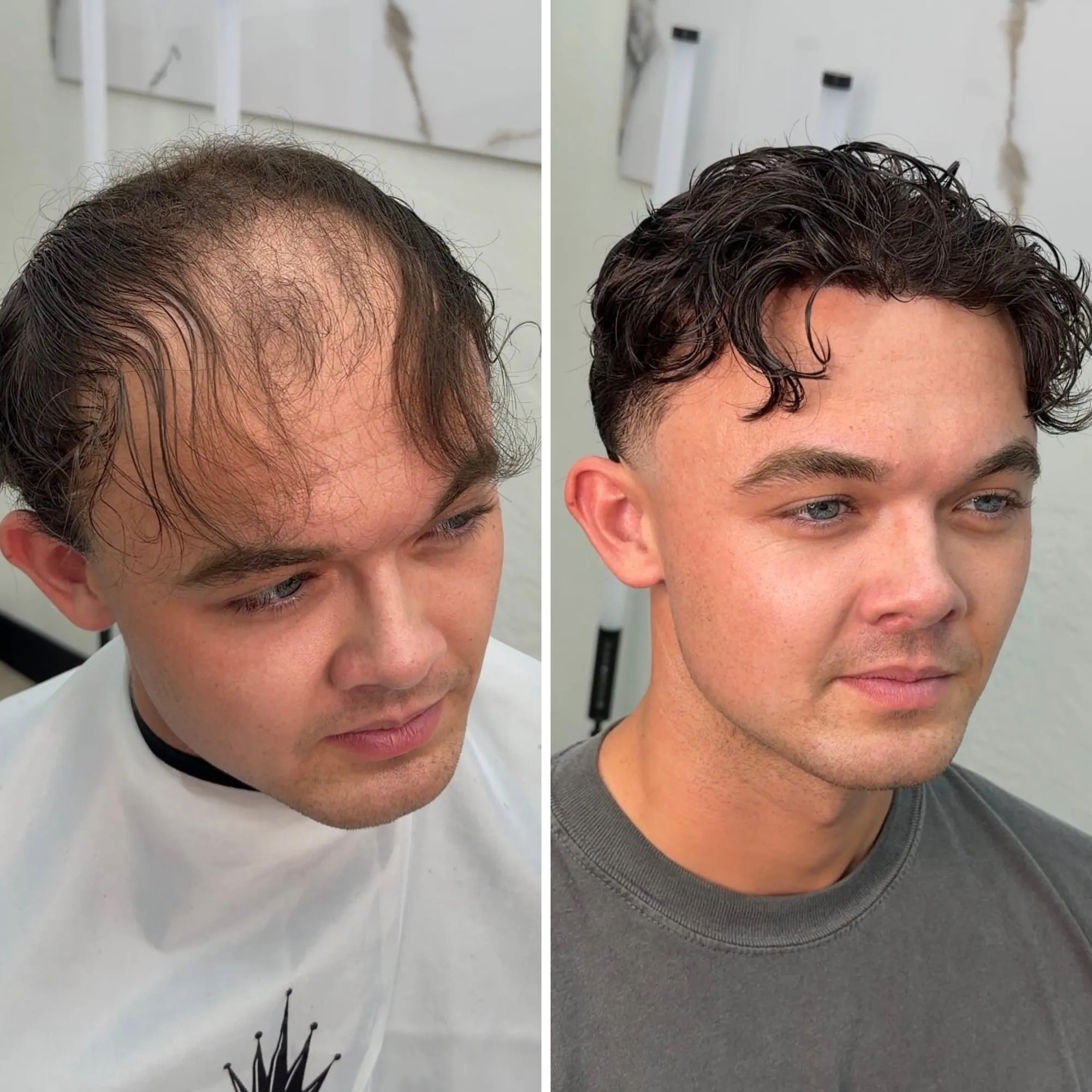
This is what it looks like.
A real client from our chair, photographed before and after his hair system was installed and cut in.
Questions, answered.
Why does a hair system hairline sometimes look fake?
Nearly always because it is too low, too straight, or too dense at the front. A real hairline sits at a believable height, has an irregular broken edge, and fades in from fine to full. Get those three right and it holds up close.
Can the hairline be made to match photos of my old hairline?
We can use old photos as a guide, and they help. The honest caveat is that a hairline set to your twenties can look too low for your face now. We aim for what reads as natural today, which usually means a touch higher and softer than people expect.
How close can people get before they notice?
A well designed and well cut hairline is built to hold up close, in photographs, and in daylight. That is the standard, and it comes down to the front edge being irregular and the density fading in rather than starting thick.
Does a finer front mean the system wears out faster?
Generally yes. The finest lace and skin fronts give the most invisible hairline and are also the most delicate. We talk through that trade at your consultation so you choose a front that matches both the look you want and how you live.
Keep reading
Related guides.
Does It Look Natural
A well fitted, well cut hair system blends into your own hair and hairline. Here is what makes a hair system look natural and undetectable.
Frontal Hair System
A frontal hair system covers the front and top where hair recedes, blending into the hair you still have. Here is who it suits and how it differs.
Types of Hair Systems
Lace, skin, and poly hair systems compared by look, feel, durability, and upkeep, so you can choose the right base for your hair and lifestyle.
Before and After
A hair system before and after mostly changes your hairline, density, and framing. Here is what actually shifts in the chair, from a real studio.