

Last updated September 28, 2026
Why the order form is worth understanding
A stock hair system comes pre made in a set of fixed specs. A custom one is built to an order form, and that form is where every decision gets locked in before anything is tied by hand. If a field is wrong, the finished unit is wrong, and a custom build takes time to remake. So the order form is not paperwork you skim. It is the single most important document in the whole process, and reading it fluently is what separates a unit that fits your life from one that fights you.
You do not need to fill this out alone. In our chair we take your measurements, look at your own hair and scalp, and translate all of it into the fields below. But knowing what each line means lets you follow along, ask sharp questions, and confirm the build is right. Below is the full field list in one table, then a closer look at each group.
Every field on a custom order, in one table
This is the complete set of attributes a custom hair system order captures. Read it top to bottom and you have read the whole form. Each field links to a deeper spec page where one exists, and the ones without a deep page are covered in the groups underneath.
| Field | What it means | Common options |
|---|---|---|
| Base size | The outline and dimensions of the unit, measured to your head | A stock footprint (a common one is 8 by 10 inches) or a custom template taken from your own scalp |
| Base design and material | What the foundation is made of and how zones are combined | Full lace (Swiss or French), skin or thin skin (poly), monofilament, silk top, or a hybrid that mixes zones |
| Density | How much hair is added per area, which reads as thickness | Light, light to medium, medium, medium to heavy, heavy; often graded as a percentage and varied by zone |
| Color | The shade of the hair, matched to your own | A numbered or named color code from a color ring, from natural black through browns to blonds |
| Grey percentage | How much grey or white hair is blended in | Written as a percentage, for example 10 percent or 30 percent, and can differ by area |
| Curl or wave | The wave pattern of the hair | Straight through graded wave and curl values, matched to your natural texture |
| Length | How long the hair is before your stylist cuts it in | Measured in inches; longer lengths are a cost driver and are set on the form |
| Hair origin | Where the hair comes from and how it was processed | Indian, Chinese, or European human hair, or synthetic; Remy or non Remy; virgin or processed |
| Ventilation | The method used to attach each hair to the base | Single or double knots, bleached knots, or injected and V loop methods on skin bases |
| Front contour | The shape of the hairline across the front | A, C, or CC contour (flat to curved), plus temple and recession shaping |
| Hair direction | The way the hair is tied to fall and part | Front to back flow, a set part side (left, right, or free), and crown whorl placement |
The base group: size, material, and contour
The first three fields define the foundation. Base size is the footprint of the unit and the single field a custom order exists to get right. A stock size is a fixed rectangle the factory keeps on hand, while a custom template is traced from a mold of your own head so the edge sits exactly where your loss starts. A custom template is a cost driver because it is more work to build to, with the figure set at your consultation.
Base design and material is the field that decides how the unit looks at the hairline, how it breathes, and how long it lasts. Lace breathes and looks the most natural, skin disappears against the scalp and wipes clean, poly is the toughest, and monofilament and silk top handle the crown and part. Most real orders are hybrids that assign a different material to each zone. Front contour is the shape of the hairline itself, written as an A, C, or CC value from flat to curved, with temple and recession detail added so the front follows the way your own hairline would sit.
- Base size: stock footprint or custom template from your mold
- Base design and material: lace, skin, poly, monofilament, silk top, or a hybrid by zone
- Front contour: A, C, or CC shape plus temple and recession shaping
The hair group: origin, density, color, grey, curl, and length
Six fields describe the hair itself. Hair origin covers where the hair was sourced and how it was treated. European hair is the finest and most sought after and is a clear cost driver, with Indian and Chinese human hair common alternatives, and Remy and virgin grades priced above processed hair. The figure for any upgrade is set at consultation. Density is how much hair goes in per area, graded from light to heavy and usually lighter at the hairline so the front reads soft and natural rather than a solid wall.
Color is chosen from a numbered ring and matched to your own hair, and grey percentage is layered on top as a number, for example 20 percent, so the blend of grey and pigmented hair matches what you actually grow. Curl or wave is set to your natural texture on a graded scale from straight to tight curl. Length is ordered in inches and cut in by your stylist afterward, and hair length over roughly six inches is a cost driver set on the form. None of these are guesses in our chair. We match each one against your own hair in person before it goes on the order.
The construction group: ventilation and hair direction
The last two fields describe how the hair is actually fixed to the base. Ventilation is the knotting or injection method, and it changes both realism and durability. Single knots at the hairline look the most invisible, double knots hold more securely through the body of the unit, bleached knots are lightened so the knot vanishes against the scalp, and injected or V loop methods are used on skin bases where there is no mesh to knot into.
Hair direction is the field people forget until it is wrong. It tells the ventilator which way every hair should lean, where the part sits, and how the crown swirls. Get it right and the hair falls and styles the way it grows. Get it wrong and no amount of cutting fixes a part that fights you. On the form it is set as a flow direction, a part side, and a crown whorl location.
- Ventilation: single knots, double knots, bleached knots, or injected and V loop on skin
- Hair direction: flow, part side, and crown whorl placement
Which fields move the price
Cost on a custom order is driven by a handful of fields, not the length of the form. We are honest about which ones matter so there are no surprises, and the actual figure is always set at your consultation once we know the full spec. Ranked roughly by how much they move the build, the drivers are:
- Hair origin: European hair, and Remy or virgin grades, sit at the top
- Base material and construction: silk top, custom hybrids, and finer lace add work
- Base size: a full custom template is more to build than a stock footprint
- Length: hair length over roughly six inches
- Ventilation detail: bleached knots and fine single knot hairlines take longer to tie
How we handle the order form in our chair
We do not hand you a blank form and walk away. We take a template of your head, match color, grey, and texture against your own hair under good light, and talk through how you live day to day before a single field is filled in. Then we read the completed order back to you so you can confirm it. That way the unit that arrives is the one we designed together, not a surprise.
If you want to go deeper on any single field, the spec pages in this cluster break each one down: base size and how to measure, base construction combinations, density by base material, color codes, grey percentage, curl and wave, front contour options, knot types, ventilation methods, and hair origin. This page is the map. When you are ready to build a real order, that starts at a consultation, and you can book one with Nico in Peoria, Arizona or with Ivette and Denisse in Eighty Four, Pennsylvania.
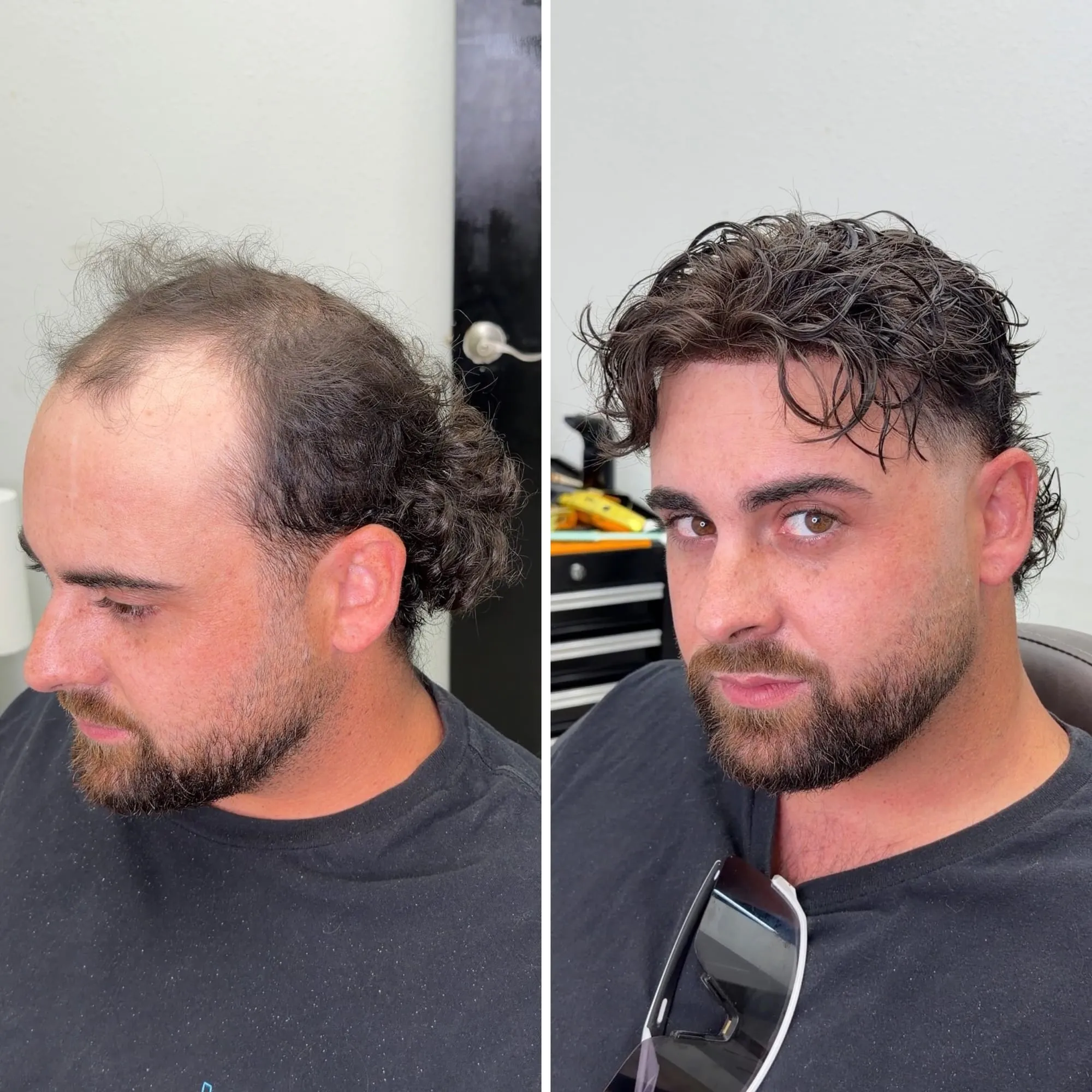
Real work
This is what it looks like.
A real client from our chair, photographed before and after his hair system was installed and cut in.
Questions, answered.
What do I need to specify to order a custom hair system?
Eleven core fields: base size, base design and material, density, color, grey percentage, curl or wave, length, hair origin, ventilation, front contour, and hair direction. Together they define how the unit looks, feels, and lasts. In our chair we measure and match each one with you before it goes on the order.
What is the most important field on the order form?
Base size and base material do the heaviest lifting, because they set the footprint that fits your head and the foundation that decides realism, breathability, and lifespan. Hair direction is the most overlooked, since a part or crown tied the wrong way cannot be fixed by cutting later.
How is grey hair specified?
As a percentage of grey or white hair blended into the base color, for example 10 percent or 30 percent, and it can be set differently in different areas. We match the percentage to what you actually grow so the blend looks like your own hair going grey, not a uniform shade.
Which fields affect what a custom unit costs?
Cost drivers include hair origin (European, Remy, and virgin grades sit highest), base material and construction like silk top and fine lace, a full custom base size, hair length over roughly six inches, and detailed ventilation such as bleached knots. The exact figure is set at your consultation once the full spec is known.
Do I have to fill out the order form myself?
No. We take the template, match color and texture to your own hair, and translate how you live into every field, then read the finished order back to you to confirm. Understanding the fields just lets you follow along and ask sharp questions.
Keep reading
Related guides.
Stock vs Custom
Stock hair systems are ready made and fast. Custom units are built to your head, color, and hairline. Here is how the two differ and when each makes sense.
Lace, Poly, or Skin
Lace breathes and looks natural, skin is invisible and easy to clean, poly holds longest. How we pick a hair system base by realism and upkeep.
Human vs Synthetic
Human hair vs synthetic hair systems compared by look, styling, longevity, and care, with the honest tradeoffs we walk through in our chair.
Cost Drivers
Hair system cost is set by base size, base material, hair origin, density, wave, color, custom vs stock, and service cadence. Here is the ranked picture.