

Last updated September 28, 2026
Why the millimeter number decides wear life
A skin base is a polyurethane membrane that the hair is injected into. It sits directly against your scalp, so the thinner that membrane is, the more it disappears into your skin and the more convincingly the hair looks like it is growing out of you. That is the whole appeal of thin skin, and it is why the very finest bases are the ones people reach for when detection is the priority.
The same thinness that makes a base invisible also makes it fragile. A thinner membrane tears more easily at the perimeter, degrades faster under adhesive and remover cycles, and softens quicker in heat and sweat. A thicker membrane resists all of that, which is why it lasts longer even though it reads slightly more present at close range. So the millimeter figure is not a detail, it is the axis that sets both realism and lifespan at the same time, in opposite directions.
The wear-life ranges below are typical for how each thickness behaves in daily use. They move with your climate, how much you sweat, how active you are, and how carefully the unit is cleaned and reattached. In the dry Arizona heat or a humid Pennsylvania summer, a given thickness tends to sit at the shorter end of its range. Treated gently and rotated with a second unit, the same base reaches the longer end.
The base thickness chart
Here is how skin base thickness maps to wear life and to the realism-versus-durability tradeoff at each step. One realistic wear figure sits on each row. No amounts appear, because the actual figure is set to your specification at consultation, but the relationship between thickness, look, and lifespan is definitive.
| Base thickness | Typical wear life | Realism vs durability tradeoff | Best suited to |
|---|---|---|---|
| 0.03mm ultra-thin skin | Roughly 4 to 6 weeks | The most invisible scalp and hairline of any base, and the most fragile, so it is replaced the most often | Special occasions and men who put detection above everything and accept short intervals |
| 0.05mm thin skin | Roughly 2 to 3 months | Still a very natural scalp with a little more structure, so it survives handling better than 0.03mm | Daily wearers who want a realistic front and can commit to a regular replacement rhythm |
| 0.06 to 0.08mm medium skin | Roughly 3 to 5 months | The balance point, a natural look with real durability, so most everyday wearers land here | Most men wanting one honest all-round base for daily life |
| 0.10mm and above thick skin | Beyond 6 months | Slightly more present at the very front, but the toughest membrane, so it lasts the longest and takes the most abuse | Active men, heavy sweaters, and anyone who wants the fewest replacements per year |
Ultra-thin skin at 0.03mm
At 0.03mm the membrane is barely there. Against your scalp it vanishes, and a bleached-knot or V-loop front on this base is about as undetectable as hair replacement gets, with no visible edge and a hairline that reads as skin. This is the base men ask for when they will be photographed up close or want to defeat scrutiny in bright light.
The cost of that realism is time. At roughly 4 to 6 weeks of wear, a 0.03mm base is the shortest-lived option on the chart, because the same delicacy that makes it disappear also makes the perimeter tear and the surface break down under repeated tape and remover. Many men keep an ultra-thin unit for events and wear a thicker base day to day, which is often the honest way to enjoy this look without replacing a full unit every month.
Thin skin at 0.05mm
A 0.05mm base keeps most of the invisibility of ultra-thin skin while adding just enough structure to survive daily handling. The scalp still reads convincingly natural, and the front can be finished to sit flush against your skin. This is a common choice for men who want a realistic result and have settled into a steady reattachment routine.
Expect roughly 2 to 3 months of wear from a 0.05mm base under normal conditions. Sweat, heat, and frequent tape changes pull it toward the shorter end, while gentle cleaning and careful removal push it toward the longer end. It is the step where realism and a manageable replacement rhythm start to meet in the middle.
Medium skin at 0.06 to 0.08mm
The 0.06 to 0.08mm band is where most everyday wearers land, and for good reason. It looks natural enough that almost no one will question it at conversational distance, and it is sturdy enough to take daily attachment, washing, and styling without the anxiety that comes with the thinnest bases. It is the practical center of the chart.
Typical wear life here is roughly 3 to 5 months, which for many men means a comfortable quarterly replacement rhythm rather than a monthly one. If you are choosing a first daily base and are not sure how hard you will be on it, this is usually the honest starting point, and you can go thinner for realism or thicker for longevity once you know your own wear pattern.
Thick skin at 0.10mm and above
At 0.10mm and above the membrane is built to last. It is slightly more present at the very front than the finer bases, so it is not the pick for someone whose only priority is an undetectable hairline under a camera, but it survives sweat, heat, sport, and heavy handling far better than anything thinner. This is the durable end of the skin range.
Wear life runs beyond 6 months for a thick skin base treated reasonably, which makes it the fewest-replacements-per-year option on the chart. For active men, heavy sweaters, and anyone in a demanding climate who values reliability over the last few percent of realism, a thicker base is frequently the sensible choice, and a small compromise at the hairline buys a large gain in how long the unit lasts.
- Want the most undetectable scalp and accept the shortest life: 0.03mm ultra-thin leans your way
- Want a realistic front with a manageable rhythm: 0.05mm thin skin fits
- Want one honest all-round daily base: 0.06 to 0.08mm medium skin is the center
- Want the fewest replacements and the toughest membrane: 0.10mm and up thick skin wins
How thickness fits the wider base picture
Thickness only settles the skin family. If undetectability at the front matters more than anything, a lace front or a lace-to-skin hybrid can outperform even the thinnest solid skin, because a knotted lace hairline reads as scalp without the perimeter that a full skin base carries. Many men run a lace or ultra-thin front on a slightly thicker body so the hairline disappears while the rest of the unit lasts. Thickness and base material are two dials you set together, not one.
The honest way to compare any two bases is cost per month of wear, meaning what the unit costs to build divided by how many months you realistically get from it. That framing keeps a thin base's short life from looking cheaper than it is, and it often shows a thicker, longer-lasting base to be the more economical daily choice even when it is less spectacular at the hairline.
What is set at consultation
The chart on this page is the durable part: thinner skin means more realism and shorter life, thicker skin means slightly more presence and longer life, with the millimeter figure predicting the wear window. What we set with you in person is which thickness matches how you actually live, whether a lace or hybrid front serves you better than solid skin, and how a second unit in rotation could extend the life of whichever base you choose.
Where a build carries a cost component, such as a fully custom template, European hair, a silk top, or hair length over about six inches, we rank those drivers openly and defer the figure to consultation rather than publish a blanket price, because two men ordering what sounds like the same base can need very different builds. Bring your routine, your climate, and how hard you are on your hair, and Nico, Ivette, or Denisse will map the right thickness to all three at our Peoria, AZ or Eighty Four, PA studio.
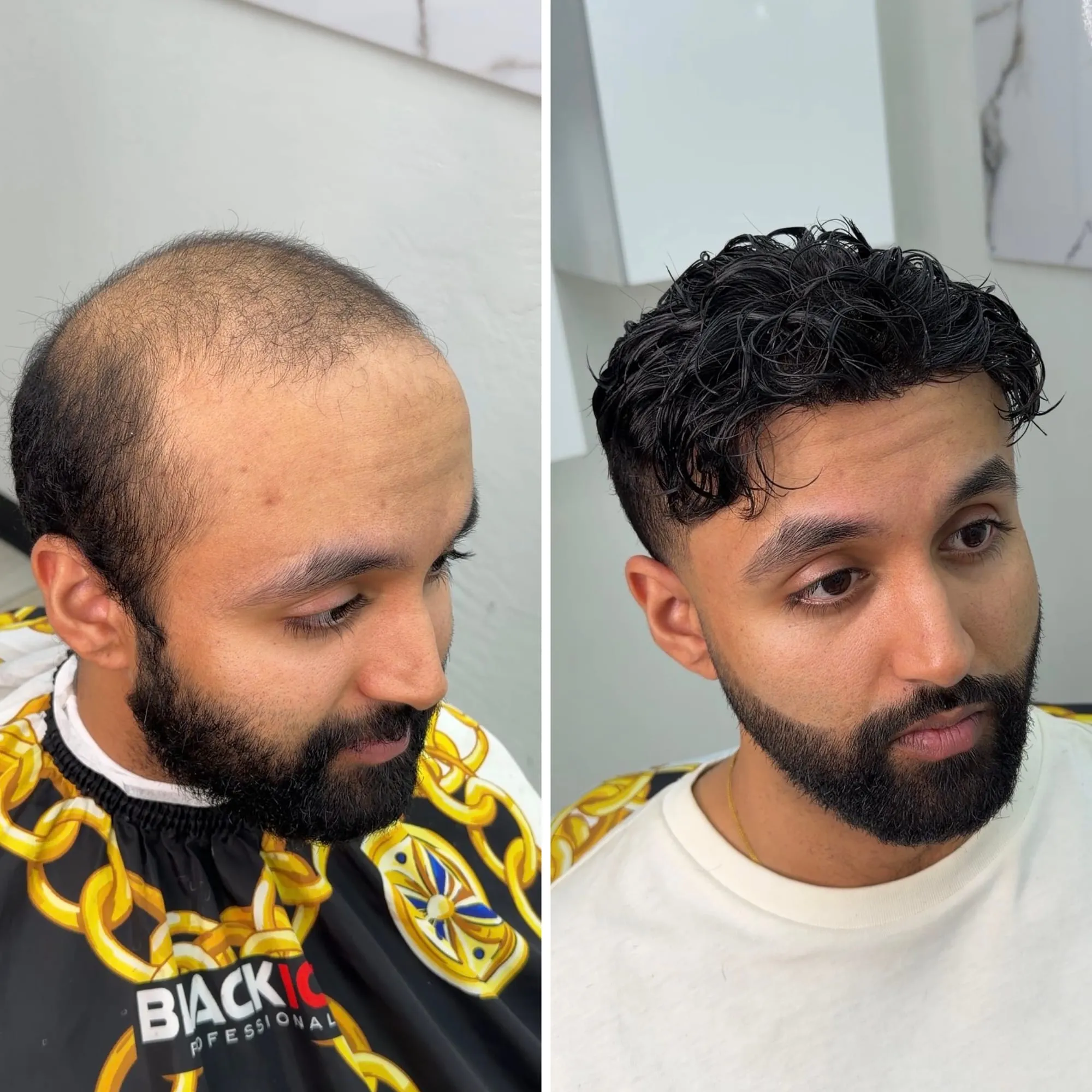
Real work
This is what it looks like.
A real client from our chair, photographed before and after his hair system was installed and cut in.
Questions, answered.
How long does a 0.03mm ultra-thin skin base last?
Roughly 4 to 6 weeks under normal wear. It is the most invisible base and also the most fragile, so it needs replacing more often than any other thickness. Many men reserve it for occasions and wear a thicker base day to day.
What is the best skin thickness for daily wear?
For most men the 0.06 to 0.08mm medium band, which lasts roughly 3 to 5 months. It looks natural at conversational distance and is sturdy enough for daily attachment, washing, and styling without the fragility of the thinnest bases.
Does a thinner base always look more natural?
At the scalp, yes, a thinner membrane disappears into your skin more completely. But a knotted lace front can read as natural as ultra-thin skin while lasting longer, which is why many units pair a fine front with a slightly thicker body.
Which thickness lasts the longest?
A 0.10mm and thicker skin base, which runs beyond 6 months treated reasonably. It is slightly more present at the front than the finest bases but resists sweat, heat, and heavy handling far better, so it needs the fewest replacements per year.
Can I make a thin base last longer?
Yes. Gentle cleaning, careful removal, keeping it out of prolonged heat, and rotating a second unit so each rests between wears all push a base toward the longer end of its range and lower its cost per month of wear.
Keep reading
Related guides.
Reading the Order Form
Every field on a custom hair system order form explained in one place: base size, material, density, color, grey, curl, length, origin, and more.
Thin Skin Systems
A thin skin hair system is a fine polyurethane base that gives the most invisible scalp look. Here is how thin and ultra thin skin bases feel and wear.
Cost by Base Type
Skin bases are usually cheaper to build than lace, but they wear out faster. Cost per month of wear is the honest way to compare bases.
How Long Hair Systems Last
How long a hair system lasts depends on the base, your routine, and maintenance. Here is what to expect and how to make yours last longer.