

What density actually means
Density is how much hair is tied into the base per square area, usually described as a percentage against a full, young head of hair. It is not the same as the base type or the hair grade. Two systems can use the same human hair and the same lace and still look completely different because one is built light and one is built heavy.
The number that matters is not the highest one available. It is the one that matches how hair grows on a real scalp, where the density is never uniform and never maxed out edge to edge.
Why over-dense reads fake
The single most common mistake we correct in our chair is too much hair. A real scalp is not a solid wall of fibre. Light passes through it, you catch glimpses of scalp at the part, and the hairline is soft and irregular at the very front. Pack the base full and you erase all of that. The eye cannot say exactly why, but it registers that something is off.
Heavy density also moves wrong. Real hair falls and separates. An over-dense unit sits as one block, holds its shape in wind, and looks styled even when it should look lived in. Getting density right is what separates work that disappears from work that announces itself.
Density by age
Age is the biggest single factor. A man in his twenties can carry more density and a lower, stronger hairline because that is what his peers still have. The same build on a man in his fifties looks like a costume, because natural hair thins gradually across the whole scalp with age.
We match density to where your own age and your existing hair actually sit, not to the fullest thing on the shelf. The goal is that nobody does a double take, including people who knew you before.
- Younger men can carry higher density and a stronger front, in line with their peers
- Men in their forties usually look best a step down from a full young head
- Men over fifty read most natural with lighter, more graduated density
Density by face and hairline zone
Density is never one setting across the whole unit. The front hairline is the most exposed and the most scrutinised, so it is built lighter and more graduated, with single hairs and irregular spacing at the very edge. Behind that, through the mid scalp and crown, density steps up to carry the visual weight.
Face shape and how you wear your hair change the call too. A man who parts hard on one side and wears it back needs a different distribution than a man with a textured crop pulled forward. We map density to how you will actually style it, so the fullness lands where your finished look needs it.
How we set your density in person
This is not a number you should have to pick blind off a spec sheet. At a consultation we look at your existing hair, your age, your skin tone at the part, and photos of you before, if you have them. Then we recommend a density and a distribution and explain the trade off in plain terms.
It is also adjustable over time. If your first unit feels a touch heavy once you live in it, we account for that on the next build. Density is a decision we make with you, not one we hand you.
Real work
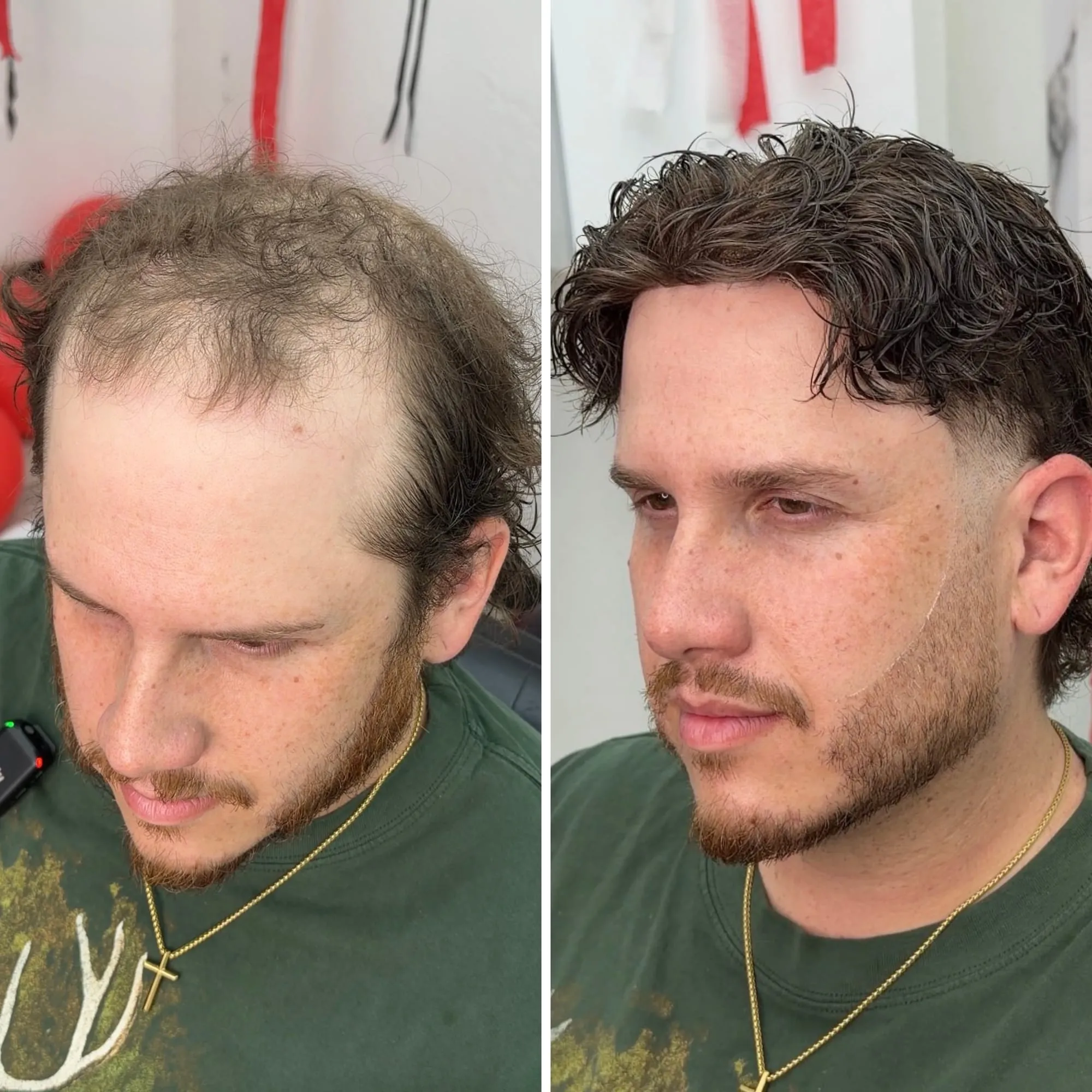
This is what it looks like.
A real client from our chair, photographed before and after his hair system was installed and cut in.
Questions, answered.
What density looks the most natural?
A density that matches a real head of hair for your age, lighter and graduated at the front hairline and fuller through the crown. There is no single best number, because natural hair is never uniform and thins with age.
Why does my system look fake or too full?
The most common cause is too much density. When a base is packed fuller than a real scalp grows, light cannot pass through, the hairline loses its softness, and the hair sits as a block. Reducing density and softening the front usually fixes it.
Should an older man use lower density?
Usually yes. Natural hair thins gradually with age, so a lighter, more graduated density reads as real on a man over fifty, while the same fullness that suits a younger man can look like a costume.
Can density be changed after my first system?
Yes. Density is set per build, so if your first unit feels too heavy or too light once you have worn it, we adjust it on the next one. It is a decision we refine with you over time.
Keep reading
Related guides.
The Hairline
A natural hair system hairline is built from irregularity, a soft density gradient, and careful placement. Here is how we design one that reads as yours.
Does It Look Natural
A well fitted, well cut hair system blends into your own hair and hairline. Here is what makes a hair system look natural and undetectable.
Color Matching
How color matching works for a hair system, and how salt-and-pepper and grey are blended so it stays believable as you age.
What to Expect at Your Consultation
Your first hair replacement consultation, step by step: the assessment, your options, and the plan you leave with. No pressure, no obligation.