

Last updated September 28, 2026
Why bases are built in zones, not one material
No single base material is best at everything a hair system has to do at once. Fine lace and ultra-thin skin look the most like bare scalp at the hairline, but they are the most fragile. Monofilament and thicker poly last far longer under daily handling, but they are a touch less invisible right at the front. A base built entirely from the delicate stuff looks perfect and dies young; a base built entirely from the durable stuff lasts but shows more at the parting.
The fix the industry landed on is zoning. A unit is divided into a front hairline zone, a top and crown zone, and a perimeter zone, and each zone gets the material that suits its job. That is what a hybrid base is: a deliberate map of materials chosen so the front disappears, the top survives styling, and the edges take tape or glue without tearing. Reading an order form is really reading that map, which is why the combination matters as much as any single spec.
The base construction map, zone by zone
Here are the five common constructions side by side, with the material in each zone, the typical thickness or dimension spec, and the realistic wear-life range. Skin gauges are quoted in millimeters, lace is graded by fineness, and the poly perimeter is quoted as a width. The wear-life ranges are typical for daily use and move with your climate, activity, and care. No amounts appear on purpose; where a construction carries a cost driver it is flagged in the last column and the figure is set at consultation.
| Construction | Front (hairline) | Top / crown | Perimeter | Typical spec | Typical wear life | What it buys / cost driver |
|---|---|---|---|---|---|---|
| All-skin (poly) | Thin skin, often V-looped or knotless | Thin skin (same membrane) | Thin skin (thicker edge or added poly) | Skin gauge about 0.03 to 0.12 mm; thicker edge to about 0.15 to 0.18 mm | Roughly 1 to 3 months at ultra-thin, up to about 6 at thicker gauges | Cleanest scalp look and easy taping; ultra-thin gauge is a durability cost driver |
| All-lace (full lace) | Swiss lace (finest) or French lace | Same lace across the whole cap | Same lace, sometimes with a poly edge strip added | Swiss lace finer than French lace; no membrane thickness | Roughly 3 to 6 months | Most breathable and invisible everywhere; fine lace fragility is the cost driver |
| Mono top, lace front, poly perimeter | French or Swiss lace, about 0.5 to 1 in deep | Monofilament (fine mono under a top layer) | Poly / skin strip about 1 in (roughly 25 mm) wide | 1 in poly perimeter; lace front strip; mono body | Roughly 4 to 9 months | Natural front, durable body, tape-ready edge; the classic all-rounder |
| Lace top, skin perimeter | Lace (Swiss or French) | Lace across the top and crown | Thin skin / poly band about 1 in (roughly 25 mm) | Lace body with a 1 in poly edge; front-to-crown lace | Roughly 3 to 6 months | Breathable lace top with a firmer taping edge; lace body still delicate |
| Silk / injected top | Lace front (knots hidden under silk layer) | Silk over lace (double-layer injected top) | Poly or lace edge | Two-layer top; front lace strip about 0.5 to 1 in | Roughly 4 to 8 months | Knots sit under the silk for a bald-scalp parting; extra layer is a cost driver |
Why the perimeter is its own zone (and why it is skin)
The perimeter is the band that runs around the very edge of the base, and it is almost always thin skin or poly even on a mostly-lace unit. There is a practical reason it exists as a separate zone. Poly is a smooth, non-porous surface, so tape and glue bond to it cleanly and release cleanly, whereas raw lace edges can fray and soak up adhesive. A poly perimeter gives you a reliable taping surface exactly where the attachment sits, which is the edge.
The other reason is the resizing margin. A poly perimeter is commonly built about one inch wide, roughly 25 millimeters, and that width is deliberate. It gives a stylist material to cut into when the unit is fitted to your head, and it leaves room to trim the base down over its life as it stretches or as your attachment habits change. A lace edge has no such margin; a one-inch skin gauze perimeter is effectively a taping surface and a resizing allowance built into the same band.
- Poly perimeter, roughly 1 in (about 25 mm) wide, is the standard taping and resizing band
- Tape and glue bond and release cleaner on smooth poly than on raw lace edges
- The 1 in width is a cut-in and resizing margin, not decoration
- A full-lace unit can still add a thin poly edge strip for the same reason
All-skin and all-lace: the two pure ends
All-skin is the whole base built from one poly membrane, with the hair injected or V-looped in so there are no visible knots. At ultra-thin gauges, around 0.03 to 0.06 millimeters, the front melts into your skin and the parting looks like bare scalp, which is why thin skin is a favorite for a first, natural-looking unit. The trade is life: the thinnest gauges tear and lift soonest, so many men run a slightly thicker gauge, closer to 0.10 to 0.12 millimeters, to buy durability, and step the edge thicker still for taping.
All-lace is the opposite pure end: the entire cap is lace, usually finer Swiss lace at the front and French lace behind it. Lace breathes, so an all-lace unit is the coolest and most comfortable in heat, and it looks natural across the whole cap, not just the front. The cost is fragility. Fine lace is delicate everywhere, not just at the hairline, so an all-lace unit generally needs the most careful handling of any construction and often adds a slim poly edge just to survive taping.
The hybrids: where most orders actually land
The mono top with a lace front and a poly perimeter is the workhorse combination, and it is where a lot of men end up. A lace strip about half an inch to an inch deep gives an undetectable hairline; a monofilament top gives a durable, styleable crown that hides knots reasonably well; and the one-inch poly perimeter gives a clean taping edge with a resizing margin. You get a natural front and a base that lasts, which is why it often lands in the moderate band for wear life at roughly four to nine months.
A lace top with a skin perimeter is the pick when breathability across the whole top matters more than maximum durability, common for men who run hot or sweat heavily. The lace keeps the crown cool and natural, while the roughly one-inch poly perimeter still gives a firm taping band. It sits shorter on wear life than a mono-bodied hybrid because the lace body stays delicate, but it is cooler to wear day to day.
A silk or injected top is the invisibility upgrade. It layers silk over lace so the knots sit underneath the silk rather than on the surface, which makes the parting look like skin with hair growing straight out of it. That double layer is an add-on cost driver and adds a little bulk at the crown, but for men whose main worry is a visible parting, it is the construction that answers it. In every one of these the perimeter stays poly for the same taping and resizing reasons.
How to choose the combination for how you live
Start from the two things you cannot compromise on, then let the base map fall out of that. If an undetectable parting is the priority and you will handle the unit gently, a fine all-lace or a silk top earns its fragility. If you are hard on your hair or want the longest interval between replacements, a mono-bodied hybrid or a thicker all-skin gauge is the honest call. If heat and sweat are your daily reality, lace across the top wins on comfort even at some cost to wear life.
For most men the mono top with a lace front and a poly perimeter is the balanced default, because it puts the delicate material only where it has to be, at the hairline, and keeps durable material everywhere else. Bring your climate, your activity, and how you plan to attach the unit to your consultation, and we will map the right material to each zone rather than defaulting you to a single-material base that is either too fragile or too visible for how you actually live.
What is set at consultation
The base map is the biggest lever on both look and life, and it interacts with the other specs on the order form. Ranked by how much they move the build, the levers are the construction combination itself, the hair type and origin, and any custom template, followed by add-ons such as a silk top, a larger base size, hair length over about six inches, or a European hair specification. Each of those is quoted against your actual order at consultation, not published as a blanket figure, because two men can request what sounds like the same unit and need very different zone maps.
What we can commit to before you sit down is the logic on this page: pick the material for each zone by the job that zone has to do, keep the delicate stuff only where invisibility demands it, and let the poly perimeter carry the taping and resizing load. We map your front, top, and perimeter to your climate and routine at the consultation, with no obligation.
Real work
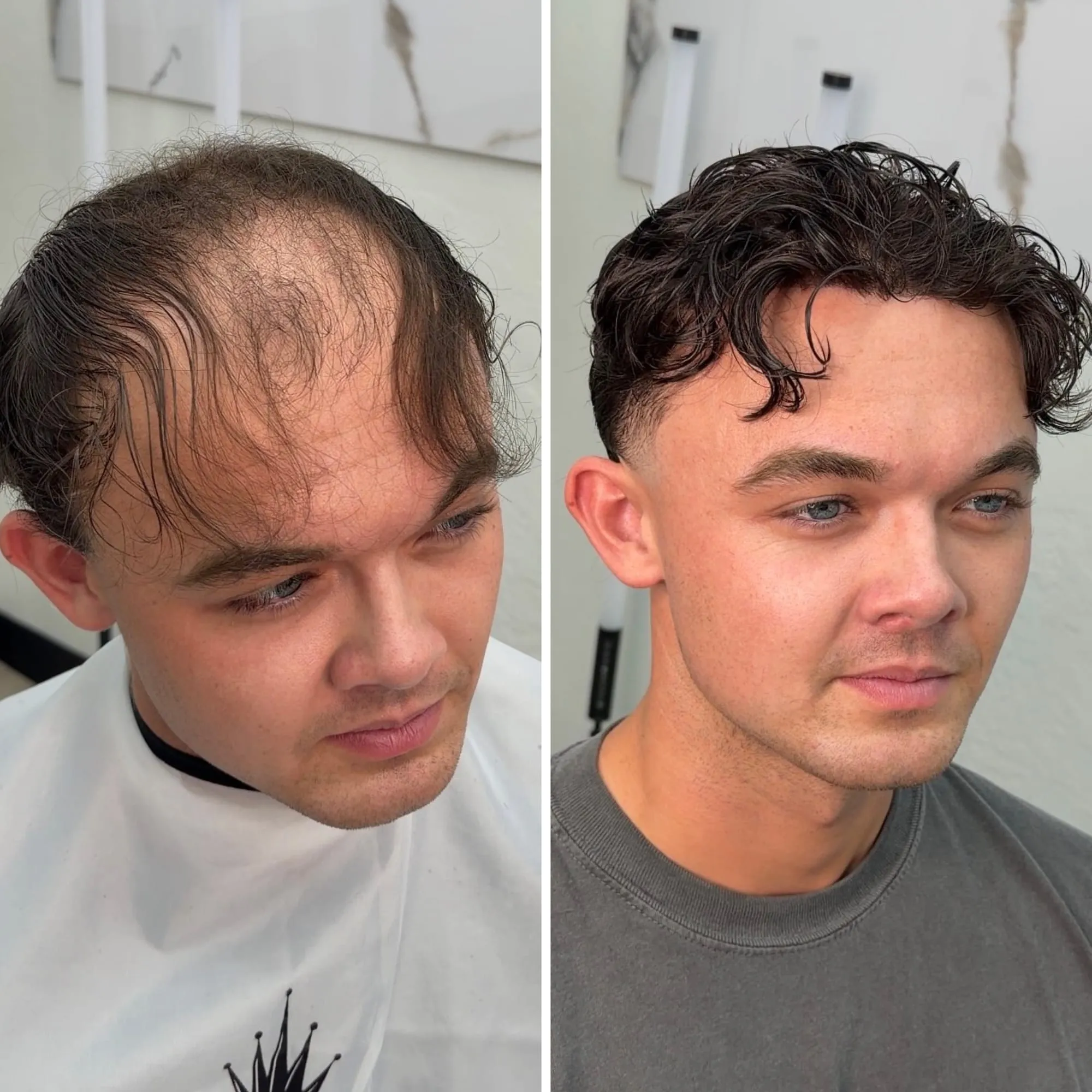
This is what it looks like.
A real client from our chair, photographed before and after his hair system was installed and cut in.
Questions, answered.
What is the most common hair system base construction?
A monofilament top with a lace front and a poly perimeter, usually about one inch (roughly 25 mm) wide. It puts delicate lace only at the hairline where invisibility matters, keeps a durable mono body for styling, and uses a poly edge as a clean taping surface, which is why it often lasts around four to nine months.
Why do lace hair systems have a skin or poly perimeter?
Because tape and glue bond and release far more cleanly on smooth poly than on raw lace edges, which can fray and soak up adhesive. The perimeter, commonly about one inch wide, also gives a resizing margin so the unit can be cut in to fit your head and trimmed down over its life.
What is an all-skin hair system?
A base built entirely from a thin poly membrane, usually about 0.03 to 0.12 mm, with the hair injected or V-looped in so there are no visible knots. Ultra-thin gauges give the most realistic scalp look but wear out soonest; thicker gauges last longer and take tape better at the edge.
What does a silk top add over a lace top?
A silk or injected top layers silk over lace so the knots sit hidden underneath, making the parting look like skin with hair growing straight from it. It is the most invisible parting available, at the cost of a little crown bulk and an add-on that is quoted at consultation.
Which base combination lasts the longest?
A mono-bodied hybrid or a thicker all-skin gauge generally lasts longest because the durable material carries the daily handling, while fine all-lace and ultra-thin all-skin sit shorter. The honest way to compare is wear life against how the unit looks where you part it, not one number alone.
Keep reading
Related guides.
Reading the Order Form
Every field on a custom hair system order form explained in one place: base size, material, density, color, grey, curl, length, origin, and more.
Lace, Poly, or Skin
Lace breathes and looks natural, skin is invisible and easy to clean, poly holds longest. How we pick a hair system base by realism and upkeep.
Cost by Base Type
Skin bases are usually cheaper to build than lace, but they wear out faster. Cost per month of wear is the honest way to compare bases.
Types of Hair Systems
Lace, skin, and poly hair systems compared by look, feel, durability, and upkeep, so you can choose the right base for your hair and lifestyle.