

Last updated September 28, 2026
The base is the foundation everything attaches to
Start with the base, because every other part sits on it. The base, sometimes called the cap, is the thin, near invisible sheet the hair is knotted or injected into and the surface that actually bonds to your scalp. It is cut to the shape and size of the area you are covering, from a small top piece to a full head unit.
The base is not always one material. Many units we fit are hybrids, with a breathable material through the middle and a firmer material around the edge, because different regions of the same base have different jobs. That is the whole reason the vocabulary below exists. When we talk about the front edge or the perimeter, we are usually talking about how the base is built and finished in that specific spot.
The regions, front to back
Here are the six terms you will hear, and what each one refers to on the base:
- Base or cap: the full sheer foundation the hair is attached to and the layer that bonds to your scalp
- Top or crown: the main interior area over the top of your head, where density and the direction the hair falls are dialed in
- Front edge or hairline: the very front border, the most visible region and the one built for the softest, most undetectable transition to your skin
- Perimeter: the outer border running all the way around the base, where adhesive is placed and where the unit is anchored
- Sides or temples: the perimeter regions above and in front of the ears, where the unit has to blend with your own hair if you have some
- Nape: the perimeter region at the back of the neck, the lowest edge, which takes the most rubbing from collars and movement
The front edge is where realism is won or lost
The front edge, or hairline, is the region people look at hardest, so it is built and finished with the most care. This is where a fine material and a soft knotting or ventilation technique let the hair look like it is growing straight out of your skin, with no visible line. It is also the most delicate region for exactly that reason, since anything undetectable is by nature thin and light.
Because the front edge carries the realism, it is often the region where the base material differs from the rest of the unit. A common build uses a fine, breathable material at the front for an invisible hairline and a sturdier material further back for hold. How the front is shaped and graded is its own topic, and it is closely tied to how the hair is tied in at that edge.
The perimeter, sides, and nape do the holding
The perimeter is the border that runs the whole way around the base, and it is the working region for attachment. This is where tape or adhesive usually goes and where the unit is anchored to your scalp, so it tends to be built from a firmer material that grips well and handles repeated removal.
The sides, near your temples and above your ears, are the perimeter regions that have to blend with any of your own hair that remains, so the transition there matters as much as the hold. The nape, at the very back of the neck, is the lowest edge and the one that sees the most friction from collars, pillows, and turning your head. Because it takes that wear, the nape is a region we check closely at maintenance appointments and a common place to see lifting first.
Why one unit is built from more than one region
Put the regions together and the logic of a hybrid build is clear. You want the front edge to disappear, the top to move and part naturally, and the perimeter to hold firmly through heat, sweat, and daily life. No single material is best at all three at once, so the smart move is to use the right material in each region rather than compromise across the whole base.
This is why, when we plan a unit with you, we talk region by region instead of picking one label for the whole thing. Your scalp, how much of your own hair remains at the sides, how hot you run, and how you attach the unit all steer what we do at the front edge versus the perimeter versus the nape. The words on this page are the shared language we use to have that conversation clearly.
How these terms come up in the chair
You will hear these regions named at almost every stage. At the consultation we map them to your head and your goals. When your unit is ordered, the spec describes the base by region. At attachment, we work the perimeter and check the front edge. At maintenance, we inspect the nape and sides for the first signs of lift and wear.
You do not need to memorize any of this to wear a hair system well. But knowing that the base is the whole foundation, the front edge is your hairline, the perimeter is where it holds, and the nape is the back edge means that nothing your practitioner says will sound like jargon. For every other term you run into, our full glossary defines it in the same plain language.
Real work
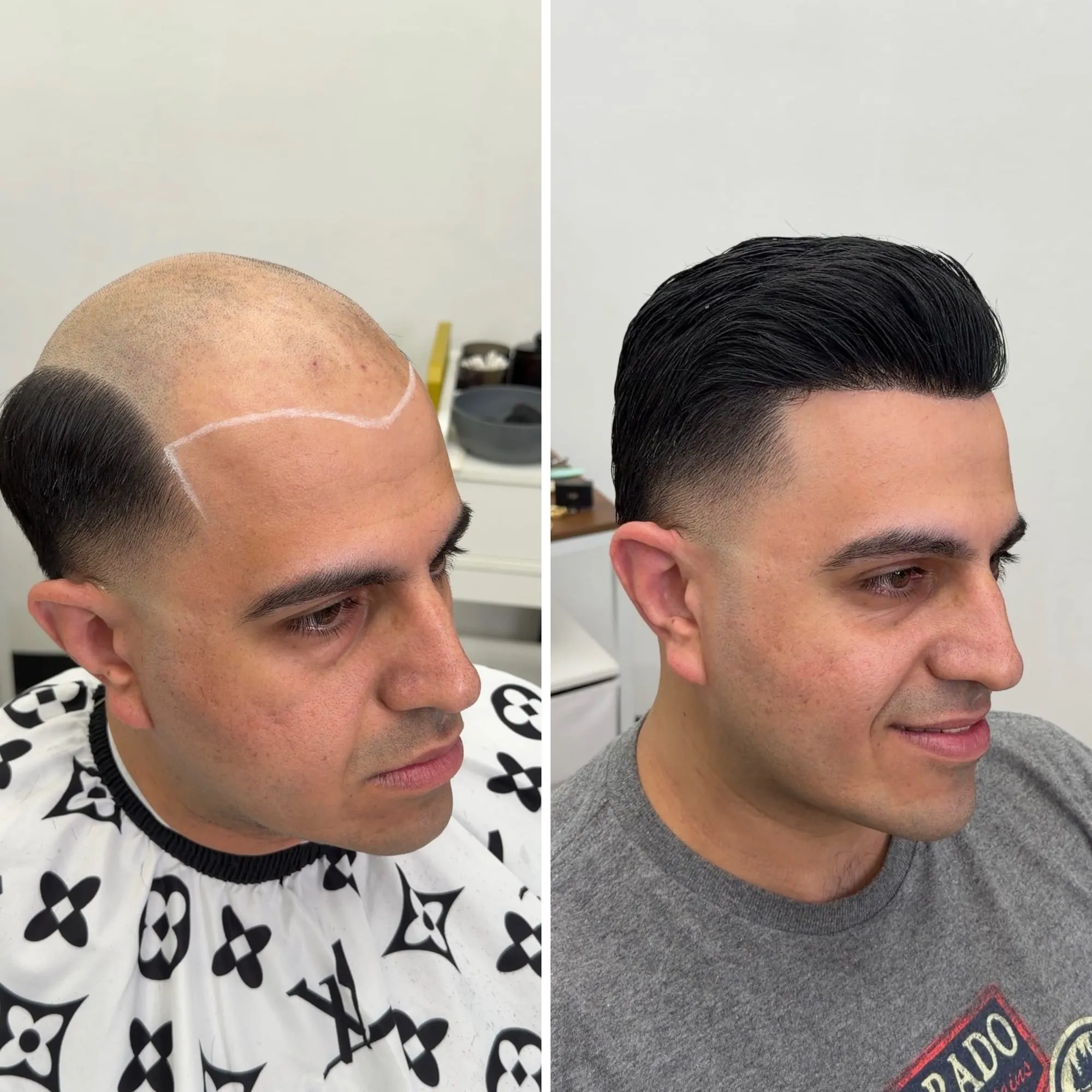
This is what it looks like.
A real client from our chair, photographed before and after his hair system was installed and cut in.
Questions, answered.
What is the base of a hair system?
The base, sometimes called the cap, is the thin, near invisible sheet the hair is tied or injected into. It is the layer that bonds to your scalp, and it is cut to the shape and size of the area being covered. Everything else on the unit sits on the base.
What is the difference between the top and the front edge?
The top, or crown, is the main interior area over your head, where density and the direction the hair falls are set. The front edge, or hairline, is the very front border, built to be the most undetectable region so the hair looks like it grows straight out of your skin.
What is the perimeter of a hair system?
The perimeter is the outer border running all the way around the base. It is the working region for attachment, where tape or adhesive is placed and where the unit is anchored, so it is often built from a firmer material that grips and handles repeated removal.
Why does the nape matter?
The nape is the lowest edge, at the back of the neck, and it takes the most friction from collars, pillows, and head movement. Because of that wear it is a common place to see lifting first, so we check it closely at maintenance appointments.
Why is one hair system made from more than one material?
Because different regions have different jobs. The front edge needs to disappear, the top needs to move naturally, and the perimeter needs to hold firmly. No single material is best at all three, so many units are hybrids that use the right material in each region.
Keep reading
Related guides.
Glossary
Plain English definitions for hair replacement: hair systems, hair units, bases, densities, attachment methods, and more.
What Is a Hair System
A hair system is a custom hair unit fitted and blended into your own hair for a full, natural look. Here is how non surgical hair replacement works.
Lace, Poly, or Skin
Lace breathes and looks natural, skin is invisible and easy to clean, poly holds longest. How we pick a hair system base by realism and upkeep.
Attachment Methods
Tape, bonding, and clip attachment for hair systems compared by hold, comfort, and how they suit your routine. How to attach a hair system.