

Last updated September 28, 2026
The short answer, origin by origin
Origin is really a shorthand for two things a strand cannot hide: how fine it is at the shaft, and how much it had to be chemically worked to reach the color on the order form. Finer hair looks and moves more like the vellus-to-terminal mix growing on a fair scalp, and hair that started close to your target shade needs less lifting and dyeing, so it keeps more of its native cuticle and softness. Those two levers are why the same length of hair from three origins can feel and photograph so differently.
European hair wins on fineness and on how gently it can be taken to a light shade, and it is scarce enough to be the top hair-quality cost driver on any order. Indian hair is the sensible middle: not as fine as true European, but finer than most other Asian hair, and forgiving enough under lighter processing to cover the majority of everyday units. Chinese hair is coarse and strong, which makes it durable, but it usually has to be stripped and rebuilt to lose its native thickness and darkness, and it is the origin most often relabeled as something more premium before it reaches a distributor.
European vs Indian vs Chinese hair, side by side
Here is how the three origins compare on the attributes that actually change the look and the cost of a unit. Strand diameter is given as a typical range in microns, because real hair from any region spans a band rather than a single number, and the bands overlap at the edges. Color codes follow the standard hair-system scale, where #1 is black, #1B is natural off-black, #2 through #4 run dark to medium brown, #5 and #6 are lighter browns, and #7 and up move into blonde. No amounts appear, because hair origin is a cost driver quoted against your finished specification at consultation, not a published price.
| Origin | Typical strand diameter | Native texture | Best shade range | Processing tolerance | Rarity and cost driver |
|---|---|---|---|---|---|
| European | Roughly 40 to 70 microns, the finest | Straight to loose wave | Lightest, blonde through light brown and grey, pairs with #5 and up plus higher grey percentages | Takes light lifting without going brittle, the best carrier for lighter shades | Rarest of the three, the top hair-quality cost driver |
| Indian | Roughly 60 to 90 microns, medium | Natural body wave to soft curl | Mid to dark, comfortable across #1B through #5, covers most general orders | Tolerates lighter processing better than other Asian hair, holds softness | Abundant and widely stocked, a moderate cost driver |
| Chinese | Roughly 80 to 120 microns, the coarsest | Thick and straight | Darkest without heavy lift, most at home at #1, #1B, and #2 | Usually stripped and re-dyed to soften and lighten, the most heavily processed | Most available, the lowest cost driver, frequently relabeled at origin |
European hair: the finest and the rarest
True European hair is the benchmark other origins are measured against. At roughly 40 to 70 microns it is the finest of the three, so it sits flatter against the base, catches light more like growing hair, and disappears at the hairline with less effort. Because it starts lighter and finer, it can be lifted to a pale shade with gentle processing that leaves the cuticle mostly intact, which is why it is the natural choice for blonde, ash, and high-grey-percentage orders where a coarser hair would look wiry once lightened.
The trade is supply. Genuinely European-sourced hair, whether gathered in Eastern Europe or comparable regions, is collected in small quantities, so it is the scarcest raw material and the single biggest hair-quality lever on a build. It rewards men who want the most undetectable result and lighter or greyer coloring, and it asks for careful maintenance in return, because the same fineness that makes it invisible also means it is less forgiving of rough handling than a coarser strand.
Indian hair: the general-use middle
Indian hair is the workhorse of the industry and the origin behind a large share of everyday units. At roughly 60 to 90 microns it is noticeably finer than most other Asian hair, with a natural body wave that blends convincingly with a wide range of European and mixed hair types once it is cut in. It arrives mostly in dark shades, and it takes lighter processing better than coarser Asian hair, so it can be brought up to medium brown and lighter while keeping enough softness to move naturally.
That balance of fineness, availability, and processing tolerance is why Indian hair covers the majority of general orders across the #1B to #5 range without pushing the build into the top cost band. For a man who wears a dark to medium-brown shade and wants a natural, durable result at a sensible tier, Indian hair is very often the honest right answer, and stepping up to European mainly earns its keep at lighter shades, higher grey percentages, or the very finest hairlines.
Chinese hair: coarsest, most processed, most relabeled
Chinese hair is strong and thick, typically around 80 to 120 microns, which makes it durable and inexpensive to source. Left in its native state it is coarse and very dark, so to reach the finer feel and lighter shades most Western clients want, it usually has to be acid-stripped and re-dyed, sometimes with the cuticle removed and a coating applied. That heavy processing is what lets a coarse strand pass for something softer, but it also means the hair leans on its coating rather than its natural cuticle, and can behave differently over the life of the unit as that coating wears.
It is also the origin most often relabeled. Because premium origins command a premium, heavily processed Chinese hair is frequently sold onward as European or as a vague blend, so an origin label alone is not a reliable spec. This is the practical reason we judge hair by the finished strand, its diameter, softness, cuticle direction, and how it takes color, rather than by the country on the paperwork. Coarse, well-processed hair is not automatically a poor choice, but it should be priced and described as what it is.
- Want the finest hairline and lighter or greyer shades: European leans your way
- Want a natural, durable result at a sensible tier in dark to medium brown: Indian usually fits
- Offered premium hair at a suspiciously low tier: ask what the finished strand actually is, not just its labeled origin
- Judge any sample on diameter, softness, cuticle, and color behavior, because origin claims can be relabeled
How origin maps to shade, grey, and color codes
Shade is where origin matters most on a real order. The standard color scale runs from #1 black and #1B natural off-black through #2 to #4 dark and medium brown, into #5 and #6 lighter browns, and up to #7 and beyond for blonde, with grey specified separately as a percentage in increments such as 10, 20, 30, and higher. The lighter and greyer your target sits on that scale, the more the raw hair has to be lifted, and the more fineness and gentle processing are worth paying for.
That is why European hair is the default carrier above roughly #5 and for higher grey percentages: it reaches those shades without the brittleness a coarser strand shows once it is heavily lightened. Chinese hair is most convincing at the dark end, #1 through #2, where little lifting is needed. Indian hair covers the broad middle. Matching origin to your color code, not to a brand name, is the move that keeps a light or grey unit looking like hair rather than like processed fiber.
What is set at consultation
Hair origin is one hair-quality cost driver, and it interacts with the others on the spec sheet: base construction, hair length past about six inches, density, and any custom template all move the number alongside origin. European and other genuinely fine hair sit at the higher end, standard Indian and processed hair at the lower end, and every one of those figures is quoted against your actual specification at consultation rather than posted as a blanket price, because two men ordering what sounds like the same unit can need very different hair.
What we can promise before you sit down is the logic on this page. Pick origin by how fine you need the strand and how light or grey your shade is, treat any origin label with healthy skepticism, and judge the sample you are shown on diameter, softness, and color behavior. Bring your target shade and how you live to the consultation with Nico, Ivette, or Denisse at our Peoria, Arizona or Eighty Four, Pennsylvania studios, and we will match the right hair to both, honestly and with no obligation.
Real work
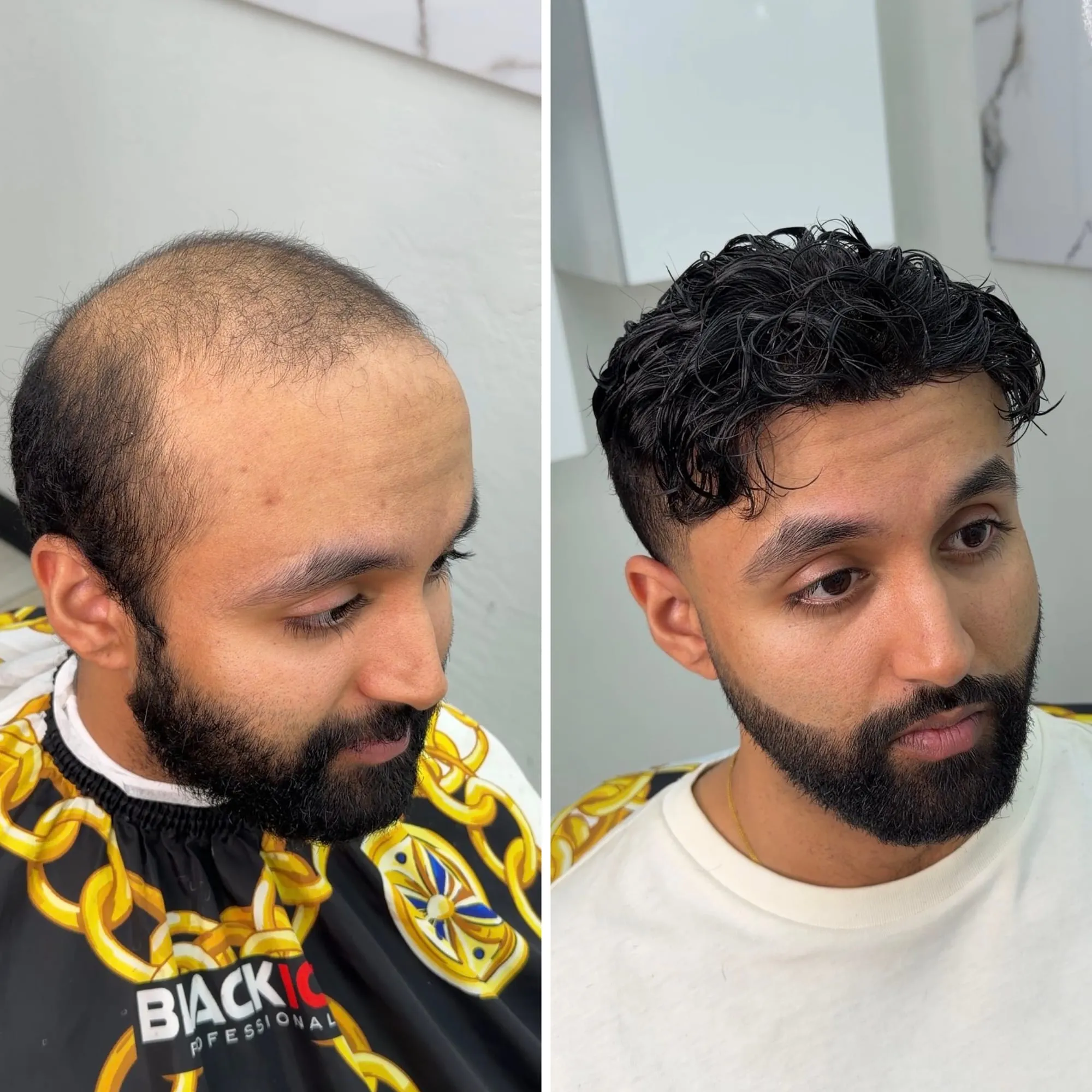
This is what it looks like.
A real client from our chair, photographed before and after his hair system was installed and cut in.
Questions, answered.
Is European hair really better than Indian or Chinese hair?
For fineness and lighter shades, yes. European hair is the finest at roughly 40 to 70 microns and takes light processing best, so it wins for blonde, grey, and the most undetectable hairlines. For dark to medium-brown units, well-sourced Indian hair often performs just as well at a more sensible tier.
Why is Chinese hair cheaper?
It is the most abundant and the coarsest, around 80 to 120 microns, so it costs less to source. Reaching a softer feel and lighter shade usually means it has to be acid-stripped and re-dyed, and it is the origin most often relabeled as a premium hair, which is why we judge it by the finished strand rather than the label.
How can I tell what origin my hair system actually is?
You often cannot from the paperwork alone, because heavily processed hair is frequently relabeled. Judge the sample instead: strand diameter, softness, whether the cuticle runs one direction, and how evenly it takes color. A finer, softer strand that holds a light shade without going brittle is the tell, not the country name.
Which hair origin is best for grey or blonde shades?
European hair, in most cases. Lighter and higher grey percentages require more lifting, and finer European hair reaches those shades while staying soft, where a coarser strand can look wiry once heavily lightened. For dark shades at #1 to #2, origin matters far less.
Why are there no prices on this page?
Because hair origin is one of several cost drivers, alongside base construction, length, density, and custom templates, and two men ordering what sounds like the same unit can need very different hair. We quote against your finished specification at consultation, with no obligation.
Keep reading
Related guides.
Options Compared
Hair systems, transplants, SMP, medication, shaving, or nothing. An honest side by side of coverage, reversibility, commitment, and upkeep.
Human vs Synthetic
Human hair vs synthetic hair systems compared by look, styling, longevity, and care, with the honest tradeoffs we walk through in our chair.
Remy vs Virgin Hair
Remy means cuticles aligned root to tip. Virgin means never chemically processed. They are not the same thing, and here is why it matters.
Color Matching
How color matching works for a hair system, and how salt-and-pepper and grey are blended so it stays believable as you age.