

Last updated October 27, 2026
The short version
An integration adds density to a head that still has hair. A full hair system supplies the hair itself. That one distinction decides almost everything else, so it is worth holding onto before the terminology gets confusing.
If you can still comb hair across the top and your problem is thinness rather than bare scalp, an integration is designed for you. If the hair is mostly gone, or the loss sits at a receded front, an integration has little to grab, and a covering unit is the more dependable route.
What integration actually means
Integration is a method, not a single product. The mesh, the open center, and the perimeter anchor are the defining features, and it is sold under several names. Integrated hair system and intralace are the common ones, and a handful of meshless builds thread very fine hair directly into your own at the edges instead of using a net. They differ in construction, but they all share the same job: blend added hair into the hair you still have.
That is the opposite of how a full hair system works. A system is a complete unit, hair tied into a lace, poly, or skin base, that sits over the whole coverage area and gives full density on its own. We cover that head to head in our integration versus hair system comparison, so here we are staying on the method itself and who it fits.
How the mesh does the work
Picture a fine net sitting just above your scalp, anchored around the edge of the thinning zone to your own hair rather than bonded to skin. The middle of that net is open. Your existing hair is drawn up through the openings so it sits on top, mixed with the extra hair that has been ventilated into the mesh. From above, the eye sees one head of hair, because most of what it is looking at is genuinely yours.
- A breathable mesh fixed around the perimeter, not glued to bare scalp
- An open center your own hair is pulled up through
- Added hair tied into the mesh to top up where you have thinned
- The whole thing cut and blended so the join disappears
Integration vs a full hair system, at a glance
A quick way to place yourself before a consultation. Read the first column as your situation, then the two approaches across. For the full factor by factor breakdown, see our dedicated comparison.
| At a glance | Hair integration system | Full hair system |
|---|---|---|
| Starting point | You still have a real amount of your own hair | Any stage, including fully bald |
| What it adds | Density around and through the hair you have | A complete head of hair on its own base |
| Your hairline | Keeps and uses the one you already have | Can build a fresh one at the front |
| How it holds | Anchored to your own hair at the edges, open in the middle | Bonded or clipped across a full base |
| Your own hair | Kept long and growing, it does half the blending | Usually kept trimmed close under the base |
Who an integration is built for
The ideal candidate is specific. You have diffuse thinning across the top, you still have a real amount of your own hair, roughly a third or more of your natural coverage, and you are happy with the hairline you have. Integration lets you add fullness while keeping and growing everything that is still there, which is a genuinely good position to be in.
The honest limit is that integration needs something to integrate with. As the surrounding hair thins past that rough one-third mark, there is not enough of your own hair to carry the blend, the mesh starts to show, and the added hair looks unsupported. It also leans on your existing front to look natural, so it cannot bring a receded hairline forward. If the front is where you have lost the most, that is a job for a hair system, not an integration.
Living with one, and keeping it tight
Day to day, an integration behaves much like your own hair. You wash it, style it, and sleep in it, with a short routine we teach you so the mesh and the added hair stay in good condition. Your own hair underneath keeps growing, which is the point, and that growth is exactly what sets the maintenance rhythm.
As your hair grows out, the perimeter anchor lifts away from your scalp, so an integration is tightened or re-anchored every several weeks rather than left indefinitely. Keeping your own hair healthy matters more here than with any other approach, because it is doing half the work of the blend. We go through the cadence and the at-home care before you commit, so none of the upkeep catches you out.
Where integration reaches its limit
Integration is the right answer for a window of hair loss, not for all of it. While you still have usable coverage, it is a smart way to stay ahead of thinning without covering the hair you have. Once loss advances, or if it is still moving quickly, the plan has to change, and that is normal rather than a failure of the method.
When that point comes, a full hair system picks up where integration stops, because it does not depend on hair you may not keep. If you are weighing the two, start with our integration versus hair system comparison and the main non-surgical hair replacement page, then come in. Nico and the team make the call with you in person at our Peoria, Arizona and Eighty Four, Pennsylvania studios, where we can actually see your density, your growth, and your hairline. We would rather fit you with what holds up for years than what photographs well for a month.
Real work
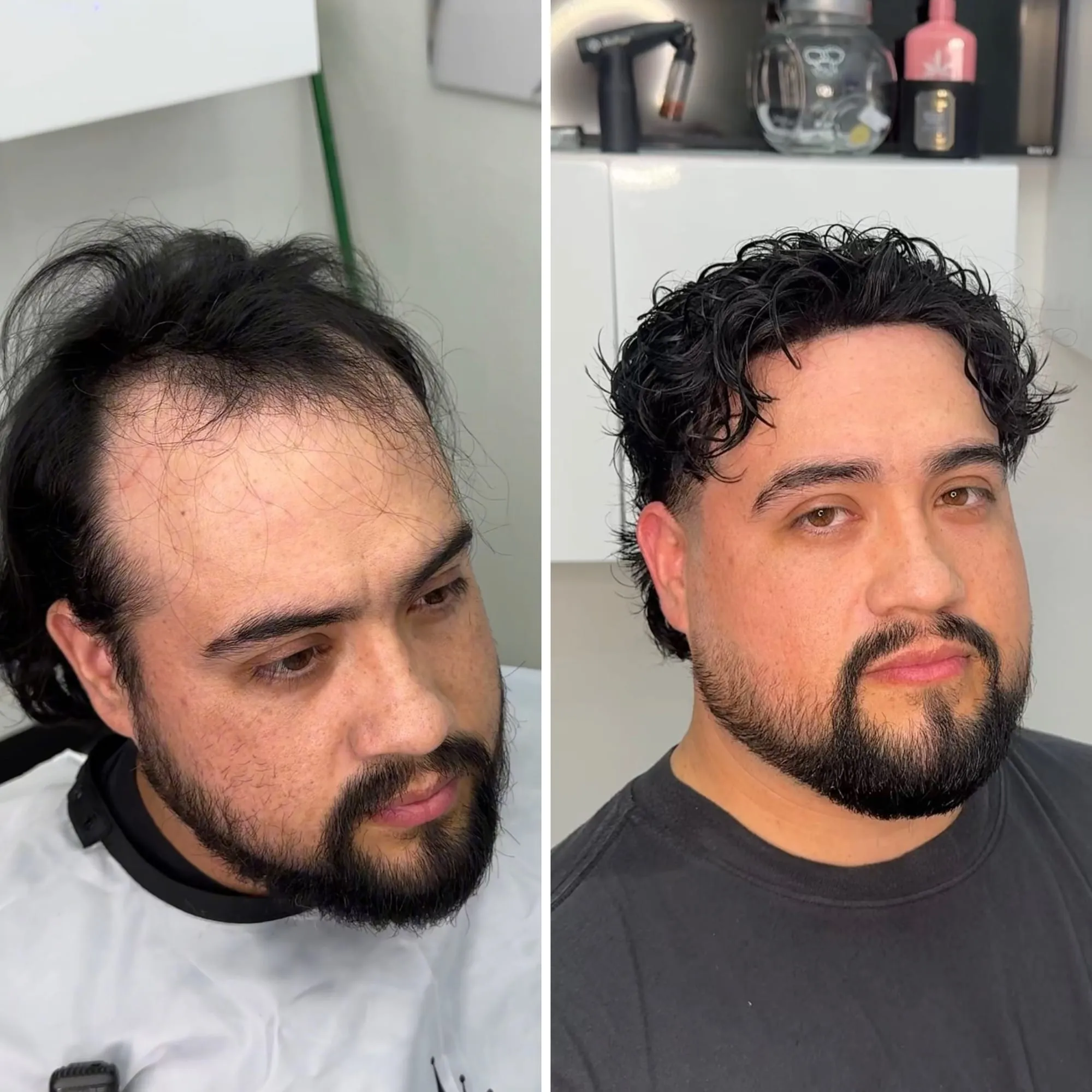
This is what it looks like.
A real client from our chair, photographed before and after his hair system was installed and cut in.
Questions, answered.
What is a hair integration system?
It is a method of adding hair for men who still have some of their own. A fine mesh is anchored over the thinning area, your existing hair is pulled up through it, and added hair tied into the mesh fills in around it, so your own hair and the added hair wear as one. It tops up the hair you have rather than replacing it.
Is a hair integration system the same as a hair system?
No. An integration blends added hair into the hair you still have and needs usable hair of your own to work. A full hair system is a complete unit on its own base that covers the area and gives full density at any stage, including a fully bald scalp. One works with your hair, the other works instead of it.
What is an intralace system?
Intralace is one brand-style name for a mesh integration. The method is the same: a fine net anchored at the perimeter with an open center your own hair passes through. Meshless builds thread very fine hair directly into your own instead of using a net, but both are forms of integration and both depend on you still having hair.
Is a hair integration system attached to my scalp?
Not to bare skin. The mesh is anchored around its edge to your own hair, usually threaded or beaded, and the center stays open. That is why men who do not want adhesive on their scalp often find integration comfortable, and why keeping your own hair healthy is part of the plan.
Can I wash and style a hair integration system normally?
Yes, with a short routine we teach you. You wash, style, and sleep in it much like your own hair, and your own hair keeps growing underneath. That growth is what sets the maintenance rhythm, since the perimeter lifts as your hair gets longer and needs tightening every several weeks.
Keep reading
Related guides.
System vs Integration
Integration pulls your existing hair through a mesh; a hair system covers the area for full density. How we pick, and who each one actually fits.
What Is a Hair System
A hair system is a custom hair unit fitted and blended into your own hair for a full, natural look. Here is how non surgical hair replacement works.
How Integration Works
Hair integration anchors a fine mesh to your own hair and blends added hair through it. Here is the full process, from consult to maintenance.
Am I a Candidate
Hair integration needs enough of your own hair to work. Here is how to tell if you are a candidate, and when a full hair system is the better route.