

Last updated October 27, 2026
The short version
Integration adds fullness by drawing your existing hair up through a breathable mesh and blending extra hair into that mesh. It tops up what you have rather than replacing it, which means your own hair is doing half the work of hiding the join. The more of it you still have, the better and the longer the blend holds.
So candidacy is not about how long you have been losing hair or how old you are. It comes down to one measurable thing: how much of your own hair is still present across the area, and whether your hairline is intact. Get those two facts straight and you know most of the answer.
The one check that decides it
You can get most of the way to an answer in front of a mirror. In bright overhead light, comb your hair the way you normally wear it and look hard at the thinning zone. The question is whether you see thin, see-through hair or actual bare skin.
If hair still covers the area and the issue is only that it reads thin or lets light through, that is the profile integration was built for. If you are looking at smooth scalp with little growing on it, there is nothing for the mesh to grip, and no amount of added hair sits naturally over bare skin. That is the same line we use in the chair.
Clear signs you are a candidate
When most of the points below describe you, integration is worth taking seriously and worth asking us about directly.
- Diffuse thinning across the top or crown rather than a defined bald spot
- Roughly a third or more of your own coverage still present in the area
- A hairline you like and want to keep, with the loss sitting behind it
- Loss that has settled and is not visibly changing year to year
- You would rather keep and grow your own hair than wear it trimmed short
- You prefer not to bond adhesive to your scalp, since integration anchors to hair
Clear signs you are not, and what we point you toward instead
We would rather say this plainly now than fit you with something that will not hold. If the picture below is closer to yours, integration is the wrong tool, and a full hair system is the route we would steer you to.
- Bare skin across the area rather than thin, see-through hair
- Most of your coverage already gone, so the mesh has little to anchor to
- A receding or thinning front, since integration leans on your own hairline to look real
- Loss that is still advancing noticeably, so any blend built now will drift out of reach
- You want a set density or a rebuilt hairline regardless of what is underneath
Why a hair system is the honest answer for the rest
A hair system does not need your own hair at all. It carries its own full-density hair on a lace, poly, or skin base and bonds over the whole area, so it works at any stage of loss, including a scalp that is completely bare. Where integration can only top up what you have, a system gives the same result whether there is thick hair, thin hair, or none underneath.
It also builds a fresh front. If your hairline is where you have lost the most, a lace or skin edge can create a natural hairline where integration cannot, because integration uses the hairline you already have. That is why we do not force integration onto an advanced loss pattern. We would rather fit the thing that holds for years than the one that photographs well for a month.
The grey area: thinning that is still moving
The trickiest candidate is the man in between, with enough hair for integration today but loss that is still progressing. Integration ties your result to your own hair, so if that hair keeps thinning, the blend you build now gets harder to hold and the plan has to keep changing to chase it.
If your loss has plateaued, that risk is low and integration can be a long, happy arrangement. If it is still moving, the steadier choice is often a hair system that does not care what happens to the hair beneath it. There is no single right answer here, which is why this part is a conversation rather than a self-diagnosis.
How we confirm candidacy in person
A mirror and this page get you to a strong guess. They cannot measure your density, judge your growth rate, read your scalp, or tell whether the thinning has settled. Those are the things that move a borderline case from yes to no, and they need a trained eye in the room.
Ivette and the team assess all of it in person at our Peoria, Arizona and Eighty Four, Pennsylvania studios, then tell you straight whether integration fits, whether a hair system is the better route, or whether you are better served waiting. There is no pressure and no obligation. The goal of the visit is a clear answer you can trust, not a sale.
Real work
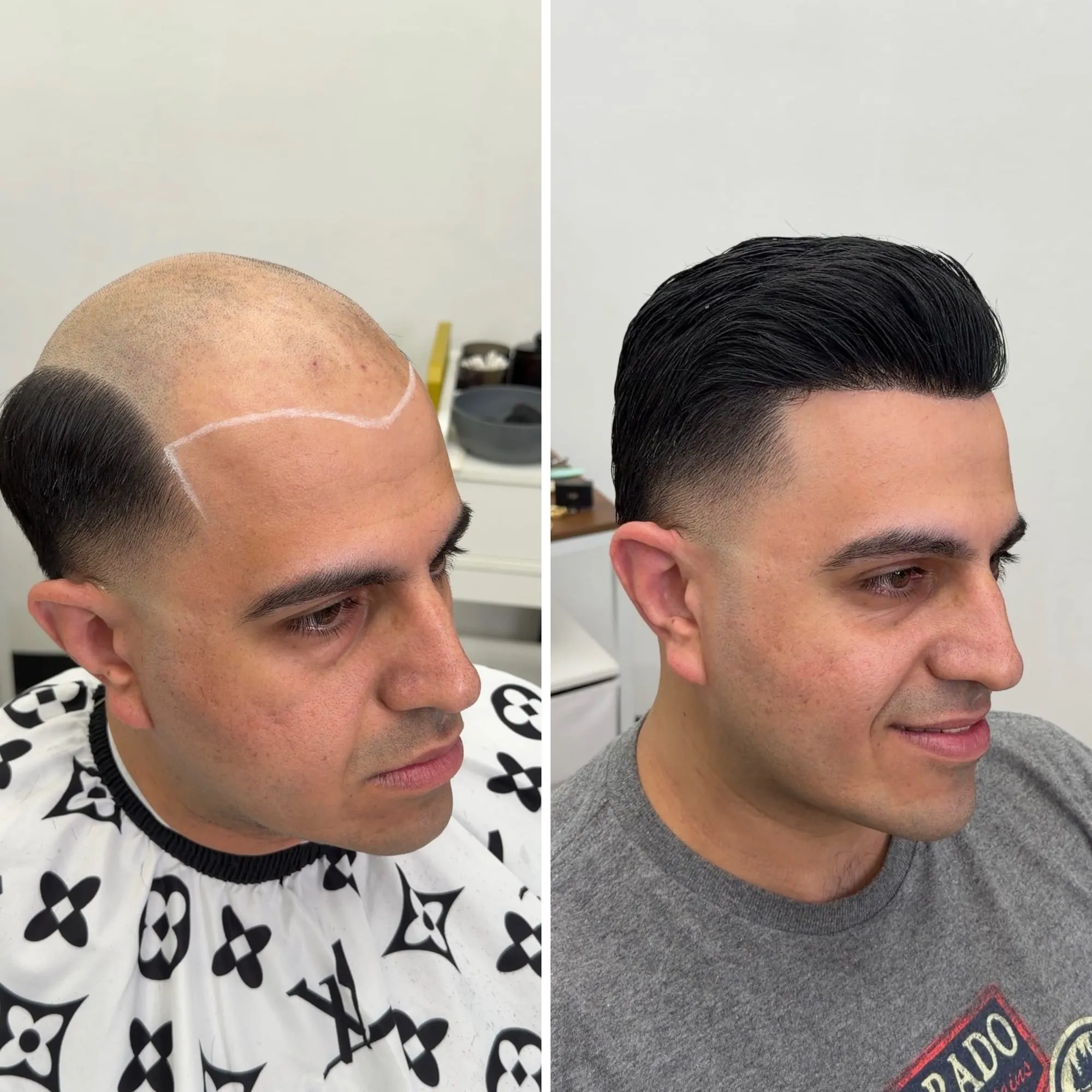
This is what it looks like.
A real client from our chair, photographed before and after his hair system was installed and cut in.
Questions, answered.
Am I a candidate for hair integration?
You are if you still have roughly a third or more of your own hair across the thinning area and a hairline you want to keep. The quick check is bare skin versus see-through hair: if hair still covers the area and only reads thin, integration can work. If you see bare scalp, it cannot.
How much of my own hair do I need for integration to work?
As a rough guide, about a third or more of your natural coverage needs to still be present. Integration blends added hair into your own through a mesh, so your hair carries the result. Below that, there is not enough to pull through, the mesh starts to show, and a hair system becomes the dependable choice.
Can I get hair integration if I am mostly bald?
No. Integration needs your own hair to grip and blend into, so a mostly bald scalp gives it nothing to work with. A hair system is the honest answer here. It carries its own full-density hair on a base that bonds over the whole area and works at any stage of loss, including a completely bare scalp.
Can integration fix a receding hairline?
No. The front of an integration relies on your existing hairline to look natural, so it cannot move a receded front forward. If the hairline is where you have lost the most, a hair system with a lace or skin front can build a fresh, natural hairline where you no longer have one. We lean toward a system whenever the front is the problem.
My hair is still thinning. Can I still get integration?
Possibly, but with eyes open. Integration ties your result to your own hair, so if the loss keeps moving, the blend gets harder to hold and the plan has to change to keep up. If the thinning has settled, you are a stronger candidate. If it is still advancing, a hair system is often the steadier route.
Keep reading
Related guides.
Integration System
A hair integration system pulls your own hair through a fine mesh and blends added hair around it, for men who still have hair. How the method works.
System vs Integration
Integration pulls your existing hair through a mesh; a hair system covers the area for full density. How we pick, and who each one actually fits.
How Integration Works
Hair integration anchors a fine mesh to your own hair and blends added hair through it. Here is the full process, from consult to maintenance.