

Last updated September 28, 2026
The core difference in one sentence
Integration works with your hair. A system works instead of it. That single distinction drives every other difference in candidacy, hairline, attachment, and upkeep, so it is worth being precise about.
In an integration, a breathable mesh is anchored around the perimeter of the thinning zone, usually threaded or beaded onto your own hair at the edges rather than bonded to bare scalp. Your existing hair is drawn up through the mesh, and extra hair is ventilated into the mesh to add volume where you have thinned. The look depends on your own hair blending with the added hair. A hair system is a complete unit: a lace, poly, or skin base with hair tied into it across the whole coverage area, bonded to the scalp with tape or adhesive, or clipped in. Under a bonded system the hair beneath is usually trimmed close so the base sits flat and undetectable.
Side by side
Here is how the two constructions compare on the factors that actually decide which one fits. Read the first column as the question, then the two answers across.
| Factor | Hair integration (mesh) | Hair system |
|---|---|---|
| What it does | Blends added hair into a mesh over your existing hair | Covers the area with a full-density unit of its own |
| Best candidate | Diffuse thinning with roughly a third or more of your own coverage still present | Any stage, from early thinning to fully bald |
| Relies on your own hair | Yes, it is the point; no donor hair left means nothing to pull through | No, it stands alone regardless of what is underneath |
| Front hairline | Uses your existing front, so it cannot move a receded hairline forward | Builds a fresh, undetectable hairline with a lace or skin front |
| Attachment | Threaded or beaded to your own hair at the perimeter, open through the middle | Tape or adhesive bond across the base, or clips, over the coverage zone |
| Added density | Tops up what you have, so the result tracks your remaining density | Full density built into the unit, commonly in the 100 to 130 percent range |
| Reattach or tighten | Perimeter rises as your hair grows, so it needs tightening every 6 to 10 weeks | Reattached on a 2 to 4 week cadence for a bonded unit, longer for clip-in |
| Own hair maintained | Kept and grown, since the blend depends on it | Usually trimmed close under a bonded unit for a flat base |
Who integration is actually for
Integration is a genuinely good answer for a specific person: someone with diffuse thinning across the top who still has a real amount of their own hair and a hairline they are happy to keep. If you can still comb hair over the area and the problem is density rather than bald skin, an integration lets you add fullness while keeping and growing your own hair. Because it anchors to your hair and not to scalp, it also suits men who cannot or do not want to bond adhesive to their skin.
The honest limit is candidacy. Integration needs something to integrate. As a rough guide, once thinning passes the point where roughly a third of your natural coverage remains, there is not enough of your own hair to carry the blend, and the mesh starts to show or the added hair looks unsupported. It is also poorly suited to a receded or bald frontal zone, because the front of an integration leans on your existing hairline to look natural. If your hairline is where you have lost the most, integration cannot rebuild it.
Mesh and meshless integration are not the same
The word integration covers two builds, and they behave differently. Mesh integration uses a fine net, sometimes called an intralace, fixed around the perimeter with an open center your own hair passes through. It is the more robust of the two and holds up to daily wear well, but the mesh is a physical layer, so fit and tension matter.
Meshless integration skips the net and instead threads very fine lines or micro-strands into your existing hair, or clips a thin section in. It can feel lighter and lower profile, but it leans even harder on your own hair to hide the attachment points and to carry density, which narrows the candidacy further. Both approaches share the same ceiling: the more hair you have lost, the less either one can do, and at that point a covering hair system is the more reliable answer.
What a hair system does that integration cannot
A hair system is indifferent to how much hair you have. Because the base carries its own full-density hair and the front can be built as a fine lace or a shaved-down skin edge, a system can create a hairline where you no longer have one and give a consistent, dense result across an area that is completely bald. That is the whole reason it works for advanced loss, alopecia, and post-transplant coverage where integration has nothing to grip.
It also decouples your result from the state of your own hair. With integration, if your remaining hair keeps thinning, the blend gets harder to hold and the plan has to change. A system does not care whether the hair underneath is thick, thin, or gone, so it gives a more stable long-term picture for men whose loss is still progressing. The trade is that a bonded system usually means keeping the hair under it trimmed close, where integration keeps your own hair long and growing.
Attachment, upkeep, and how the two feel to live with
Day to day, the biggest practical difference is the maintenance cycle. An integration is tied to your growth. As your own hair grows out, the perimeter anchor point lifts away from your scalp, so integrations are tightened or re-anchored on a schedule that tends to land in the 6 to 10 week range depending on how fast you grow. A bonded hair system is on a shorter loop, usually reattached every 2 to 4 weeks as the adhesive bond ages, though a clip-in unit can go longer between full resets.
Comfort and cleaning differ too. Integration leaves the center open, which many men find breathable, but the perimeter anchors sit against hair that has to be handled gently to avoid tension. A system sits as one continuous base, which is why base material choice, lace for airflow, skin for a clean edge, poly for durability, matters so much. Neither is hard to live with once you know the routine, and we teach the exact routine for whatever you leave with.
Cost drivers, ranked
Both options carry the same handful of cost drivers, and we walk through them openly at a consultation rather than posting a number that would not match your build. Ranked roughly by how much they move the figure: custom hair length over six inches, European hair, a fully custom template or mesh cut to your head, a silk top or other realism upgrade at the front, and higher density. Integration and system pricing both flex on these, so the honest figure comes from your actual specification, not a chart.
How we choose in our chair
We start with two questions, not with a product. First, how much of your own hair is still there, and is it stable or still thinning. Second, is your hairline intact or receded. If you have real coverage, a hairline you like, and thinning that has settled, integration is worth a serious look because it keeps and uses your own hair. If your loss is advanced, still moving, or concentrated at the front, a hair system is the more reliable answer because it does not depend on hair you may not keep.
Nico, Ivette, and Denisse make this call with you in person at our Peoria, Arizona and Eighty Four, Pennsylvania studios, because it depends on things a page cannot see: your density, your growth rate, your scalp, and how you want to live. There is no pressure either way. We would rather fit you with the thing that holds up for years than sell you the one that photographs well for a month.
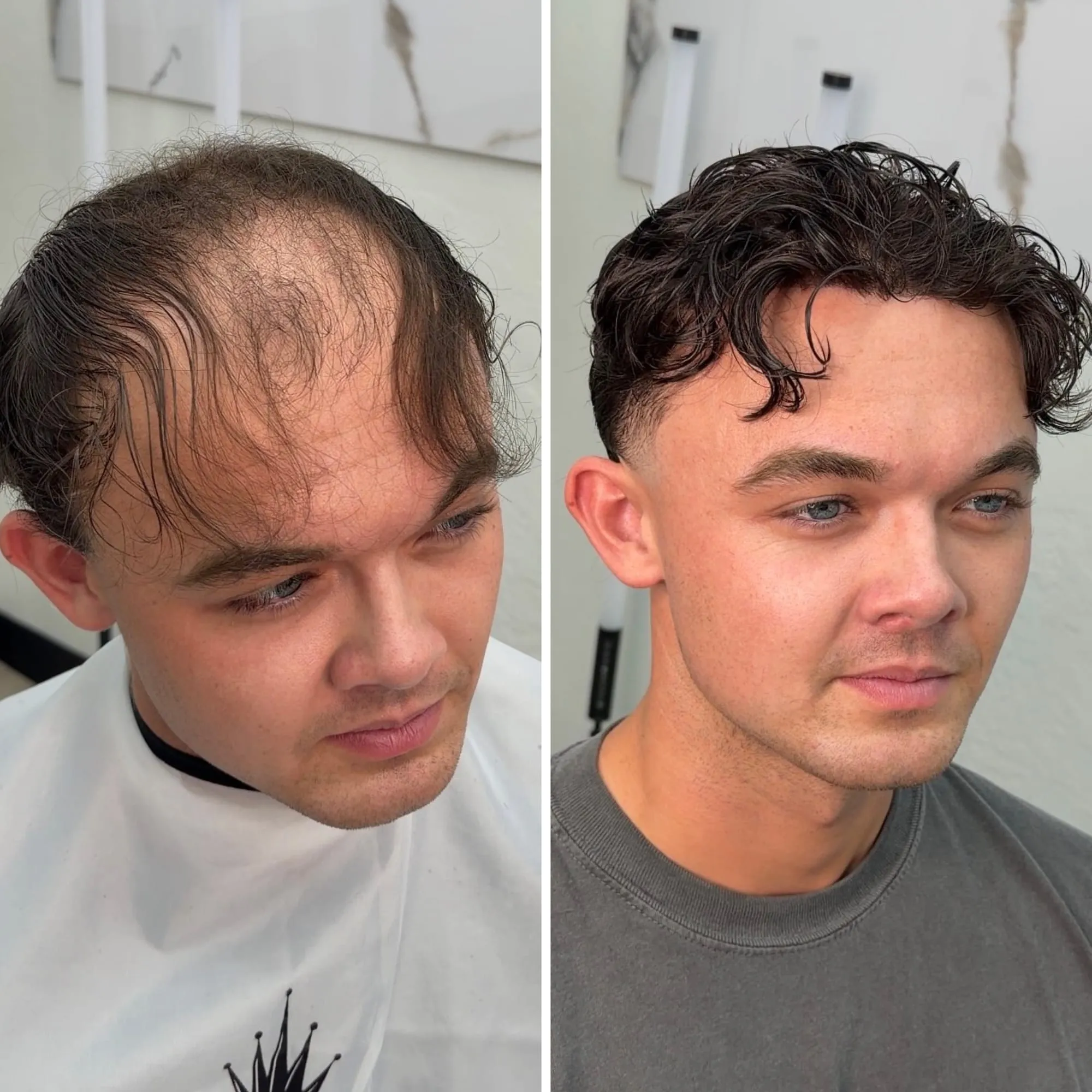
Real work
This is what it looks like.
A real client from our chair, photographed before and after his hair system was installed and cut in.
Questions, answered.
What is the difference between a hair integration system and a hair system?
An integration pulls your existing hair up through a fine mesh and blends added hair into that mesh, so it needs usable hair of your own to work. A hair system covers the area with its own full-density base and works at any stage, including a fully bald scalp. Integration works with your hair; a system works instead of it.
Am I a candidate for hair integration?
Integration suits diffuse thinning where roughly a third or more of your natural coverage is still present and your hairline is intact. If you have lost most of your hair, or the loss is concentrated at a receded front, there is not enough to pull through the mesh, and a covering hair system is the more dependable choice.
Can hair integration rebuild my hairline?
No. The front of an integration relies on your own existing hairline to look natural, so it cannot move a receded hairline forward. A hair system with a lace or skin front can build a fresh, undetectable hairline where you no longer have one, which is why we lean toward a system when the front is the problem.
Does a hair system damage or replace my existing hair?
Under a bonded system your own hair is usually trimmed close so the base sits flat, but it is not removed and grows back if you stop. Integration keeps your hair long because the blend depends on it. Neither treats or regrows hair; both cover cosmetically, and we protect the hair you have with the routine we teach.
Which needs more upkeep, integration or a hair system?
They run on different cycles. An integration is tightened as your own hair grows out, typically every 6 to 10 weeks, while a bonded hair system is reattached every 2 to 4 weeks as the adhesive ages. A clip-in system can go longer. We match the cadence to your routine and show you exactly how to maintain whichever you choose.
Keep reading
Related guides.
Integration System
A hair integration system pulls your own hair through a fine mesh and blends added hair around it, for men who still have hair. How the method works.
Options Compared
Hair systems, transplants, SMP, medication, shaving, or nothing. An honest side by side of coverage, reversibility, commitment, and upkeep.
What Is a Hair System
A hair system is a custom hair unit fitted and blended into your own hair for a full, natural look. Here is how non surgical hair replacement works.
The Hairline
A natural hair system hairline is built from irregularity, a soft density gradient, and careful placement. Here is how we design one that reads as yours.
Density Guide
How much density actually reads as real hair by age and face, and why over-dense systems look fake. A practical density guide from our chair.