

Last updated October 27, 2026
The short version
Integration builds on your hair instead of covering it over. A fine mesh is fixed to the perimeter of your thinning area, your own hair is pulled up through it, and added hair tied into the mesh fills in the density you have lost. The top is then cut and blended as one. That is the difference from a full hair system, which carries its own base across the entire area and does not depend on the hair underneath.
- A consult and an honest assessment of how much of your own hair there is to work with
- A template and a custom mesh, ventilated with added hair matched to your color and density
- Fitting day, when the mesh is anchored at the perimeter and your own hair is drawn up through it
- A cut-in and blend that fuses your hair and the added hair into one
- A tightening cadence that keeps pace with your own hair as it grows
Step one: the consult and the hair assessment
Everything starts with what you still have, because integration has nothing to build on without it. At the consult we look at how much of your own hair is left across the top, how it is distributed, and whether the loss has settled or is still moving. Diffuse thinning with a real amount of coverage still present is the sweet spot, and a hairline you are happy to keep matters too, since integration uses your existing front rather than rebuilding it.
This is also where we are honest about fit. If the thinning has passed the point where enough of your own hair can carry the blend, or the loss sits mostly at the front, we will say a covering hair system is the more reliable route rather than start an integration that will not hold up.
Step two: the template and the custom mesh
Once integration is the right call, we take a template. Unlike a full hair system, where the mold captures the whole scalp, an integration template maps the thinning zone and the ring of healthy hair around it that the mesh anchors to, because that perimeter is load-bearing. From that template your mesh is built, a fine breathable net sometimes called an intralace, with added hair ventilated into it by hand and matched to your own color, texture, and a believable density rather than the maximum it could hold. Overloading density is the fastest way to make hair replacement look bought instead of grown.
Step three: fitting day, anchoring the mesh and drawing your hair through
On fitting day the mesh goes on. Rather than bonding to bare scalp with tape or adhesive the way a hair system does, an integration is anchored to your own hair around the perimeter, usually threaded or beaded along the edges of the thinning zone. The center is left open.
Then your own hair is drawn up through the openings so it sits on top, mingled with the added hair rather than trapped beneath it. This is the mechanical heart of integration and the reason it only works with hair of your own. Your hair and the added hair end up in the same plane, which lets them move and part together. A bonded hair system, by contrast, trims the hair underneath close.
Step four: the cut-in and blend
With everything in place, the piece is still not finished, and the cut-in is the step that makes an integration disappear. Your artist cuts the added hair and your own hair together, grading the density at the edges so there is no line where the mesh starts and no shelf where added hair meets your own, with length and parting dialed in on your head in one sitting. Done well, you cannot find the transition by looking or by running a hand through it, which is why the same mesh can look seamless in one chair and obvious in another.
Living with an integration: the maintenance cadence
The one rhythm integration adds to your life comes from your own hair growing. Because the mesh is anchored at the perimeter, that anchor point lifts away from your scalp as your hair grows out, so the piece is tightened or re-anchored on a schedule that usually lands in the 6 to 10 week range depending on how fast you grow. Leave it too long and the perimeter can start to show.
Between visits you wash and style much like your own hair, with a few gentle habits we teach. Because your own hair is doing part of the work, keeping it healthy keeps the integration looking right, and we set the cadence and routine to you at the fitting rather than hand you a generic rule.
Real work
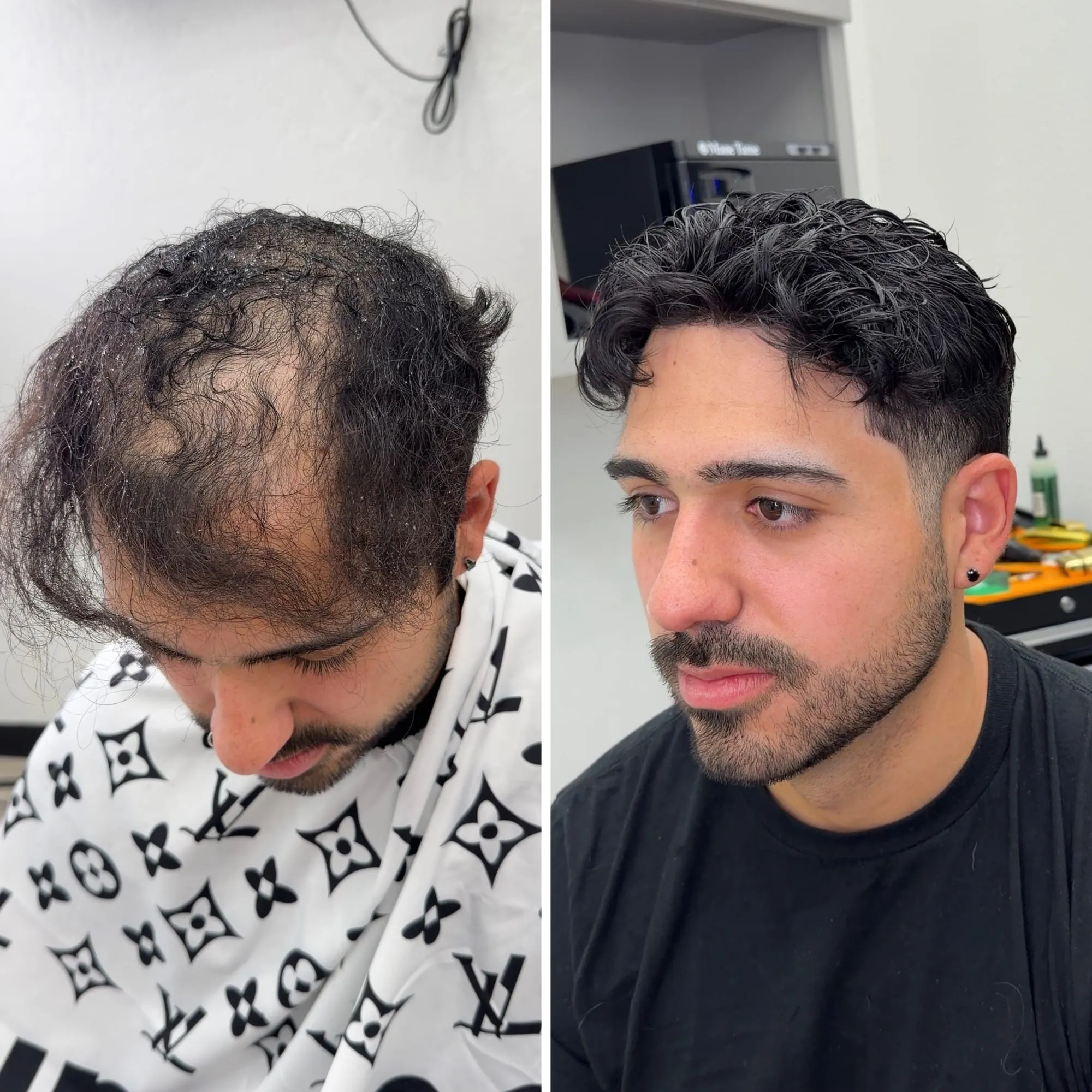
This is what it looks like.
A real client from our chair, photographed before and after his hair system was installed and cut in.
Questions, answered.
How does a hair integration attach to your head?
It anchors to your own hair, not your scalp. A fine mesh is threaded or beaded onto the ring of hair around the thinning area, and your existing hair is pulled up through the openings to blend with added hair tied into the mesh. The hold comes from your own hair at the perimeter, so no adhesive is bonded to bare skin.
Does hair integration damage your own hair?
It does not have to, and protecting your hair is part of the point. The perimeter anchors sit against your own hair, so it has to be handled gently and tightened on schedule to keep tension from building up. Because the blend depends on your hair staying healthy, we teach the exact routine to protect it.
How often does a hair integration need to be tightened?
Usually every 6 to 10 weeks, set by how fast your own hair grows. As it grows out, the anchored perimeter lifts away from your scalp, so a tightening visit brings it back down and keeps the mesh invisible. We agree the cadence with you at the fitting.
Can I wash and style my own hair normally with an integration in?
Yes, with a few adjustments we show you. You shampoo, dry, and style much as you did before, being gentle around the perimeter anchors and the added hair. The point of integration is that your own hair stays in play, so normal washing and styling are expected.
Is hair integration the same as a hair system?
No. An integration works with your existing hair and needs a real amount of it to blend. A hair system carries its own full-density base across the whole area and works at any stage, including a fully bald scalp. Integration builds on your hair; a system stands on its own.
Keep reading
Related guides.
Integration System
A hair integration system pulls your own hair through a fine mesh and blends added hair around it, for men who still have hair. How the method works.
System vs Integration
Integration pulls your existing hair through a mesh; a hair system covers the area for full density. How we pick, and who each one actually fits.
What to Expect at Your Consultation
Your first hair replacement consultation, step by step: the assessment, your options, and the plan you leave with. No pressure, no obligation.