

You do not have to wait until you are bald
A lot of men assume a hair system is only for someone who has lost most of their hair. It is not. Diffuse thinning, where the hair is still there but has lost body and coverage across the top, is one of the situations a system handles most naturally, precisely because there is so much of your own hair left to blend into.
The advantage of acting at this stage is the blend. When your surrounding hair is still dense, the edge of a unit has plenty to hide under, colour and texture have a clear reference to copy, and the finished cut has real hair to disappear into on every side. That is a harder thing to fake once the surrounding hair has gone.
How we add density in our chair
We start by looking at where you have thinned and where you are still holding, because thinning is rarely even. From there the unit is sized to sit over the areas that have opened up and feathered into the fuller hair around them, rather than stopping at a border that would show once your own hair is thinner than the piece.
Density is the decision that makes or breaks a thinning-hair result. It is tempting to go thick, but hair that is heavier than your age and build would give is the fastest way to look like you are wearing something. We build to a density that sits just above where you are now, so you look like a fuller version of yourself, not a different person.
- Density matched to your age and build, not maxed out
- The unit feathered into fuller hair instead of a hard edge
- Colour and texture matched to the hair still growing
- Both layers cut as one style so there is no visible seam
Blending two layers so they move as one
The trick with thinning hair is that your own hair and the unit have to behave like a single head. If the direction, the parting, or the movement is off, the eye catches two layers even when the colour is perfect. So we set the unit to follow how your own hair already falls, then cut through both together.
Because your existing hair is doing so much of the blending, its condition matters. Keeping it healthy and cut to work with the piece is part of the plan, not an afterthought. When the two are cut as one, added density looks like the hair you had a few years ago, not a layer sitting on top of the hair you have now.
Working with hair you still have, not against it
This is the honest difference between early-stage and later-stage work. We are not rebuilding a whole head. We are adding coverage where the top has thinned and letting the hair around it carry the frame. You keep your own hairline hair, your own sides, and your own movement, and the unit fills in the density you have lost.
Some men picture a solid patch dropped over a thin spot, and that is not what this is. A well fitted system for thinning hair has no obvious start or stop, because it is tied into a head that still has plenty of its own hair to hide the transition.
What it means as your own hair keeps changing
Thinning is not static, and we are straight with men about that. The hair you have now may continue to change over the years, and the good news is a system adapts with it. Density and coverage can be adjusted at maintenance, and the unit can be rebuilt to cover more if the surrounding hair thins further down the line.
Starting while you still have hair does not lock you into anything. It gives you a natural result now and a flexible base to adjust later, which is a calmer position to be in than waiting until there is little left to blend into.
What drives cost and upkeep for thinning hair
Cost is driven by the same factors as any hair replacement: the base material, the type of hair, and how often you come in for maintenance. A unit for thinning hair is often lighter than a full piece, but the blend into a head of existing hair takes real skill, so the value sits in the work as much as the materials.
Upkeep is steady. Your own hair keeps growing under and around the unit, so maintenance is partly about recutting the two layers back into one style as your hair moves. We are upfront about that rhythm before you commit so nothing about the ongoing schedule catches you out.
Is a system right for thinning hair specifically
If your hair has thinned across the top but you still have a solid frame of your own hair, a system suits you well, because the whole approach depends on having hair to blend into and you have it. You add density where you have lost it and keep everything that is still working.
The honest way to find out is a consultation. We look at how much hair you have and where, check how it falls, and tell you plainly whether adding density with a system is the right call for you right now. If it is not, we will say so.
Real work
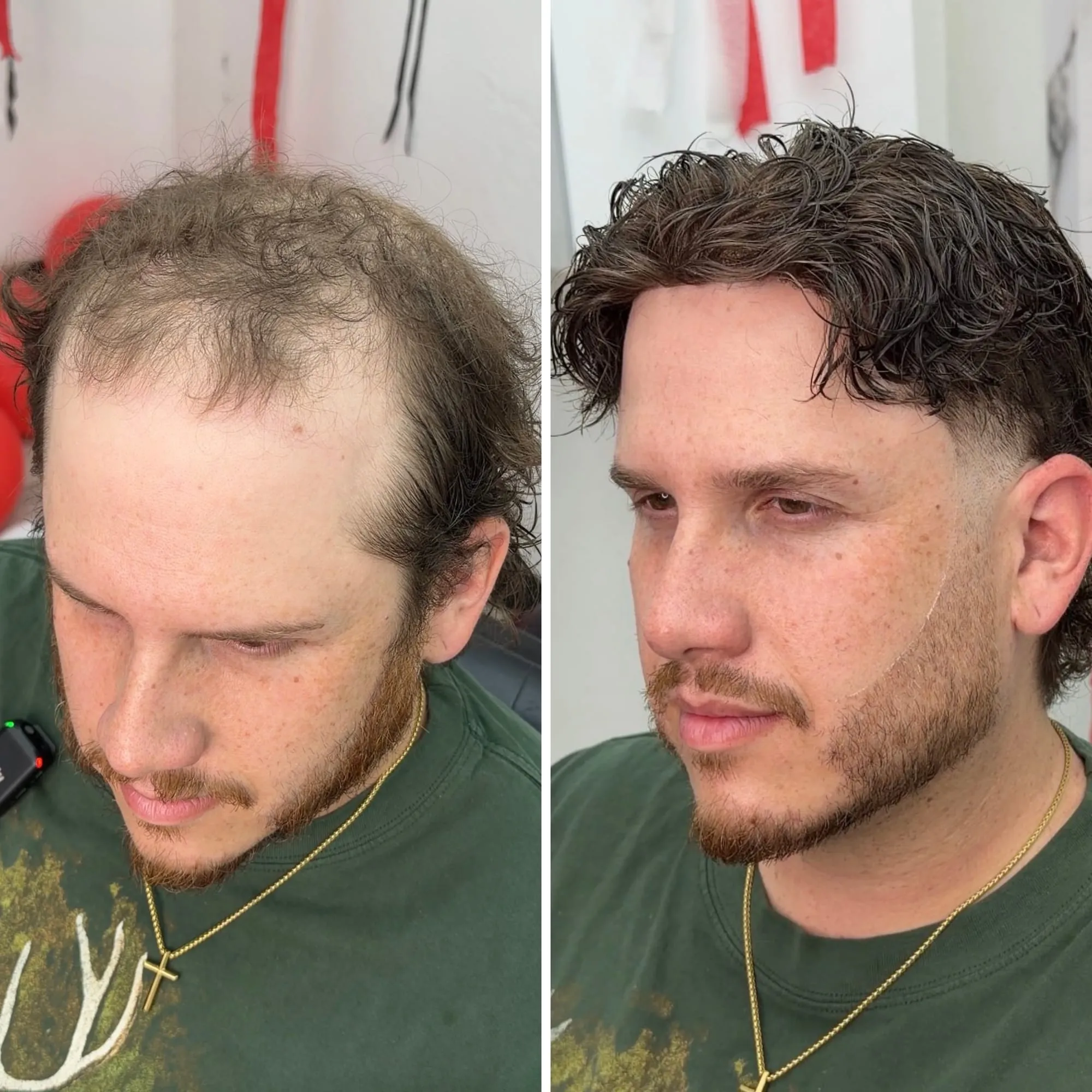
This is what it looks like.
A real client from our chair, photographed before and after his hair system was installed and cut in.
Questions, answered.
Can I get a hair system if I am thinning but not bald?
Yes, and it is often the easiest time to do it. With plenty of your own hair still growing, the unit has more to blend into, so a light-to-moderate density piece reads as thicker hair rather than added hair.
Will added density look obvious next to my own hair?
Not when it is built and cut correctly. We match density, colour, texture, and direction to the hair you still have and cut both layers as one style, so there is no visible line between them.
What happens if my own hair keeps thinning?
The system adapts. Density and coverage can be adjusted at maintenance, and the unit can be rebuilt to cover more if the surrounding hair thins further. Starting now does not lock you in.
How much density should I add?
Just above where you are now. Going heavier than your age and build would naturally give is the most common way a result starts to look worn rather than grown, so we build for believable, not maximum.
Keep reading
Related.
Thinning Crown
How a hair system covers a thinning crown without surgery: coverage over the vertex blended into the hair around it, whorl and all.
Receding Hairline
How a hair system rebuilds a receding hairline without surgery: a front built where your hairline used to sit and blended into your own hair.