Last updated September 28, 2026
What a system does, and what it does not do
Trichotillomania, sometimes described as hair pulling, is a body focused behavior, and a hair unit does not treat it. It is not a medicine, it is not therapy, and it is not a diagnosis. What a system does is cover the affected area, so the visible side of what you are dealing with has an answer you control while you work on the rest.
We are hair replacement artists, not doctors or therapists. The behavior and any tenderness or irritation on your scalp belong with a physician, dermatologist, or mental health professional, and we are glad to work alongside whatever care you already have. We will never tell you a unit will stop the urge, cure the condition, or regrow what has been pulled.
Why a bonded unit sits differently
Loss from pulling tends to be irregular, showing up as thin spots or a wider area where the same place keeps getting worked. A system is cut and blended to cover that, so the eye reads an even head of hair instead of the bare spots underneath.
The physical difference with a bonded unit is the part worth understanding. It is attached to the scalp as a single continuous surface rather than clipped into loose strands, so at the covered area there is no individual hair standing proud to isolate and take hold of. The affected scalp is no longer exposed at the surface. Whether that changes the urge is between you and your clinician, and we make no promise there, but the coverage is real and it is under your control the moment the unit is on.
Working with areas that keep changing
Pulling does not always stay in one place. A spot can settle for a while, hair can fill back in, and then a different area can start to thin, and that can make any fixed plan feel wrong within weeks. A system is one of the more forgiving options for exactly this reason, because it is not permanent and it is not committed to your scalp staying the same.
If a new area opens up, coverage can be extended. If hair grows back in a spot, the fit can be adjusted or the surrounding hair reworked into the blend. We would rather set that expectation plainly at the start than fit you to a single snapshot that stops matching what your scalp is actually doing.
- Coverage sized to irregular spots, not just a clean hairline
- A bonded surface with no loose hair on top of the covered area
- Fit that can be resized as areas open up or fill back in
- A plan that assumes your scalp may keep changing
- Medical and behavioral care left to your own clinician
Comfort on a scalp that may be tender
Repeated pulling can leave the scalp sore, irritated, or sensitive in the spots that get the most attention, and that matters when a unit is bonded to the skin rather than clipped into hair. We test how your scalp responds to adhesive before committing to a routine, because comfort over a tender area is not something to guess at.
If the skin is broken, inflamed, or actively sore, that is a health question to settle with your doctor before any attachment goes on. We will hold off rather than bond over skin that needs to heal first. The plan is built around your scalp being comfortable, then the look, in that order.
What drives cost and upkeep
Cost is driven by the base material, the type of hair, the size of the area being covered, and how often you come in for maintenance. Covering a wider affected area uses more material than a small spot, and finer, more skin like bases ask more than sturdier ones, so the right balance depends on your scalp and your daily life rather than any fixed number.
Upkeep is a rhythm, not a one time thing. The bond loosens over time and the hair needs cleaning and cutting like any hair does, so regular maintenance is what keeps the coverage looking the way it did on day one. We are upfront about that cadence before you commit so none of it is a surprise later.
Deciding if this is right for you
If you are living with trichotillomania and you want a way to look like yourself again while you and your clinician work on the behavior, a system is a genuine cosmetic option worth considering. It hands you control over the visible side today without asking you to wait on anything.
The honest way to know is a consultation. We look at your scalp in person, talk through what your affected areas are doing and how they feel, and tell you plainly whether a unit fits your situation right now. If it is not the right call yet, we will say so.
Real work
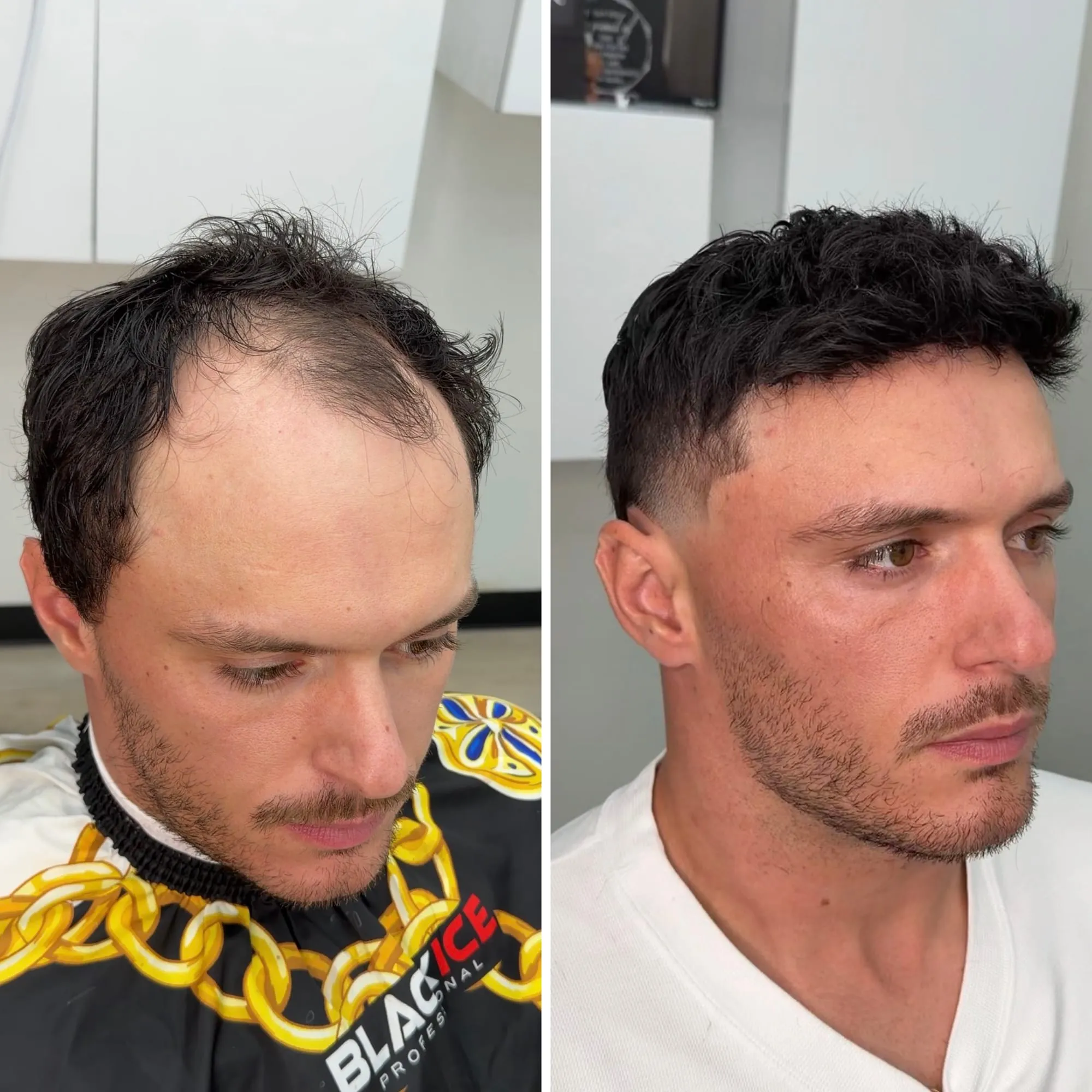
This is what it looks like.
A real client from our chair, photographed before and after his hair system was installed and cut in.
Questions, answered.
Will a hair system stop me pulling or treat trichotillomania?
No. A system is a cosmetic covering, not a treatment, a therapy, or a diagnosis. It changes how the affected area looks, not the behavior behind it. The pulling itself belongs with a physician or mental health professional, and we are happy to work alongside that care.
Can a system cover the irregular spots pulling leaves?
Yes. A unit is cut and blended to cover thin spots or a wider worked area, and because it bonds down as one continuous surface the eye reads even hair rather than the bare spots underneath. Coverage can be resized as areas change.
Does a bonded unit remove access to the hair?
At the covered area, yes in a physical sense. The unit is a single continuous surface bonded to the scalp, so there is no individual loose hair standing proud to isolate. Whether that changes the urge is between you and your clinician, and we make no promise there.
Is a system comfortable if my scalp is tender?
That is what we check first. We test how your scalp reacts to adhesive and build the plan around comfort. If the skin is broken or inflamed, we hold off and ask you to settle that with your doctor before any attachment goes on.
Keep reading
Related.
Alopecia Areata
The comes-and-goes case with unpredictable regrowth. How to decide between a partial hair system blended into your own hair or full coverage.
Alopecia
How a hair system covers alopecia-related loss, whether patchy or full scalp, without surgery. What is realistic, and what to ask your doctor.
Traction Alopecia
How a hair system covers traction loss along the hairline, temples, and nape when the interior is intact. A cosmetic option, not a treatment.
Thinning Hair
Thinning but not bald? A hair system can add density and blend into the hair you still have. How early-stage hair systems work, from our chair.