

Last updated September 28, 2026
Why areata is a different decision from other loss
Most hair loss moves in one direction and stays where it lands. Alopecia areata does not. Patches can appear over a few weeks, fill back in on their own, and then show up somewhere else entirely, which is exactly what makes it hard to plan around. A single small patch on the crown is a very different situation from several patches that keep opening and closing across the scalp.
That unpredictability is the whole reason the coverage decision matters here. We are hair replacement artists, not doctors, so we do not diagnose areata or promise anything about whether your hair returns. What we can do is fit the scalp in front of us today and build a plan that expects it to keep changing rather than one that quietly assumes it will hold still.
Option one: blend a partial unit around your own hair
When you have one or two stable patches and strong healthy hair around them, a smaller unit can be sized to the patch and blended into the hair you still have. Your own hair overlaps the edge, so there is no visible border, and you keep most of your growing hair in play. This is the lighter-touch route and it feels the least like a big change.
The catch is that it depends on the hair around the patch staying put. If areata is active and the surrounding hair is what starts shedding next, the blend that looked seamless last month can leave an exposed edge. A partial unit suits patches that have settled down, not ones that are still opening.
- Best when patches are few, stable, and settled
- Keeps most of your own growing hair
- Relies on the surrounding hair holding for the blend to hide the edge
- Can be resized if a single patch grows or shrinks
Option two: commit to full coverage
When patches are widespread, keep migrating, or the surrounding hair is thinning too, full coverage is often the calmer choice. Instead of chasing each patch, the unit builds a full head of hair from the hairline back and stops depending on where the areata is this week. The design of the hairline becomes the detail that makes it read as yours.
It sounds like the bigger commitment, and in coverage it is, but for an unpredictable scalp it is frequently the more stable and lower-stress option. You are no longer re-planning every time a new patch opens, because the coverage does not care where the patches are. Many people who start with a partial unit move to full coverage once they are tired of adjusting to a moving target.
- Best when patches are widespread, active, or migrating
- Coverage no longer tracks where individual patches sit
- One consistent look regardless of what the scalp is doing
- Less re-planning as new patches open or old ones fill in
How the patches move should drive the call
The honest deciding factor is not how much hair you have lost, it is how busy your scalp is. A calm scalp with a couple of old patches leans toward a partial blend. A scalp that is actively opening new patches leans toward full coverage, because chasing an active pattern with small units tends to mean constant rework.
If your patches are filling back in, that is genuinely good news, and it is a reason not to over-commit before things settle. We would rather talk you through waiting or starting partial than sell you more coverage than your scalp currently calls for. This is also a conversation to have with your physician or dermatologist, since the pattern and cause matter for your health well beyond the cosmetic side.
Fitting a scalp with bare patches
Areata patches are usually smooth skin rather than scarred tissue, which means attachment sits partly on bare scalp. How your skin reacts to adhesive matters more than it would over a full head of hair, so we test that response before settling on a routine. If a patch is inflamed or you are mid flare, we hold off on that spot rather than push through.
Comfort comes first and the look comes second, because a unit that irritates a patch is one you will stop wearing. If your scalp is sensitive or you are managing active flares, tell us plainly and we will build the attachment plan around that instead of around hold alone.
What drives cost and upkeep
Cost is driven by how much area you are covering, the base material, the type of hair, and how often you come in for maintenance. A partial unit over one patch uses less material than full coverage, but if your scalp is active you may be adjusting a partial unit often enough that the steadier route is worth weighing. The right balance depends on your pattern and your daily life, not a fixed number.
Upkeep is a rhythm rather than a one time thing. The bond loosens over time, the hair needs cleaning and cutting like any hair does, and with areata a partial fit may need reworking as the surrounding hair changes. We are upfront about that cadence before you commit.
Deciding if this is right for you
If you are living with alopecia areata and want to look like yourself again while you and your doctor handle the medical side, a hair system is a genuine cosmetic option. The choice between a partial blend and full coverage is the real work, and it turns on how active your patches are rather than on any single rule.
The honest way to decide is a consultation. We look at your scalp in person, talk through what the patches have been doing, and tell you plainly whether a partial unit or full coverage fits, or whether it is worth waiting. If a system is not the right call right now, we will say so.
Real work
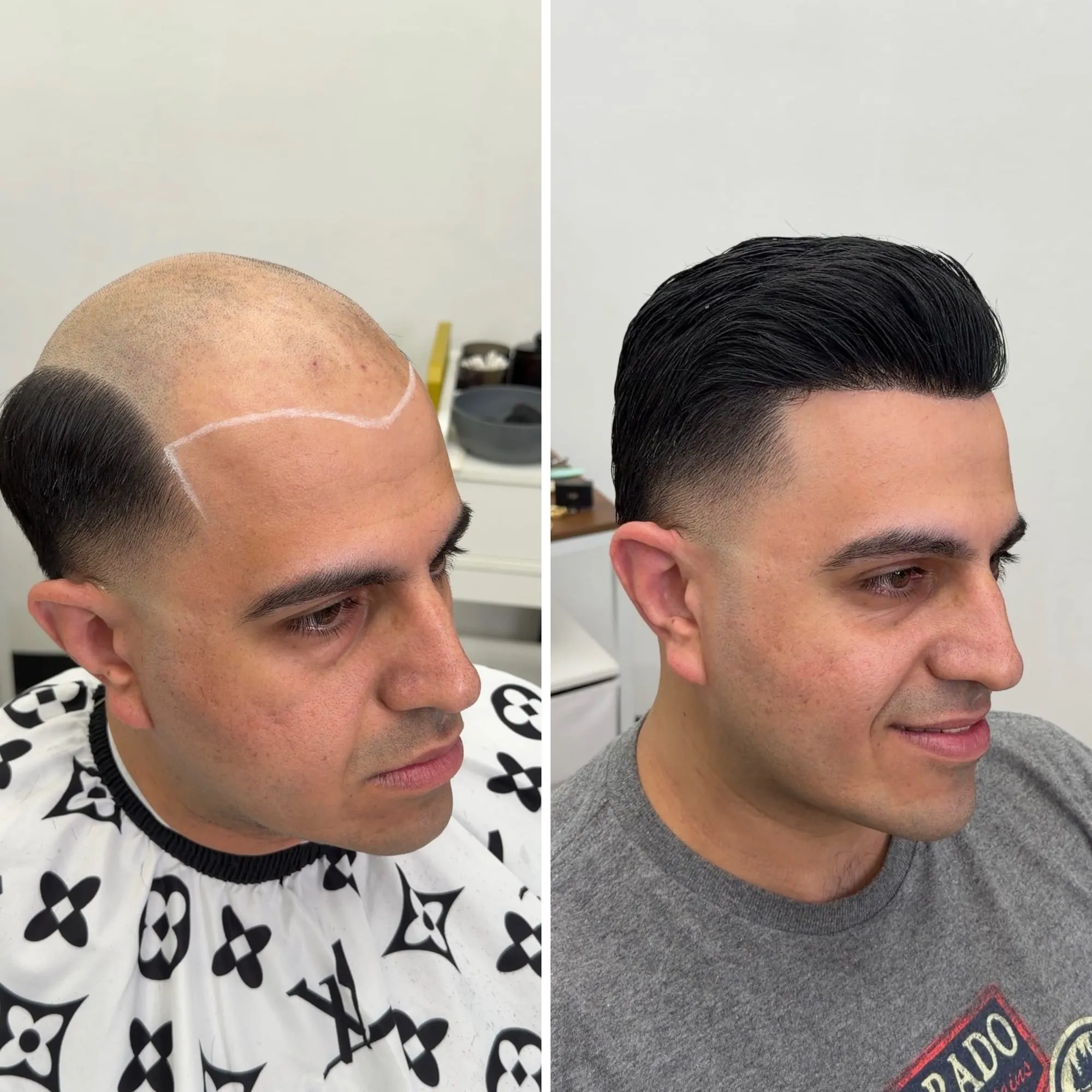
This is what it looks like.
A real client from our chair, photographed before and after his hair system was installed and cut in.
Questions, answered.
Should I get a partial unit or full coverage for alopecia areata?
It depends on how active your patches are, not how many you have. Few stable patches with strong hair around them suit a partial blend. Widespread, migrating, or active patches usually suit full coverage, because it does not track where the patches sit.
What happens to a partial unit if a new patch opens next to it?
A partial blend relies on the surrounding hair to hide its edge, so if that hair sheds you can get an exposed edge. It can be resized, but a scalp that keeps opening new patches is often better served by full coverage.
Will a hair system treat or regrow my alopecia areata?
No. A system is a cosmetic covering, not a medicine or a diagnosis. It changes how the patches look, not the condition causing them. For the medical side, speak with a physician or dermatologist, and we are glad to work alongside that.
My patches keep filling back in. Should I still get a system?
Maybe not yet, and we will tell you so. If patches are settling on their own, that is a reason not to over-commit. A partial approach or waiting can make more sense than full coverage until your scalp calms down.
Keep reading
Related.
Alopecia
How a hair system covers alopecia-related loss, whether patchy or full scalp, without surgery. What is realistic, and what to ask your doctor.
Alopecia Totalis
How a full-cap hair system covers alopecia totalis when there is no anchor hair left. Honest talk on base size, wear cycle, and reattachment.
Scarring Alopecia
How a hair system covers the look of scarring alopecia over scar tissue, without surgery. Cosmetic coverage; medical stays with your doctor.
Thinning Hair
Thinning but not bald? A hair system can add density and blend into the hair you still have. How early-stage hair systems work, from our chair.