

Last updated September 28, 2026
Why the edge, not the crown, changes everything
Traction alopecia comes from tension on the hair rather than from a pattern set inside the follicle. Years of tight braids, extensions, cornrows, buns, or ponytails pull steadily on the follicles at the perimeter, and the loss shows up exactly where the pull was hardest: a receding or broken frontal line, thinning at the temples, bare zones behind the ears, and a softened nape. The hair in the interior, which was never under that load, usually stays thick.
That is close to the opposite of most pattern loss, which starts on top and works outward. It is why a unit designed for a bald crown is the wrong tool here. The job is not to build a whole head of hair, it is to restore a missing outline around hair you still have, and that is a different build from the base up.
Covering an edge that has already scarred
Almost everything written about traction alopecia is dermatology about prevention: loosen the styles, vary the tension, catch it early. That advice matters, and it is worth following, but it stops at the point most people actually reach us. Once an edge has been under tension long enough that the skin there looks smooth and shiny with no fine stubble coming through, styling changes no longer bring the line back. Whether any of it can recover is a question for your dermatologist, not for us.
This is the gap a hair system fills. We are hair replacement artists, not doctors, so we make no claim to treat, reverse, or regrow the follicles tension has worn out. What we can do is cover that scarred or smoothed edge cosmetically, rebuilding the hairline and the perimeter so the loss is not the first thing anyone sees.
A unit built for the perimeter, not the whole head
The spec for traction loss is smaller and more precise than a full-scalp unit. A perimeter or partial hair system sits over the thinned outline and carries its own hair to rebuild the frontal line, the temple corners, and the nape, while your intact interior either shows through an open area or blends over the top. Because the front edge is where every eye lands, we lean on the finest, most skin-like base material right at the hairline so the new line reads as growth from the scalp.
It takes more finesse in a smaller space than a full unit does across a bald head. The measurements follow the shape of your remaining hair, the density is dialled to sit level with your interior rather than heavier, and the temple angles are cut to frame your face the way your own line once did.
Blending into the hair you still have
With a dense interior to work into, the whole result lives or dies on the blend. The border is hidden where the unit's hair overlaps your growing hair, so there is no visible seam between the rebuilt edge and the top you kept. Match the density and the direction of that interior and the eye simply reads one head of hair.
This is also why traction loss and afro-textured hair often come up together, since tight protective styling is a common cause. Curl pattern and direction are part of the blend, and getting the rebuilt edge to move the way your own hair moves is as important as the hairline shape itself.
- A perimeter build shaped to the outline, not a full-scalp unit
- A hairline and temple line rebuilt to frame your face
- Density matched to your intact interior so nothing looks heavy
- Attachment placed to spare the follicles still holding at the edge
- No claim to treat, reverse, or regrow what tension wore out
Attachment around a tender, tension-worn edge
The skin along an old tension line can be smooth, sensitive, or reactive, and there is often a fringe of fragile hair still hanging on right at the border. Both change how we attach. We plan the bond so it holds cleanly over the covered zone without loading tension back onto the follicles that survived, because re-creating the exact pull that caused the loss is the last thing anyone wants.
Before we settle on any routine we test how your scalp takes adhesive, and we build the plan around comfort first. If your dermatologist has flagged the area as still recovering, we work around that guidance rather than over it.
What drives cost and upkeep
Cost is driven by how much of the perimeter you are covering, how fine the base is at the front, the hair type and how closely it has to match your interior, and how often you come in for maintenance. A perimeter unit uses less material than a full build, but the front work is more exacting, so the right balance depends on your outline and your daily styling rather than a fixed figure.
Upkeep is a rhythm. The bond loosens over time and the hair needs washing and cutting the way any hair does, so a regular maintenance cadence is what keeps the rebuilt edge sitting the way it did on the first day. We are clear about that cadence before you commit so none of it is a surprise.
Deciding if this is right for you
If tension has taken your hairline, temples, or nape and your own hair on top is still strong, a perimeter hair system is a genuine way to look like yourself again without surgery and without waiting. It gives you control over how the edge looks today while you and your dermatologist handle the rest.
The honest way to know is a consultation. Nico Rigano, Ivette Rigano, or Denisse Diaz will look at your edge in person at our Peoria, AZ or Eighty Four, PA studio, talk through what your hair is doing and how the skin feels, and tell you plainly whether a system fits. If it is not the right call, we will say so.
Real work
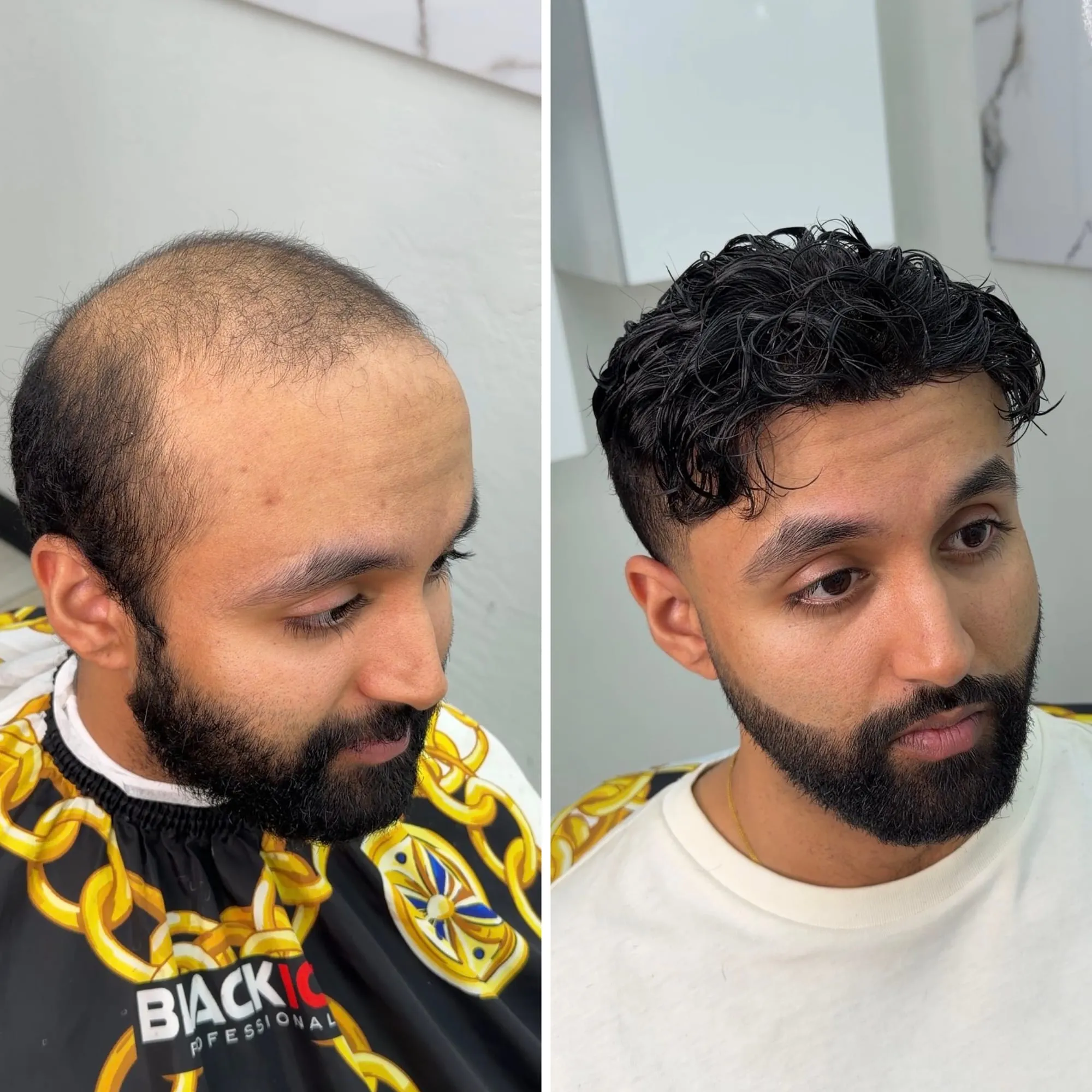
This is what it looks like.
A real client from our chair, photographed before and after his hair system was installed and cut in.
Questions, answered.
Can a hair system cover traction alopecia along my hairline?
Yes. A perimeter hair system rebuilds the frontal line, temples, and nape where tension thinned them, and blends into the denser hair you kept on top. It covers how the edge looks, it does not treat the condition.
Will a hair system treat or reverse traction alopecia?
No. A system is a cosmetic covering, not a medicine, and it makes no claim to reverse or regrow follicles that tension has worn out. Whether any early loss can recover is a question for your dermatologist.
Do I need a full unit if only my edges are gone?
Usually not. When the interior is intact, a smaller perimeter or partial unit covers just the thinned outline and blends into your own hair, rather than building a full head you do not need.
Could attaching a unit make the traction worse?
We plan the attachment to avoid loading tension back onto the hair still holding at the edge, since that pull is what caused the loss. We test how your scalp takes adhesive and build the routine around comfort first.
Keep reading
Related.
For Black Men
How a hair system is matched to coil and curl pattern, density, and skin tone for Black men, so the result reads as your own textured hair.
Afro-Textured Hair
Most stock hair systems ship straight or wavy, so a true coily or kinky match almost always means a custom-ordered unit built to your curl pattern.
Scarring Alopecia
How a hair system covers the look of scarring alopecia over scar tissue, without surgery. Cosmetic coverage; medical stays with your doctor.
Receding Hairline
How a hair system rebuilds a receding hairline without surgery: a front built where your hairline used to sit and blended into your own hair.