Last updated September 28, 2026
Why the intent here is cover, not treat
Scarring alopecia, which a doctor may call cicatricial alopecia, is different from the more common patterns of loss. The follicles in the affected area are not dormant or waiting to be stimulated, they have been replaced by scar tissue, so nothing grows there again. That is exactly why a hair system fits this situation so cleanly as a cosmetic choice: it is not trying to bring anything back, it is simply covering an area that will stay bare.
Doctors group several conditions under this heading, including lichen planopilaris, central centrifugal cicatricial alopecia (often shortened to CCCA), discoid lupus, folliculitis decalvans, and frontal fibrosing alopecia. Whatever the specific label your dermatologist gives you, the cosmetic question in our chair is the same: how do we cover the scarred zone so it looks like a normal head of hair. We do not diagnose, stage, or treat any of these. That work belongs to your physician.
How adhesive behaves on scar tissue
This is the honest technical difference with scarring alopecia, and it is worth being plain about. Scar tissue does not behave like the rest of your scalp. It can be smoother and shinier, it often produces less of the natural oil that ordinary skin does, and its texture can vary from soft to firm across a single area. All of that changes how an adhesive grips, how long a bond holds, and how the skin underneath feels while it is worn.
We do not guess at any of this. Before we commit to a routine, we test how your scalp and the scarred area respond to adhesive, and we choose the attachment around what we actually see rather than a default. Some scarred skin holds a bond well, some needs a gentler product or a different placement so the strongest hold sits over healthier skin at the perimeter. The goal is coverage that stays put without asking the scar tissue to do more than it comfortably can.
Working with an uneven scalp contour
Scarring can leave the surface of the scalp uneven. An area might sit slightly raised, slightly sunken, or firmer than the skin around it, and a base that is cut for a smooth scalp will not lie flat over that. When a base does not sit flat, you get lifting at the edges and a shape that catches the light, which is the opposite of what makes a unit disappear.
The fix is a proper template, a mold taken of your scalp as it actually is, so the base is built to your real contour instead of an idealized one. That is standard in careful hair replacement work, and with scarring alopecia it is the step that matters most. A base shaped to the true surface follows the dips and rises, sits flat across the scarred zone, and lets the hairline and the blend do their job without a visible border.
- Attachment chosen from a real test on your scalp, not a default
- The strongest bond placed over healthier skin where it makes sense
- A template that captures the true, uneven contour of the scarred area
- A base built to lie flat so the edges do not lift or catch light
- A hairline designed to read as though it grew from your head
The medical side stays with your doctor
We are hair replacement artists, not doctors, and scarring alopecia is a place where that line matters. Some of these conditions can be active and inflamed at times, and some settle into a stable, burnt-out phase where the scarring is set. Which phase you are in is a medical question, and whether it is sensible to bond a unit over a given area is one we want your physician or dermatologist in on, not one we decide alone.
If your condition is still active or your scalp is irritated, the sensible order is to let your doctor guide that first, then look at coverage once things are stable and comfortable. We are glad to work alongside your medical team, and we will never tell you a unit will calm inflammation, heal scarring, or bring back a single follicle. It covers the appearance. That is the whole and honest claim.
What drives cost and upkeep
Cost is driven by the base material, the type of hair, the size of the area being covered, and how often you come in for maintenance. Scarring alopecia often adds the templating step and, depending on how the scar tissue holds a bond, a more careful choice of adhesive and reattachment cadence, so the right balance depends on your scalp and your daily life rather than a fixed number we could quote before seeing it.
Upkeep is a rhythm rather than a one time thing. The bond loosens over time and the hair needs cleaning and cutting the way any hair does, so regular maintenance keeps the coverage looking the way it did on day one. When part of the attachment sits over scar tissue, we watch how that bond behaves over the first few visits and adjust the routine so the hold stays reliable and the skin stays comfortable.
Deciding if this is right for you
If you are living with scarring alopecia and you want a way to look like yourself again while your doctor manages the condition itself, a hair system is a genuine cosmetic option worth considering. It gives you control over your appearance today, over an area you already know is not going to fill back in on its own.
The honest way to know is a consultation. Nico Rigano, Ivette Rigano, and Denisse Diaz look at your scalp in person at our Peoria, AZ and Eighty Four, PA studios, feel how the scarred area sits, and tell you plainly whether a system fits your situation and how attachment is likely to behave. If it is not the right call for you, we will say so.
Real work
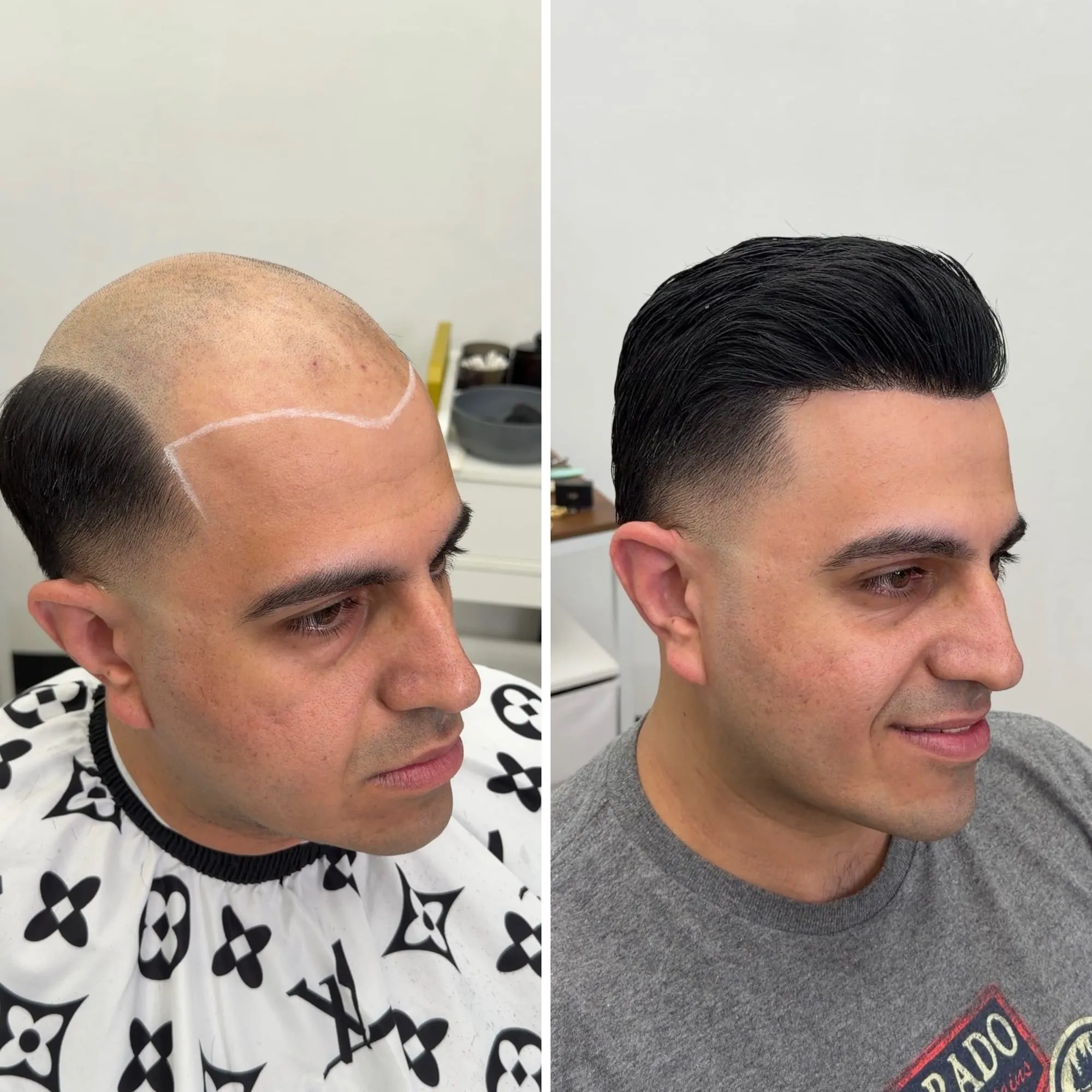
This is what it looks like.
A real client from our chair, photographed before and after his hair system was installed and cut in.
Questions, answered.
Can a hair system regrow hair on a scarred area?
No. In scarring alopecia the follicles in the scarred area are permanently gone, so nothing regrows there. A hair system does not treat or regrow anything. It covers the appearance of the scarred zone so it looks like a normal head of hair.
Does adhesive stick to scar tissue?
It can, but scar tissue behaves differently from normal scalp, so we test how your skin responds before settling on a routine. We choose the adhesive and placement around what we see, sometimes anchoring the strongest hold over healthier skin at the edges.
My scalp is uneven where it scarred. Can a unit still sit flat?
Yes. We take a template, a mold of your scalp as it actually is, so the base is built to your real contour rather than a smooth one. A base shaped to the true surface follows the dips and rises and sits flat so the edges do not lift.
Should I see a doctor before getting a hair system?
Yes. Scarring alopecia is diagnosed and managed by a physician or dermatologist, and whether your condition is active or stable is a medical question. We work alongside your doctor and cover the appearance once your scalp is stable and comfortable.
Keep reading
Related.
Alopecia
How a hair system covers alopecia-related loss, whether patchy or full scalp, without surgery. What is realistic, and what to ask your doctor.
Not a transplant candidate
Turned down for a hair transplant? A hair system covers diffuse or low-donor loss without surgery. What a no usually means and what to do next.
Hair Transplant Scars
How a hair system covers the look of FUT strip scars, FUE dots, and depleted donor areas across the top of the scalp. What it can and cannot reach.
Alopecia Areata
The comes-and-goes case with unpredictable regrowth. How to decide between a partial hair system blended into your own hair or full coverage.