

Last updated September 28, 2026
Why stock units rarely match coily hair
The ready-made hair replacement supply chain is built around straight to loosely waved hair, and most of the curl options that do exist are approximations rather than true coils. That is a stocking decision, not a comment on your hair, but it is the reason a walk-in, same-day unit almost never fits afro-textured hair honestly. A curl that is close but not matched still moves differently and reflects light differently than your own.
This is the point most people are not told up front. A studio that mostly fits straight European hair can sell you a stock unit quickly, but for a defined curl or a tight coil that speed usually costs you the match. Getting the texture right is worth the extra step, because texture is the first thing the eye reads and the hardest thing to disguise after the fact.
What a true match actually means
Matching afro-textured hair is more than picking a curl off a swatch card. Your pattern has a specific tightness, a way it clumps into coils, and a spring back that has to be met rather than approximated, and it changes how the hair behaves when it is cut short. We look at how your hair coils at the length you want to wear, then order or build the unit to sit and move the same way.
If you want the detail behind how curl and coil families are graded, our curl and wave chart lays out the pattern scale we work from so you can see where your own hair sits before a consultation. On this page the point is simpler: the closer the unit's pattern is to yours, the less there is for the eye to catch at the join.
- Curl or coil pattern matched to your own, not the nearest stock option
- Spring and clump behaviour met so the hair moves like yours
- Density set to read full for coily hair without packing it solid
- Colour, undertone, and any grey matched at the hairline and part
Why coily texture usually means a custom order
For most afro-textured patterns the honest route is a unit ordered or built to specification rather than adapted from stock. That means the base, the hair, the curl pattern, and the density are chosen for you, and it takes time to produce because the hair is ventilated into the base by hand to hold your pattern. We are clear about that lead time at the start so the wait is planned, not a surprise.
A custom order is not the studio upselling you. It is what a genuine coily match requires, and it is the difference between a unit that looks like it grew from your scalp and one that reads as a piece sitting on top. When someone has been sold a mismatched stock unit before, this is usually why it never looked right no matter how well it was cut in.
Keeping the pattern through wear and washing
Coily and kinky hair holds its shape beautifully but asks for specific handling once it is a unit, because the same tight pattern that reads as full can also tangle or lock if it is washed and dried the wrong way. We show you how to cleanse, condition, and dry the unit so the curl stays defined instead of matting, and we set a maintenance rhythm that keeps the pattern crisp.
This is cosmetic upkeep, not a fix for anything on your own scalp. If thinning or a receding front is part of why you are here, that is worth raising with your physician or dermatologist for the health side, while the unit handles how the coverage looks day to day. We are glad to work alongside that and we will never tell you a unit treats or regrows anything.
Getting matched in our chair
The way to know whether a coily match is right for you is a consultation where we look at your hair in person, identify your curl pattern, and talk through what you want it to do. It is fair to ask any studio directly whether they have ordered custom units for texture like yours, because afro-textured hair is a specialty and a shop set up for straight hair will struggle with it.
If a custom-matched system is the right call, we order it to your pattern and tell you plainly what the lead time and upkeep will take. If it is not the right call for you, we will say so. Either way you leave the consultation knowing exactly what a real match involves rather than guessing.
Real work
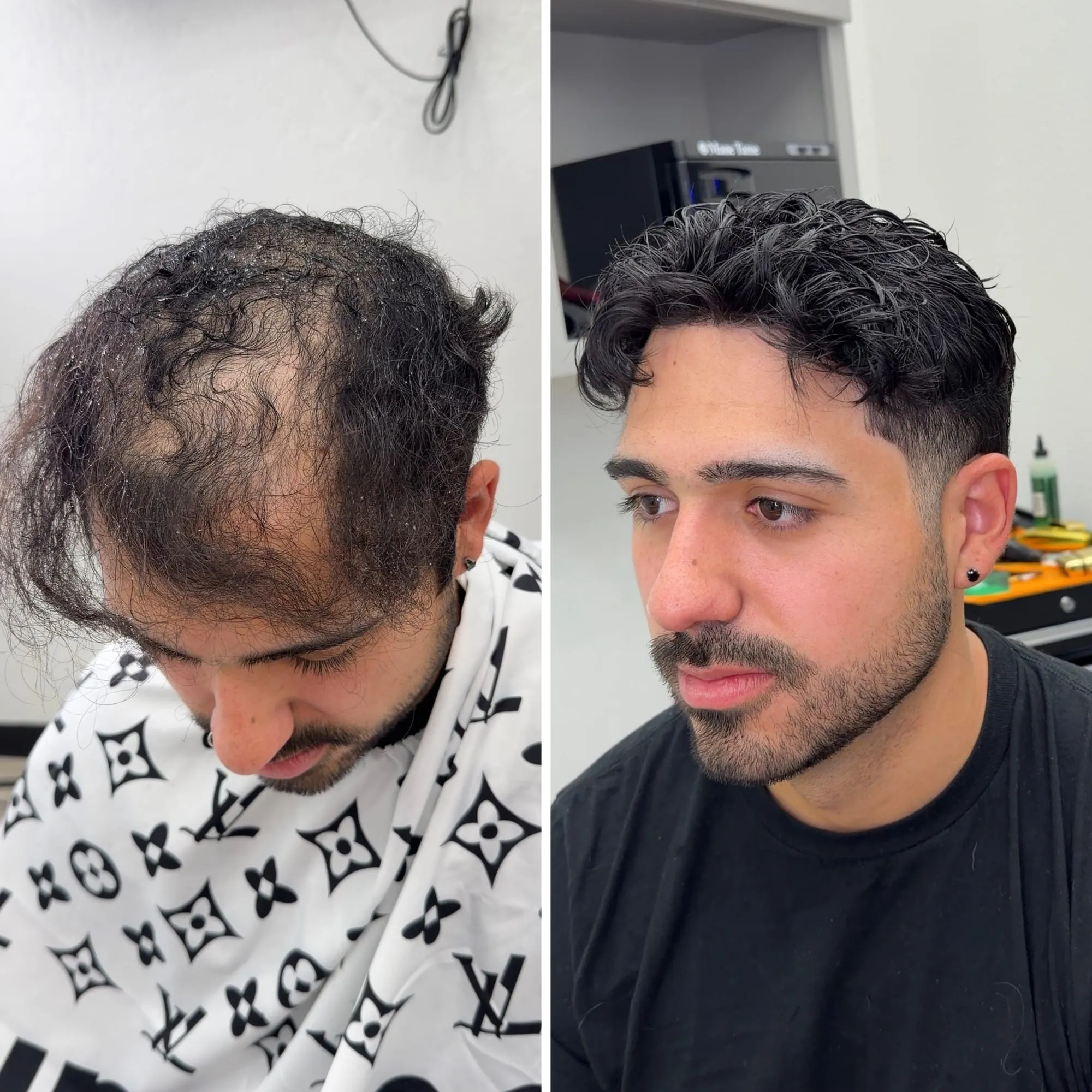
This is what it looks like.
A real client from our chair, photographed before and after his hair system was installed and cut in.
Questions, answered.
Can a hair system match tight coily or kinky hair?
Yes, but almost always as a custom-ordered unit rather than a stock one. Most ready-made systems ship straight or wavy, so a true coil is built to your specific pattern so the spring, clump, and movement match your own hair.
Why can I not just buy a coily unit off the shelf?
The stock supply chain is built around straight to loosely waved hair, and the curl options that exist are usually approximations. A pattern that is close but not matched moves and reflects light differently, so the eye finds the seam. A custom order is what a genuine coily match takes.
Does a custom unit take longer to get?
Yes. A custom afro-textured unit is ventilated to your pattern by hand, so it takes time to produce. We are clear about that lead time at the start so the wait is planned rather than a surprise.
How do I keep coily hair from tangling once it is a unit?
Coily hair holds its shape well but can mat if it is washed or dried the wrong way. We show you how to cleanse, condition, and dry the unit so the curl stays defined, and we set a maintenance rhythm that keeps the pattern crisp.
Keep reading
Related.
For Black Men
How a hair system is matched to coil and curl pattern, density, and skin tone for Black men, so the result reads as your own textured hair.
Traction Alopecia
How a hair system covers traction loss along the hairline, temples, and nape when the interior is intact. A cosmetic option, not a treatment.
Receding Hairline
How a hair system rebuilds a receding hairline without surgery: a front built where your hairline used to sit and blended into your own hair.
Thinning Hair
Thinning but not bald? A hair system can add density and blend into the hair you still have. How early-stage hair systems work, from our chair.