

Why textured hair is a specialty, not an afterthought
A lot of hair replacement is built and stocked around straight or lightly waved European hair, because that is the volume market. For a man with a tight coil or a defined curl, a unit made from the wrong texture never sits right no matter how skilled the fit is. The pattern does not match, the way it catches light does not match, and the eye picks that up.
That is exactly why texture has to be the first decision, not a detail sorted out at the end. We start from your hair and work outward: what your curl or coil pattern actually is, how tightly it springs, and how it behaves when it is cut short. Everything after that, the base, the density, the hairline, follows from getting the texture honest.
Matching curl and coil pattern
Textured hair covers a wide range, from a loose wave through a defined curl to a tight coil, and each one has to be sourced or ordered to match rather than approximated. A system that is one step too loose or too tight against your own hair creates a seam the eye can find, even when the colour is perfect.
In practice that means we look closely at how your hair coils, how it clumps, and how it sits when it is at the length you want to wear. We match the unit to that, then cut and shape it so it moves the same way your own hair does.
- Curl and coil pattern matched to your own, not a nearest-available guess
- Density set to look right for textured hair rather than piled on
- Hair chosen so it clumps and catches light the way yours does
- Cut and shaped to move with your existing hair, not against it
Density, and why more is not better
One of the most common mistakes with textured hair is overloading density to look full. Real hair, cut short and coiled, reads as full without being packed solid, and a unit that is too dense looks like a helmet the moment it is on.
We set density to match how your own hair grows in the areas around the unit, then feather it so there is no sudden wall of hair where the system starts. For a lot of Black men that means a lighter, more honest density than they expect, and it is what keeps a fresh fade or a short cut looking like it grew that way.
The hairline and the fade
The hairline carries most of the realism, and for textured hair the shape of that line is specific. A lot of men want a defined edge, a clean front, and the option to keep a crisp lineup, and the front of the unit has to be built to allow that rather than fighting it. We cut the front to sit where a natural hairline sits for your face and set it up so a barber can edge it without exposing the base.
Blending into a fade is its own piece of the work. Because a fade takes the sides and back down to skin and climbs into the longer hair on top, the unit has to marry into that transition cleanly. We work with how you wear your fade, or with your barber, so the system lives inside the haircut instead of sitting on top of it. Some people still call this kind of added hair a man weave, but a properly matched, cut-in system is a long way from that idea.
Colour, skin tone, and the base
Colour matching for Black hair is not only about the black itself. It is about the undertone, any grey coming through, and how the base of the unit reads against your scalp where the hair parts or where the front meets skin. A base that is too light against darker skin shows at the hairline, so the material and its shade are chosen to disappear against your scalp, not a generic one.
The base material is a trade off you should understand before anything is ordered. A finer, more see-through front gives the most invisible hairline but asks for gentler handling and more regular attention. A slightly sturdier base lasts longer and takes more day-to-day wear. We walk you through which side of that line fits your routine, your climate, and how you like to wear your hair.
Finding the right studio for textured hair
This is the honest part. Not every hair replacement studio has real experience with tight coils and curls, and a shop that mostly fits straight European hair will struggle to match your texture. It is fair to ask directly whether a studio has worked with hair like yours and to see real clients from their chair with texture close to your own.
In our chair we treat textured hair as a specialty, because it is one. If a system is the right call for you, we match it properly and tell you plainly what it will take to maintain. If it is not the right call, we will say so. The way to find out is a consultation where we look at your hair in person and talk through what you want it to do.
Real work
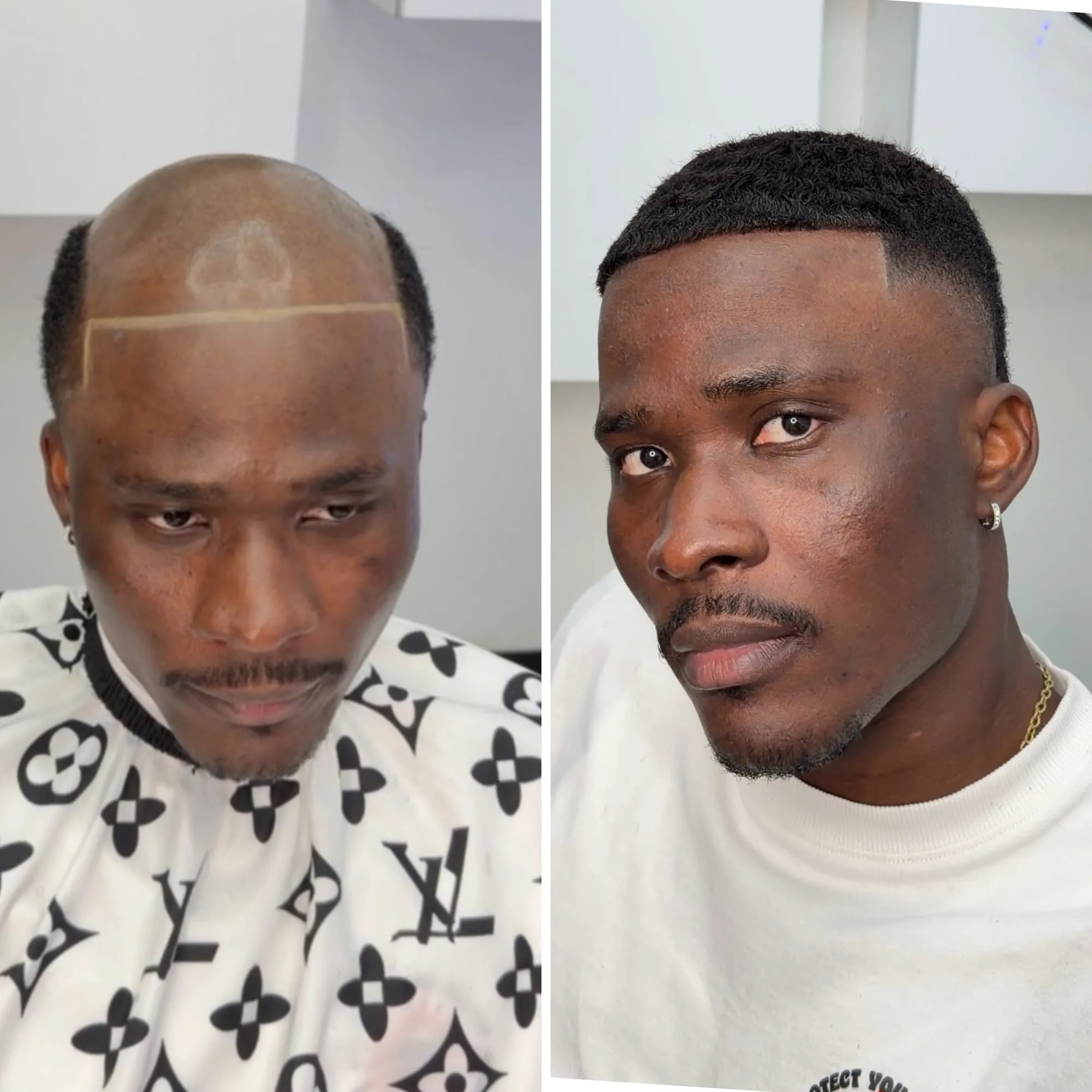
This is what it looks like.
A real client from our chair, photographed before and after his hair system was installed and cut in.
Questions, answered.
Can a hair system match tight coily or curly hair?
Yes, but the unit has to be sourced or ordered to match your specific coil or curl pattern rather than approximated. A texture that is one step off from yours creates a seam the eye can find, so matching it is the first decision we make.
Will it work with a fade and a clean lineup?
It can. The front is built so a barber can edge it without exposing the base, and the unit is blended into the transition of your fade so it lives inside the haircut instead of sitting on top of it.
How do you match the colour against darker skin?
We match the black plus its undertone and any grey, and we choose a base shade that disappears against your scalp at the part and hairline. A base that is too light against darker skin shows at the front, so the material matters as much as the hair colour.
How do I know a studio can actually handle textured hair?
Ask directly whether they have worked with coils or curls like yours, and ask to see real clients from their chair with texture close to your own. Textured hair is a specialty, and a studio that mostly fits straight hair will struggle to match it.
Keep reading
Related.
Receding Hairline
How a hair system rebuilds a receding hairline without surgery: a front built where your hairline used to sit and blended into your own hair.
Thinning Crown
How a hair system covers a thinning crown without surgery: coverage over the vertex blended into the hair around it, whorl and all.
For Young Men
Why a hair system fits men in their 20s and 30s. Full hair now, no surgery, built for an active life and natural at close range.