Last updated September 28, 2026
What a system covers, and what it does not
A transplant can leave a few different marks. FUT, the strip method, leaves a linear scar in the donor area. FUE leaves many small round scars, often called dots, spread across the area hair was taken from. And a result that thinned out or never filled the way you hoped can leave the top of your scalp looking sparse or patchy. A hair system addresses how all of that looks by covering the area with a full head of hair that is cut and blended to read as yours.
What it does not do is fix the skin underneath. It is not a medicine, a graft, or a surgical revision, and it will not regrow hair or change the scar tissue itself. We are hair replacement artists, not surgeons or doctors. Anything about the health of your scalp, or whether a scar can be revised or grafted into, belongs with the surgeon who did the work or a dermatologist, and we are glad to work alongside that.
Where a top system reaches, and where it does not
This is the honest part most pages skip. A hair system worn on the top of the scalp covers the front, the crown, and the mid scalp, which is exactly where a thinned or failed result usually shows. If your concern is a top that never filled in, a system can give you back a full, natural looking head of hair over that whole area.
A linear FUT donor scar, or a band of FUE dots, usually sits low on the back and sides of the head, below where a top unit ends. A system on top does not reach down there. If that lower scarring is your main concern, wearing your surrounding hair a little longer to blur the line, or asking about scalp micropigmentation, tends to be the more direct cosmetic route, and revision is a surgical question for your surgeon. We will tell you which situation you are actually in rather than sell you coverage that sits in the wrong place.
- Top, crown, and hairline that thinned or failed: a system covers it well
- Depleted or sparse top after grafts: a full unit reads as your own hair
- Low FUT strip line or FUE dot band on the back: a top unit does not reach it
- Scar tissue itself: unchanged, and a matter for your surgeon or dermatologist
Fitting a unit over scarred skin
Scar tissue behaves differently from unaffected scalp. It can be firmer, more or less sensitive, and it can take adhesive differently, so we do not assume anything about how your skin will respond. Before we commit to a routine we test how the area handles attachment and give it time to tell us the truth.
The plan is built around your scalp being comfortable first and the look second. If a stretch of scarring is touchy or the skin is still settling from a recent procedure, we adjust the attachment or wait, because a unit that irritates the area is not one you will want to wear. Comfort over scarred skin is not something to guess at.
The advice you have probably already heard
Search this problem and the same answers come up: scalp micropigmentation to shade the scar, keeping your hair long enough to hide it, hats, or going back under the knife for a revision. Those are real options, and for a low donor scar some of them are the right call. What rarely gets mentioned is that for a thinned or failed result across the top, a hair system covers the whole area in one step and lets you set the density and hairline you want.
We are not here to talk you out of the surgical route or SMP if that is what fits your scarring. We would rather lay the options next to each other honestly and let you choose. A system is reversible and non surgical, so it is a low commitment way to see what a full head of hair looks like on you before you decide anything permanent.
What drives cost and upkeep
Cost is driven by the base material, the type of hair, how much of the scalp you are covering, and how often you come in for maintenance. A full top unit uses more material than a small piece, and finer, more skin like bases cost more than sturdier ones, so the right balance depends on your scarring and your daily life rather than a fixed figure we could quote before seeing you.
Upkeep is a rhythm rather than a one time thing. The bond loosens over time and the hair needs cleaning and cutting like any hair does, so regular maintenance is what keeps the coverage looking the way it did on day one. We are upfront about that cadence before you commit so none of the commitment is a surprise.
Deciding if this is right for you
If a transplant left the top of your scalp thin, patchy, or short of what you hoped for, a hair system is a genuine option worth considering, and it works today without asking you to wait on anything or go back into surgery. It gives you control over how the result looks while you and your surgeon sort out anything medical.
The honest way to know is a consultation. We look at your scalp in person, find exactly where your scarring sits, and tell you plainly whether a system covers it, whether another route fits better, or whether a combination makes the most sense. If a system is not the right call for your situation, we will say so.
Real work
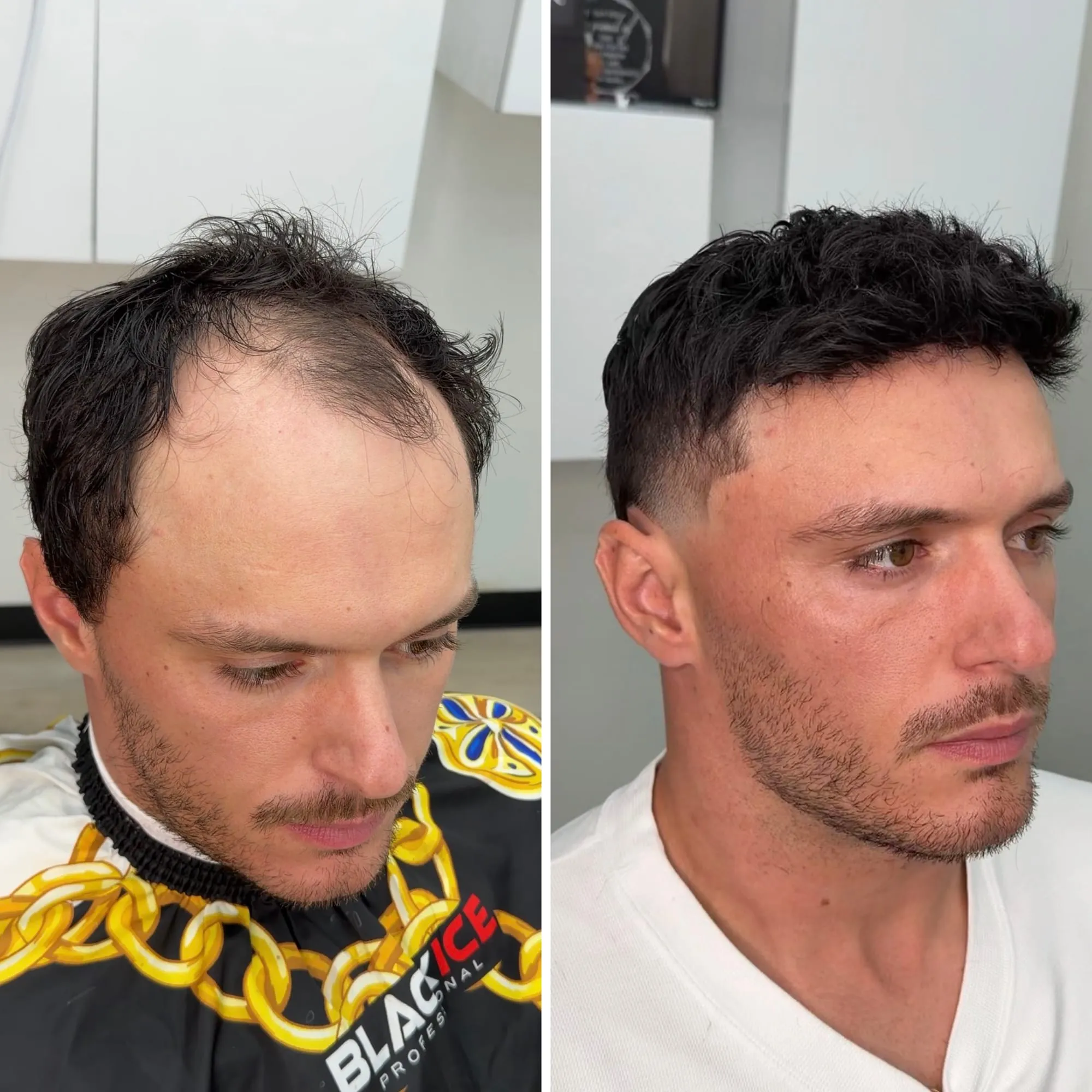
This is what it looks like.
A real client from our chair, photographed before and after his hair system was installed and cut in.
Questions, answered.
Can a hair system cover a FUT strip scar?
Only if the scar is high enough to sit under the unit, which is uncommon. A strip scar usually runs low on the back of the head, below where a top system ends, so a top unit does not reach it. We will tell you exactly where yours sits before suggesting anything.
Will a system hide FUE dot scarring?
It depends on where the dots are. Across the top or crown, a full unit covers them completely. In the lower donor area on the back and sides, a top unit does not reach, so wearing that hair longer or asking about micropigmentation tends to be the more direct route.
Does a hair system fix or heal transplant scars?
No. A system covers the appearance of scarring by sitting over the top of the scalp. It does not heal, remove, or repair scar tissue, and it is not a substitute for surgical revision. Anything about the skin itself belongs with your surgeon or a dermatologist.
Is it safe to attach a unit over scar tissue?
That is exactly what we check first. Scar tissue can take adhesive differently and can be more or less sensitive, so we test how the area responds and build the plan around comfort before the look. If the skin is still settling from a recent procedure, we wait.
Keep reading
Related.
After a Failed Transplant
Your transplant healed but the hairline, density, or donor let you down. How a hair system covers the whole result without more surgery.
Not a transplant candidate
Turned down for a hair transplant? A hair system covers diffuse or low-donor loss without surgery. What a no usually means and what to do next.
Advanced Loss
At the horseshoe stage a hair system gives full, natural-looking coverage without surgery or a donor area. What is realistic, honestly.
Thinning Crown
How a hair system covers a thinning crown without surgery: coverage over the vertex blended into the hair around it, whorl and all.