

Last updated September 28, 2026
Why surgeons say no, in plain terms
A hair transplant does not create hair. It relocates hair from a donor area, usually the back and sides, into the areas that show loss. That math only works when the donor area is dense enough to spare hair and the loss is confined enough to cover with what gets moved. When either of those is not true, a responsible surgeon declines, and that is a sign they are being honest with you rather than a sign something is wrong with you.
We are hair replacement artists, not doctors, so we will not tell you what a surgeon saw on your scalp. What we can do is describe the common patterns behind a no in cosmetic terms, so you can recognise your situation. If you want the medical picture, that conversation belongs with your physician or dermatologist.
- Diffuse loss with no clear pattern, so thinning is spread across the whole scalp rather than a defined bald area
- Low donor density, where the back and sides do not hold enough hair to move without thinning the donor site too
- Loss that is still advancing, so any transplanted hair could be stranded by continued thinning around it
- An area of loss too large for the donor supply to realistically fill
Why a system does not have the same limits
The reason a transplant runs out of options is supply. A hair system has no such ceiling, because the hair is added to a base that sits on your scalp rather than harvested from your own head. Diffuse loss, a thin donor area, and a large area of loss are all reasons a surgeon steps back, and none of them change what a system can cover.
That flips the usual disappointment on its head. The exact features that make you a poor transplant candidate tend to make you a straightforward system client, because a system builds coverage from a full hairline back regardless of what your own scalp is holding. There is no waiting for grafts to take and no gamble on whether the density will look right months later.
This is different from starting over after surgery
Being turned down before surgery is a cleaner starting point than most people expect. Your scalp has not been operated on, there is no scarring to work around, and there is no earlier result that fell short of what you hoped for. We are simply fitting a system to your scalp as it is today.
If you have already had a transplant that did not deliver, or you are living with a scar from one, that is a related but separate conversation, and we have pages built for those situations. Here the focus is the man who got a no and was handed nothing else to do about it.
What the fitting looks like for diffuse loss
Diffuse thinning has one wrinkle worth naming. When there is still a fair amount of native hair spread across the scalp, we decide together how the system works with it, whether the unit blends into the hair you have or the coverage is designed to carry the look on its own. Neither is wrong, and the right call depends on how much hair is left and how you want it to feel day to day.
We fit to the scalp in front of us, not to a scan or an average. If your loss is still moving, we plan for that rather than pretend the picture will hold still, because a system is not committed to your scalp staying exactly as it is now. That flexibility is part of why it suits loss that a surgeon called too unpredictable to operate on.
What drives cost and upkeep
Cost is driven by the base material, the type of hair, the size of the area being covered, and how often you come in for maintenance. Coverage for widespread loss uses more material than a small area, and finer, more skin-like bases sit at a different level than sturdier ones, so the right balance depends on your loss and your daily life rather than a fixed number.
Upkeep is a rhythm rather than a one time cost. The bond loosens over time and the hair needs washing and cutting like any hair does, so regular maintenance is what keeps the coverage looking the way it did on day one. We are upfront about that cadence before you commit so nothing about it is a surprise later.
Deciding if this is your next move
If surgery is off the table and you were left without a plan, a system is a genuine answer rather than a fallback. It gives you a full head of hair now, without a donor area, without an operation, and without waiting to see whether a result holds.
The honest way to know is a consultation. We look at your scalp in person, talk through what your loss is doing, and tell you plainly whether a system fits. If it is not the right call for you, we will say so, because our job is to earn a client who trusts us, not to sell a unit that will not serve you.
Real work
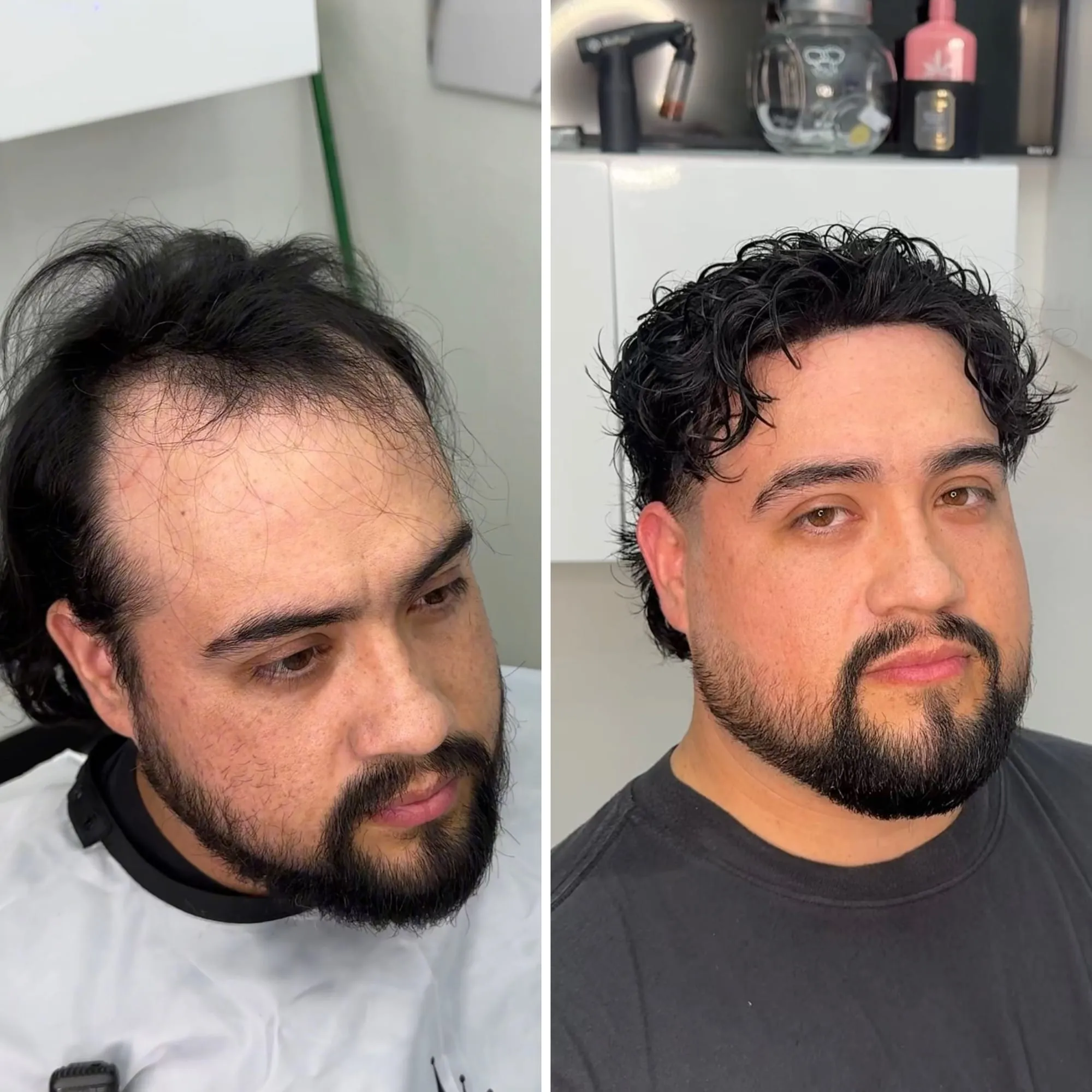
This is what it looks like.
A real client from our chair, photographed before and after his hair system was installed and cut in.
Questions, answered.
Why was I told I am not a candidate for a hair transplant?
A transplant only moves hair you already have, so surgeons decline when loss is spread out with no clear pattern, when the donor area is too thin to spare hair, or when the loss is still advancing. It is an honest limit of the procedure, not a fault in you. Your doctor can explain your specific reason.
Can a hair system cover loss that a transplant cannot?
Yes. A system adds hair to a base on your scalp instead of harvesting your own, so diffuse loss, a thin donor area, and a large area of loss do not limit it the way they limit surgery. The traits that make you a poor transplant candidate often make you a straightforward system client.
Does a hair system treat or regrow my hair?
No. A system is a cosmetic covering, not a medicine or a diagnosis. It changes how the loss looks, not what is causing it. For the medical side, speak with a physician or dermatologist, and we are glad to work alongside them.
I still have a lot of thin hair. Will that get in the way?
No, we plan around it. We decide together whether the unit blends into the hair you still have or carries the look on its own, based on how much is left and how you want it to feel. If your loss keeps moving, the fit can be adjusted rather than starting over.
Keep reading
Related.
Advanced Loss
At the horseshoe stage a hair system gives full, natural-looking coverage without surgery or a donor area. What is realistic, honestly.
Thinning Hair
Thinning but not bald? A hair system can add density and blend into the hair you still have. How early-stage hair systems work, from our chair.
Thinning Crown
How a hair system covers a thinning crown without surgery: coverage over the vertex blended into the hair around it, whorl and all.
After a Failed Transplant
Your transplant healed but the hairline, density, or donor let you down. How a hair system covers the whole result without more surgery.