

Last updated September 28, 2026
If you are reading this, you already know the feeling
You did the research, you paid for the procedure, you sat through the healing, and the result is not what you were sold. Maybe the hairline was drawn too straight or too low and reads as unnatural. Maybe the density came in thin and see-through under bright light. Maybe the surgeon took so much from the back that a second procedure is off the table. Whatever the specifics, the disappointment is real, and the frustration of having spent time and money to still feel self conscious is its own kind of tired.
We fit men in exactly this spot regularly. You are not wondering whether to do something about your hair anymore. You already tried the surgical route, and you are here to see what covers the result now, which is a much clearer question to answer.
What a hair system does for a result that let you down
A hair system is a breathable base carrying real or synthetic hair that bonds over your scalp and sits above the old transplant work. Because it does not depend on your existing hair, it covers the three things a poor transplant tends to leave behind in a single step: not enough density, a hairline in the wrong place, and scarring you would rather not see. We cut and blend it so it reads as your own hair growing from your own head.
It is important to be plain about what this is and is not. A system is cosmetic. It does not touch the grafts, revise the surgery, treat your scalp, or bring back hair that is gone. Anything to do with the health of your scalp, whether a revision procedure is possible, or what your donor area can still support is a conversation for the surgeon or physician who knows your history. We cover the appearance. We are glad to work alongside the medical side, and we will never tell you a unit fixes the surgery itself.
The part that makes your situation different
Covering a scalp that has been through surgery is not the same as covering untouched skin, and the difference is worth knowing before you book. Healed graft scars behave differently under adhesive than normal scalp, and surviving transplanted hairs change how a base sits and blends. This is craft, not a catalog order, which is why the how of it matters more here than in a straightforward case.
Exactly how we route attachment around scar tissue, which base seals cleanly over a linear or dotted donor scar, and how we blend over sparse surviving grafts is its own detailed subject. We break it down step by step on our companion page, Hair System After a Failed Hair Transplant, the decision guide to read once you know you want to move forward. This page is about whether it is worth considering at all, and for most men in your position it is.
- Coverage for a hairline that was designed badly the first time
- Density you choose, over grafts that came in too thin
- A base and bond routed around healed donor and recipient scars
- A fresh, natural hairline designed from scratch above the old work
- A reversible option that does not commit your scalp to another surgery
Why men choose this over another procedure
After one result that did not land, the appetite for going back under the knife is usually low, and often the donor area no longer has enough to give even if the willingness were there. A hair system asks nothing of your donor, needs no healing time, and carries no surgical risk. You walk out of the first fitting already covered rather than waiting months to see whether it took.
It is also reversible. If your circumstances change or you simply want to stop, you can, which is a very different commitment from surgery. That does not make it automatically right for you, but it is a serious option a lot of men in your position are relieved to learn exists.
What upkeep actually looks like
A system is a routine, not a one time fix. The bond loosens over time and needs periodic reattachment, and the hair needs washing, conditioning, and cutting like any hair does. Coming in for maintenance on a regular cadence is what keeps the coverage looking the way it did on the day we fit it, and we are upfront about that rhythm before you commit.
What drives your cost is the base material, the type of hair, the size of the area, and how often you come in, not a single figure we can quote before we see your scalp. We would rather look at what your transplant left behind in person and give you a straight answer.
The honest next step
The only way to know whether a system suits your result is to have someone who does this look at your scalp. In a consultation we examine the hairline, the density, the scarring, and the surviving grafts, tell you plainly what a system can and cannot cover for you, and lay out the routine so you can decide with clear eyes. If it is not the right call, we will say so rather than sell you a second thing that disappoints.
You already spent once on a promise that did not hold, and we are not interested in repeating that. Come in, get a straight read on where you stand, and go from there.
Real work
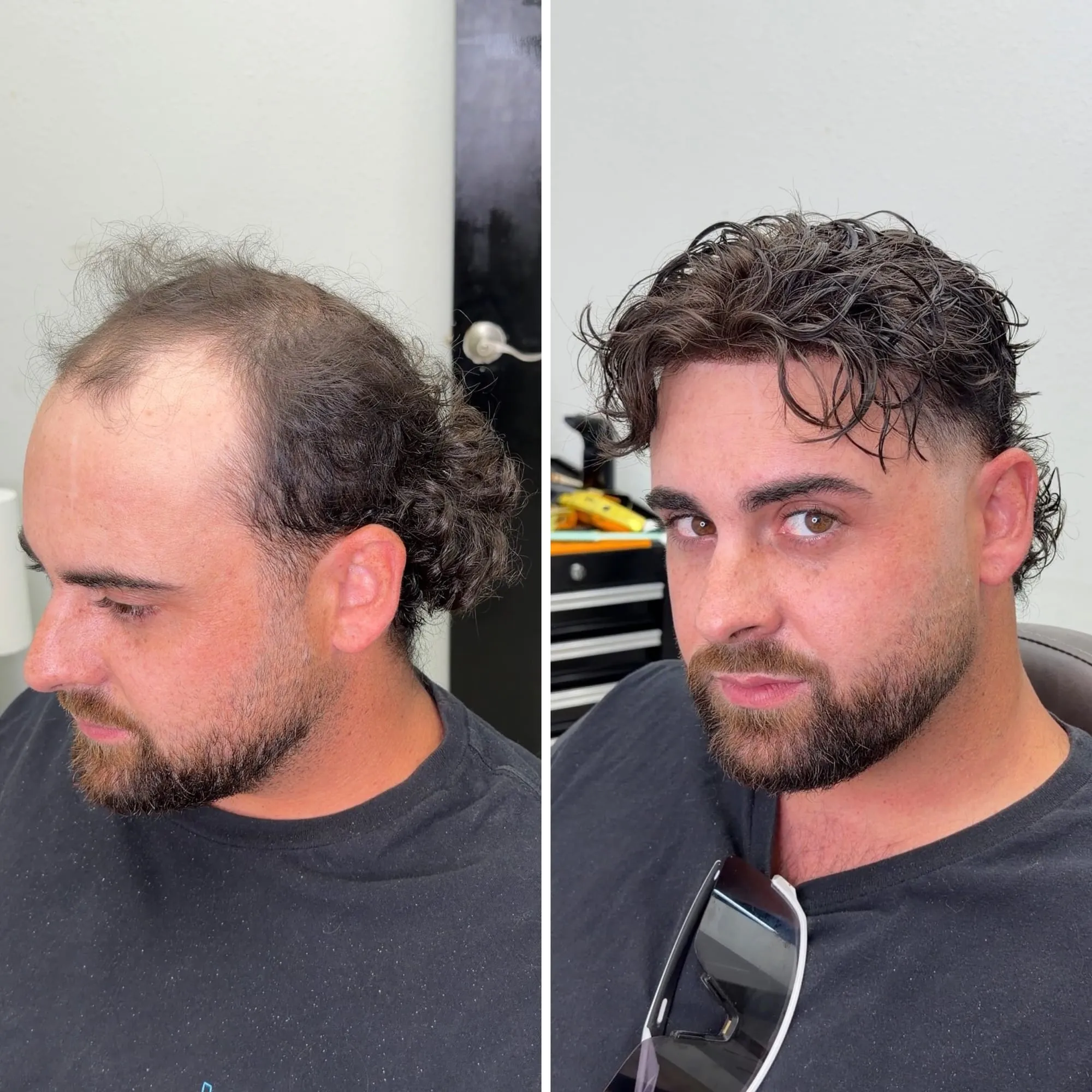
This is what it looks like.
A real client from our chair, photographed before and after his hair system was installed and cut in.
Questions, answered.
Can I wear a hair system after a failed hair transplant?
Yes. Because a system bonds over your scalp and carries its own hair, it covers a poorly placed hairline, thin density, and scarring in one step, without depending on the grafts. It is cosmetic coverage, not a revision of the surgery.
Will a hair system fix or revise my transplant?
No. A system covers the appearance of the result. It does not touch the grafts, revise the surgery, or regrow hair. Whether a revision procedure is possible is a question for your surgeon, and we are happy to work alongside that.
Can a system cover my donor and transplant scars?
Usually yes, once the scars are fully healed. We route the attachment and choose a base that seals cleanly over linear or dotted scarring. How we do that is covered on our companion decision page, Hair System After a Failed Hair Transplant.
Do I need enough hair left for a system to work?
No. A system does not draw on your donor area or your existing hair the way another procedure would, which is part of why men choose it after surgery. It works whether surviving grafts are sparse or the donor is spent.
Keep reading
Related.
Hair Transplant Scars
How a hair system covers the look of FUT strip scars, FUE dots, and depleted donor areas across the top of the scalp. What it can and cannot reach.
Not a transplant candidate
Turned down for a hair transplant? A hair system covers diffuse or low-donor loss without surgery. What a no usually means and what to do next.
Advanced Loss
At the horseshoe stage a hair system gives full, natural-looking coverage without surgery or a donor area. What is realistic, honestly.
For Professionals
How a hair system fits a working professional's schedule: discreet, low-maintenance, and undetectable on camera and across a desk.