Last updated September 28, 2026
The horseshoe stage calls for full coverage, not a partial
Advanced loss usually settles into a familiar shape: the top and crown are bare, and what remains is a band of hair around the sides and back, the pattern most people picture as a horseshoe. Our three pattern-specific pages deal with partial loss, where there is still real hair on top to work into. This is the opposite situation, and it needs a different answer.
When there is little or nothing left on top, the sensible route is a full unit rather than trying to fill a partial area. The system covers the entire top of the scalp from the hairline back and meets your natural side and back hair at the edges. You keep the hair you still have, and the unit does the rest.
Will it look fake at this stage?
This is the honest worry at the horseshoe stage, and it is a fair one. The short answer is that a full unit does not read as fake because of how much it covers, it reads as fake when the hairline is wrong, the density is too heavy, or the color does not match. Those are craft problems, not stage problems, and they are the things we control in the chair.
A good hairline at this stage is soft, slightly irregular, and set at a height that suits your age and your face rather than the height you had at twenty. Density is kept honest so the hair looks grown rather than stacked. When those details are right, coverage over a bare scalp holds up in normal light and at a normal conversational distance, which is where people actually see you.
Why a full unit can read more naturally than a partial
It sounds backward, but covering everything is often more convincing than covering part. A partial system has to disappear into your own hair along every edge, and any mismatch in color, texture, or density shows at that seam. A full unit meets your hair only at the fringe around the sides and back, low and out of the main line of sight.
That means the whole top can be designed as one consistent head of hair, with a single hairline to get right instead of a border running through the middle of your scalp. For many men at this stage, that is what finally makes the result look like theirs.
What full coverage involves
Because there is no hair on top to clip into, the unit is bonded to the scalp with adhesive or tape, so how your skin responds matters more than it would with a partial. We check that before settling on a routine. A bare scalp also means the base of the unit is what touches your skin all day, so comfort and breathability are part of the choice, not an afterthought.
- A full unit covering the whole top, meeting your side and back hair at the edges
- A hairline designed soft and age-appropriate, not the one you had at twenty
- Honest density so the hair reads as grown, not stacked
- Attachment bonded to the scalp, chosen around skin comfort as well as hold
- Color and texture matched to the hair you still have around the sides
This covers the appearance, it is not a treatment
We are hair replacement artists, not doctors. A hair system covers how advanced loss looks. It does not treat it, cure it, reverse it, or bring hair back, and it is not a diagnosis. If you have not talked to a physician or dermatologist about what is behind your loss, that is worth doing for your health, and we are glad to work alongside whatever they advise.
What a system gives you is control over your appearance now, without surgery and without waiting on anything. For men who are past the stage where a transplant has enough donor hair to work with, that is a large part of why full coverage is the practical route.
What drives cost and upkeep
Full coverage uses more material than a partial, so the base size and the amount of hair are real cost drivers, along with the base material you choose and how skin-like you want it to feel. Finer, more natural bases ask for more care than sturdier ones, so the right balance depends on your daily life as much as your look. We talk figures through in person once we know what your scalp and your routine actually need.
Upkeep is a rhythm rather than a one-time step. The bond loosens over time, and the hair needs cleaning and cutting like any hair does, so regular maintenance is what keeps a full unit looking the way it did on day one. We are upfront about that cadence before you commit so none of it is a surprise.
Deciding if this is right for you
If your loss has reached the horseshoe stage and you want a full head of hair again without surgery, a system is a genuine option, and often the most straightforward one at this point. The honest way to know is to see it on your own scalp.
In a consultation we look at your remaining hair, the shape of your loss, and how your scalp handles attachment, then tell you plainly whether a full unit is the right call and what a natural result would look like on you. If it is not right for your situation, we will say so.
Real work
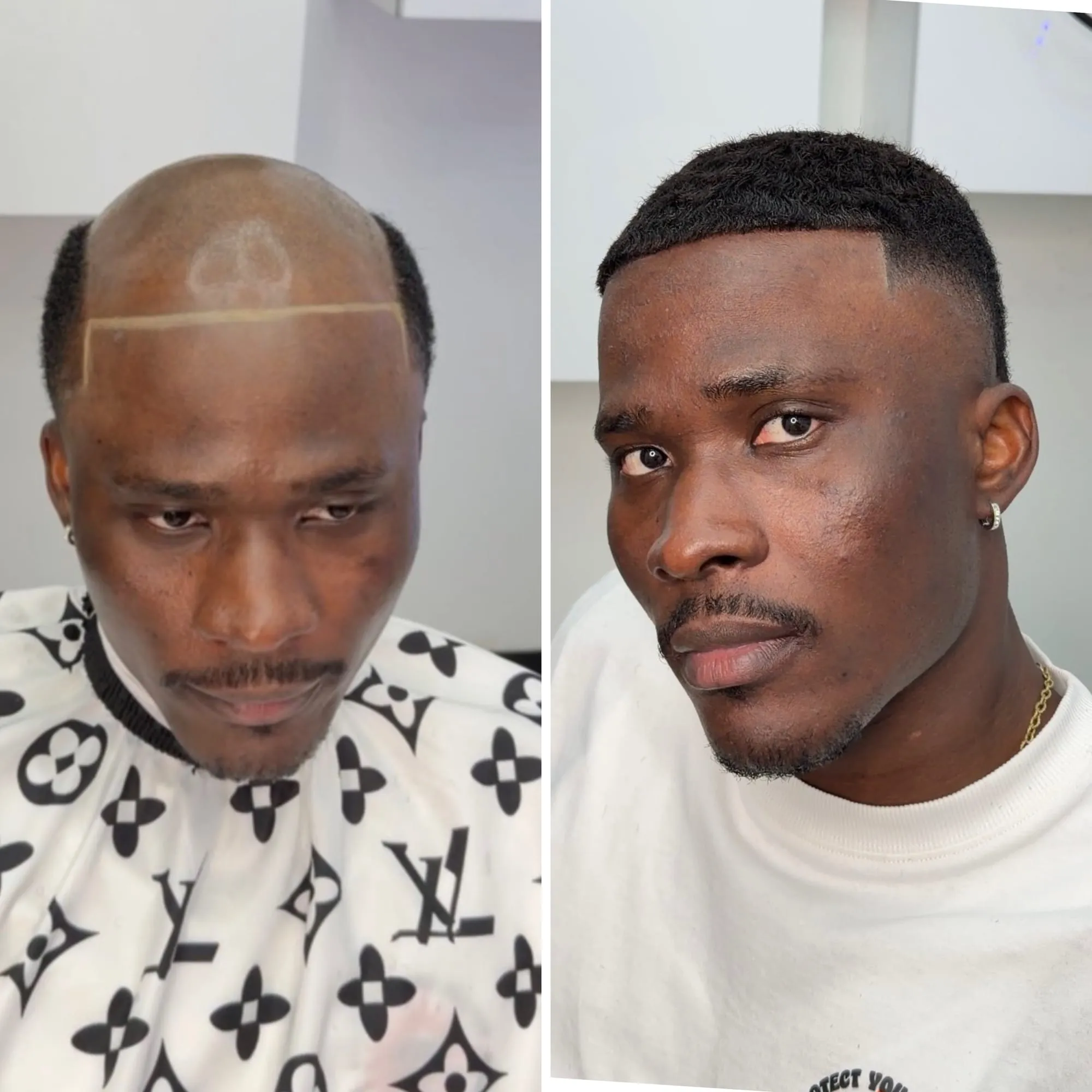
This is what it looks like.
A real client from our chair, photographed before and after his hair system was installed and cut in.
Questions, answered.
Can a hair system work if I only have hair on the sides and back?
Yes. That horseshoe pattern is well suited to a full unit that covers the whole top and meets your remaining side and back hair at the edges. You keep the hair you have, and the system rebuilds everything on top.
Will a full system look fake?
It looks fake when the hairline, density, or color are wrong, not because of how much it covers. Those are craft details we control. Set right, a soft age-appropriate hairline and honest density hold up in normal light and at a normal distance.
Is full coverage harder to get right than a partial?
Often it is easier. A full unit has one hairline to design and fewer seams to hide, since it only meets your hair low around the sides and back, rather than blending through the middle of your scalp where mismatches show.
Can a system regrow or treat my hair loss?
No. A system is a cosmetic covering, not a medicine or a diagnosis. It changes how the loss looks, not the cause. For the medical side, speak with a physician or dermatologist, and we are happy to work alongside their guidance.
Keep reading
Related.
For Men Over 50
How a hair system is built for a man in his fifties or sixties: age-appropriate density, grey blending, and a mature hairline that reads as your own.
Not a transplant candidate
Turned down for a hair transplant? A hair system covers diffuse or low-donor loss without surgery. What a no usually means and what to do next.
After a Failed Transplant
Your transplant healed but the hairline, density, or donor let you down. How a hair system covers the whole result without more surgery.
Thinning Crown
How a hair system covers a thinning crown without surgery: coverage over the vertex blended into the hair around it, whorl and all.