

Why the crown is its own problem
The crown, or vertex, is the spot at the back and top of the head where the hair spirals out from a central point. It thins differently from the front. You rarely catch it in a straight-on mirror, so it tends to be pointed out by other people or spotted in a photo taken from behind or above.
Two things make the crown harder to treat than a flat panel of scalp. It is curved, so a unit has to follow the dome of the head rather than lie flat, and the hair there grows in a whorl instead of one clean direction. Get either of those wrong and coverage looks convincing from one angle and obvious from another.
How we cover the crown in our chair
We start by finding the edge of the thinning, which is usually softer and less defined than a receding front. From there the unit is sized so it sits over the open area and tucks under the hair that still frames it, rather than stopping at a hard border that could show when the light comes from overhead.
The blend is the whole job at the crown. Your own hair around the perimeter overlaps the edge of the system, colour and texture are matched to what is already there, and the piece is cut into the surrounding hair as a single style. Done right, there is no line where your hair ends and the unit begins, whether someone is looking down at you or standing behind you.
Rebuilding the whorl so it looks like it grew
A real crown has a swirl. If a unit is fitted with all the hair running one way, it can look flat and directionless from above, which is exactly the angle a crown gets judged from. So the direction of the hair matters as much as the amount of it.
We set the parting and the swirl to follow how your own crown naturally sits, then cut into it so the coverage falls the way growing hair would. This is the detail that separates real coverage from a piece that technically fills the gap but never quite convinces from the back.
- A swirl set to match your natural crown pattern, not a flat sheet of hair
- Density matched to the hair around the vertex, not overloaded
- An edge tucked under your own hair instead of a hard border
- Colour and texture matched to the hair framing the crown
Working with the hair you still have
A thinning crown usually means the front and sides are holding, and often there is still some hair left in the crown itself. That is an advantage. We are not replacing a whole head, we are adding coverage where the vertex has opened up and letting your existing hair do the rest of the framing.
Because the surrounding hair is doing so much of the blending, keeping it in good condition and cut to work with the unit is part of the plan. When the two are cut as one style, the coverage disappears into the hair you already have instead of sitting on top of it. Some people still picture a patch dropped over the bald spot, and that is not what a well fitted crown looks like.
What drives cost and upkeep for a crown
Cost is driven by the same things as any hair replacement: the base material, the type of hair, and how often you come in for maintenance. A crown unit is often smaller than a full top piece, but the curve and the whorl mean the fit and the cut take real skill, so the value is in the work as much as the materials.
Upkeep is steady rather than dramatic. The crown takes overhead light and the bond loosens over time like anywhere else, so a regular maintenance rhythm is what keeps the coverage looking the way it did on the day we fitted it. We are upfront about that cadence before you commit so there are no surprises later.
Is a system right for a thinning crown specifically
If your thinning is concentrated at the crown while the rest of your hair is holding, a system suits your situation well because it targets exactly the zone that has opened up. You keep what you have and add coverage only where you have lost it.
The honest way to know is a consultation. We look at your crown in person, check how much hair is still there and how the surrounding hair falls, and tell you plainly whether a system is the right call. If it is not, we will say so.
Real work
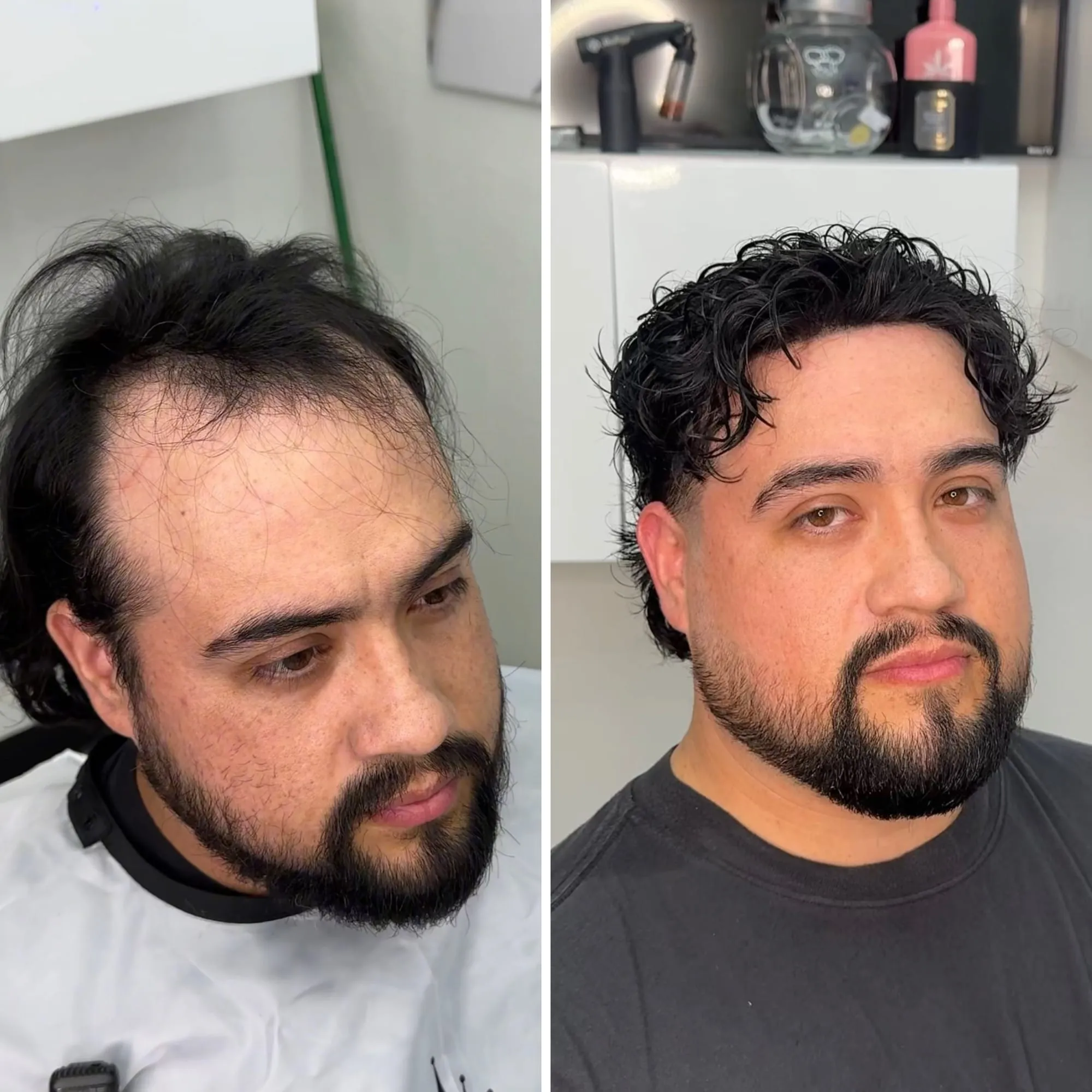
This is what it looks like.
A real client from our chair, photographed before and after his hair system was installed and cut in.
Questions, answered.
Can a hair system cover just my crown and leave the rest alone?
Yes. The unit is sized to sit over the vertex and blended into the hair around it, so we cover the thinning crown without touching the front and sides that are holding fine.
Will the crown look natural from behind and from above?
That is the goal. We set the swirl to match your natural crown pattern and tuck the edge under your own hair, so the coverage reads as one head from the angles a crown actually gets seen from.
What about the whorl or swirl at the crown?
We rebuild it. The hair direction is set to follow your natural crown pattern and cut so it falls like growing hair, rather than running flat in one direction.
Does a crown unit need less maintenance than a full piece?
Not really. It is often smaller, but the bond loosens over time like anywhere else, so a regular maintenance rhythm keeps the coverage crisp. We walk you through the cadence before you commit.
Keep reading
Related.
Receding Hairline
How a hair system rebuilds a receding hairline without surgery: a front built where your hairline used to sit and blended into your own hair.
For Young Men
Why a hair system fits men in their 20s and 30s. Full hair now, no surgery, built for an active life and natural at close range.
For Black Men
How a hair system is matched to coil and curl pattern, density, and skin tone for Black men, so the result reads as your own textured hair.