Last updated September 28, 2026
Why totalis is the hardest fit, and what a system still does
Most hair replacement leans on the hair around the edges. Loss gets blended into the hair beside it, a thinning crown borrows density from what is still growing, and the perimeter hides where the unit stops. Alopecia totalis takes all of that away, because there is no surviving hair anywhere on the scalp to blend into, borrow from, or hide behind.
A system still works, and for many people it works well, but the whole build changes. The unit becomes a full head of hair on its own rather than an addition to yours, it bonds to bare skin, and every detail your own hair would normally soften has to be engineered instead. None of this is medical. A hair system is a cosmetic covering, not a medicine and not a diagnosis. If a physician or dermatologist is guiding your care, we work alongside them, and we will never tell you a unit will reverse or regrow anything.
A full-cap base, sized to your whole scalp
Because the loss covers everything, the base has to cover everything too. It is sized to your entire scalp from the front hairline to the nape, taken from a mold or template of your head so it follows your shape. A precise template matters more here than on any partial fit, since there is no surrounding hair to forgive a base that sits slightly off.
Base material is a real trade off, not a menu of better and worse. A fine, skin-like base looks the most natural and reads as scalp where the hair parts, but it is more delicate. A sturdier base gives you more wear and takes daily life better, but it is thicker against the skin. Across a full cap that choice touches comfort, longevity, and how the unit feels in heat, so we walk through it against your actual routine.
Attachment is adhesive only
With no anchor hair at the perimeter, there is nothing to clip or bond into, so a totalis unit is held by adhesive across the base against your skin. That makes your scalp, and how it reacts to adhesive, the center of the plan. We test how your skin responds before settling on any product or routine, because a full-cap bond that irritates you is not one you will keep wearing.
The bond is what keeps the whole unit in place, so it needs refreshing on a schedule, and the scalp underneath needs to breathe and be cleaned between attachments. We are upfront about that cadence before you make the commitment.
- A skin test of how your scalp handles adhesive, done first
- A full-cap base molded to your head, not a generic shape
- A hairline designed from scratch, since there is no reference
- A wear-and-reattach rhythm you know before you commit
Designing a hairline with no reference
On most fits, your existing hairline tells us where the new one should sit. Totalis removes that reference, so the hairline is a design decision made from your face, your age, and old photos if you have them, rather than copied from hair that is still there.
The hairline is the single detail that decides whether a full-cap unit reads as yours. We favor a line that suits your face now over one that chases a younger look, and we build in irregularity and a soft front edge so it looks grown rather than drawn.
When eyebrows and facial hair no longer match
Totalis often takes the eyebrows and can take beard and body hair too. A scalp system does not address eyebrows or a beard, and we will not pretend it does. What we can do is design the scalp hair so it does not fight with a face that has little other hair, keeping color, density, and hairline in a range that looks intentional. Eyebrows and facial hair are separate questions, and some of them belong with your physician or dermatologist.
Alopecia universalis: the same fit, extended
Alopecia universalis means the loss extends past the scalp to the whole body, including eyebrows, lashes, beard, and body hair. For the scalp itself, the fit is the same one described here: a full-cap unit bonded to bare skin, with the same base, hairline, and attachment questions.
The difference is context, not method. With no eyebrows or facial hair anywhere, the scalp hairline and density carry even more of the finished look. As always, anything beyond the scalp, and anything medical, belongs with your doctor, and a system stays a cosmetic covering for the appearance of loss.
Wear cycle, reattachment, and what drives cost
A totalis unit lives on a cycle. You wear it bonded for a stretch, then come in or reattach at home to refresh the adhesive, clean the base and scalp, and let the skin recover before the next bond. How long each stretch lasts depends on your skin, your adhesive, and your daily life, so we set the rhythm with you rather than quote one interval.
Cost is driven by the same things that drive the build: a full-cap base uses more material than a partial one, finer skin-like bases ask more than sturdier ones, the grade of hair matters, and maintenance cadence adds up over time. Because full coverage sits at the larger end of every one of those drivers, the honest figure comes from a consultation that looks at your scalp and your routine.
Deciding if this is right for you
If you are living with alopecia totalis or universalis and you want to look like yourself again while your medical care runs its course, a full-cap system is a genuine option, as long as you go in knowing it is the hardest fit and the most hands-on to own.
The honest way to know is a consultation. We look at your scalp in person, test how it handles adhesive, talk through the hairline and the wear cycle, and tell you plainly whether a system fits your situation. If it is not the right call, we will say so.
Real work
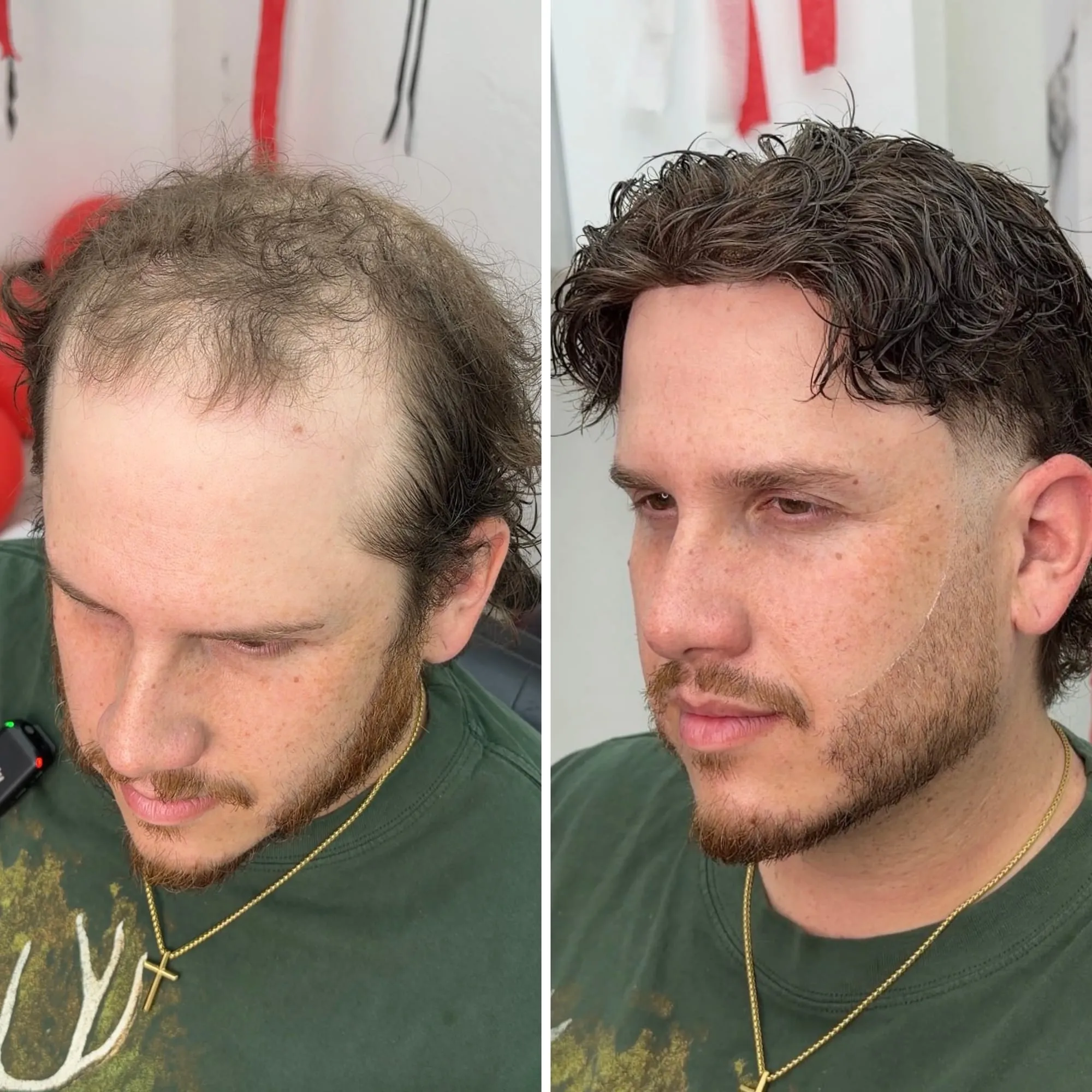
This is what it looks like.
A real client from our chair, photographed before and after his hair system was installed and cut in.
Questions, answered.
Can a hair system work if I have no hair anywhere on my scalp?
Yes. With no hair to blend into, the unit is a full-cap system bonded to bare skin, so it builds a whole head of hair on its own. The hairline design and the base fit are what make it read as yours.
How is a totalis fit different from covering a small area?
There is no perimeter hair to anchor to, blend into, or hide the edge, so the hold is adhesive only and the hairline is designed from scratch instead of matched to what is there.
Will a scalp system fix my eyebrows or beard?
No. A scalp unit covers the scalp only. We design its color, density, and hairline so they do not clash with a face that has little other hair, but eyebrows and facial hair are separate questions, and some of them belong with your physician or dermatologist.
How often will I need to reattach it?
A full-cap unit is worn on a cycle, bonded for a stretch and then refreshed so the adhesive, base, and scalp all get attention. How long each stretch lasts depends on your skin, your adhesive, and your daily life, so we set that rhythm with you.
Keep reading
Related.
Alopecia
How a hair system covers alopecia-related loss, whether patchy or full scalp, without surgery. What is realistic, and what to ask your doctor.
Alopecia Areata
The comes-and-goes case with unpredictable regrowth. How to decide between a partial hair system blended into your own hair or full coverage.
Advanced Loss
At the horseshoe stage a hair system gives full, natural-looking coverage without surgery or a donor area. What is realistic, honestly.
Sensitive skin and adhesive allergies
How a hair system can work when adhesive irritates your skin: acrylate and latex sensitivity, skin testing, and tape-free clip alternatives.