

Last updated September 28, 2026
What actually reacts, and why
Skin rarely reacts to the idea of a hair system. It reacts to a specific ingredient, and knowing which one changes everything about how we fit you. The usual culprits are acrylate compounds in some liquid adhesives and tapes, latex in certain older bonds, and the solvents used at removal. Contact dermatitis from one of those can look like redness, itching, small bumps, or a stinging feeling along the bond line.
A hair system does not treat a skin condition and it will not cure a sensitivity, and if your skin is reacting to something in daily life we would rather you see a dermatologist about it than guess in our chair. What we can do is choose materials and a method that keep the reactive ingredient off your scalp, so the coverage is comfortable to wear.
Testing before a full install
We do not commit you to a full install on faith. Before that, we test how your skin handles the specific tape or adhesive we plan to use, applying a small amount and giving your skin time to tell us the truth. This is the same logic behind a sensitivity test at a skin clinic, scaled to the exact products that will touch your scalp.
If a product reacts, we swap it and test again rather than pushing through. It is a slower start, and it is the right one, because a bond you cannot tolerate is not a bond worth wearing. Once we find what your skin is happy with, that becomes your routine.
Tape-free and clip alternatives
When scalp adhesive is off the table entirely, attachment does not have to be. A clip based or integration style attachment anchors the unit to the hair you still have rather than bonding to skin, which removes adhesive from the equation for men who have enough surrounding hair to work with.
For men with little hair to clip into, we look at low-tack and latex-free tapes, medical grade bonds formulated for reactive skin, and shorter wear cycles that give the scalp regular breaks. The right answer depends on how much hair you have and what your skin tolerated in testing, so we build the method around your results, not a default.
- Skin testing of the exact tape or adhesive before any full install
- Latex-free and low-tack options for reactive skin
- Clip or integration attachment that avoids scalp adhesive
- Gentler removal solvents chosen for sensitive skin
- Shorter wear cycles that give the scalp time to rest
Living with it day to day
Sensitive skin asks for a little more rhythm, not a lot more work. Keeping the scalp clean and dry under the bond, using the products we tested rather than swapping in whatever is on the shelf, and coming in on schedule for reattachment all keep irritation from creeping back. Most reactions we see start when someone changes a product without testing it first.
Upkeep cost tracks the same things it does for anyone: the base material, the type of bond, and how often you come in. Sensitive skin can push you toward gentler tapes and shorter wear cycles, which shifts the cadence more than anything else. We walk through that rhythm with you before you commit so none of it is a surprise.
Deciding if this is right for you
A history of adhesive reactions is a reason to be careful, not a reason to rule a system out. Plenty of men who reacted to one product wear a unit comfortably on another once the testing is done. The only way to know your skin is to test your skin.
Book a consultation and we will look at your scalp, talk through what has irritated you before, and run the tests that tell us what you can wear. If your skin genuinely cannot tolerate any option we have, we will tell you straight rather than sell you something you will regret.
Real work
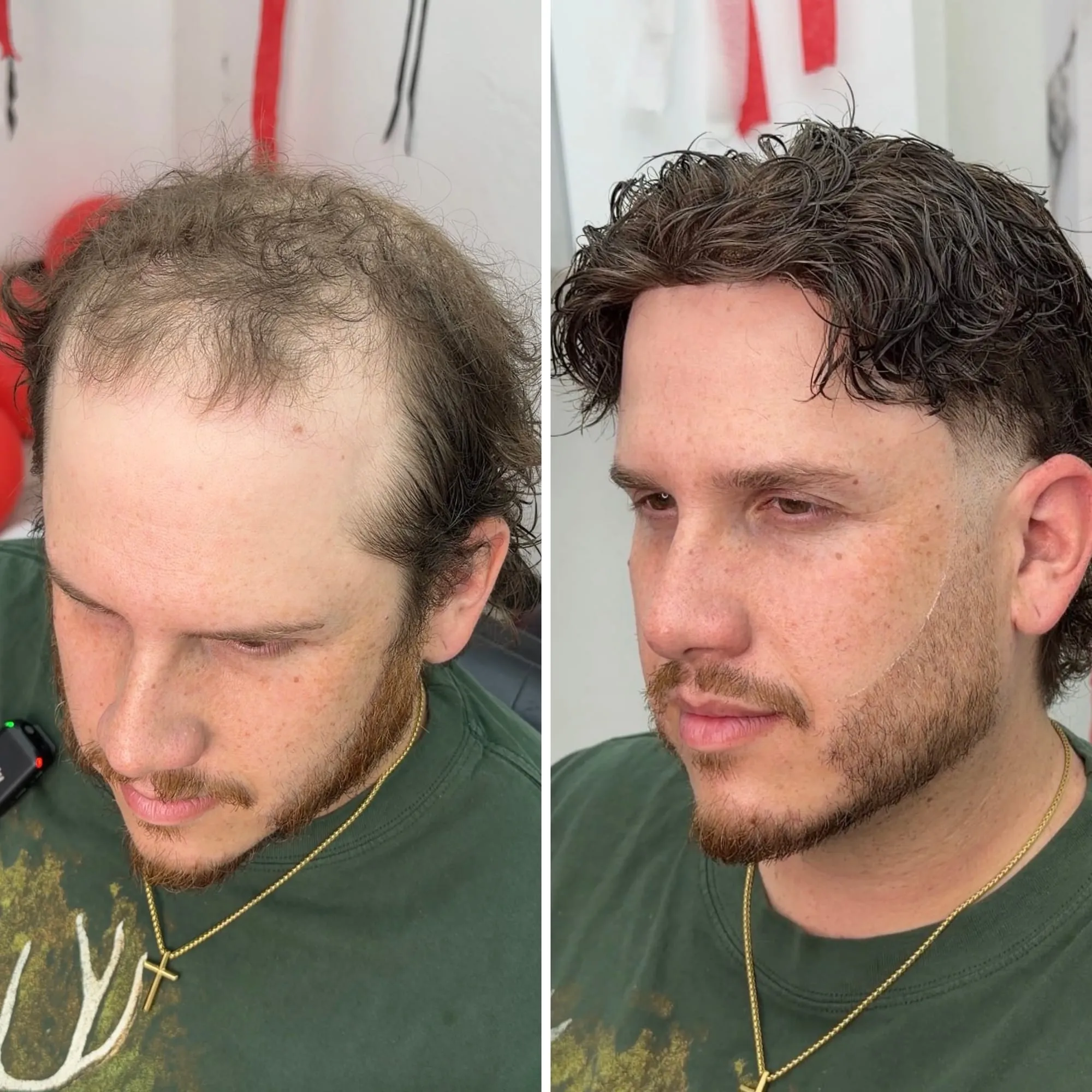
This is what it looks like.
A real client from our chair, photographed before and after his hair system was installed and cut in.
Questions, answered.
Can I wear a hair system if I am allergic to adhesive?
Often yes. Reactions are usually to a specific ingredient like an acrylate or latex, not to every product, so we test alternatives such as latex-free tapes or a clip based attachment that avoids scalp adhesive entirely. Testing first is how we find what your skin tolerates.
Do you test the adhesive before a full install?
Yes, always. We apply a small amount of the exact tape or adhesive we plan to use and give your skin time to react, the same way a clinic checks a product before you rely on it. If it reacts, we swap the product and test again before committing you to anything.
Is there a way to attach a system without any adhesive?
Yes, if you have enough surrounding hair. A clip or integration style attachment anchors the unit to your own hair instead of bonding to the scalp, which keeps adhesive off your skin. For men with little hair to clip into, we look at low-tack, latex-free tapes instead.
Will a hair system make my skin condition worse?
A system does not treat or cause a skin condition, and our aim is to keep any reactive ingredient off your scalp. If your skin is already inflamed or you are managing a diagnosed condition, see your dermatologist first, and we are glad to fit you once your skin is settled.
Keep reading
Related.
Oily and sweaty scalps
If your hair system keeps coming off on an oily scalp, the fix is adhesive choice, scalp prep, and a shorter reattachment cycle. Here is how.
Alopecia
How a hair system covers alopecia-related loss, whether patchy or full scalp, without surgery. What is realistic, and what to ask your doctor.
Swimmers
Can you swim in a hair system? Yes. How chlorine, salt water, and full submersion change the bond and the aftercare, from a Phoenix studio.
For Professionals
How a hair system fits a working professional's schedule: discreet, low-maintenance, and undetectable on camera and across a desk.