

Last updated September 28, 2026
Age tells you when to look, condition tells you when to act
A hair system does not expire on a calendar. Two men can wear the same base for very different lengths of time depending on how hard they are on it, how they clean it, and how often it is reattached. That is why we judge a unit by what it is actually doing on your head, not by how many months old it is.
Use the signals below as a checklist. One mild sign usually means a repair or a maintenance visit. Several signs together, or any one of them severe, means the unit has reached the end of its useful life and a replacement will look and feel better than nursing the old one along. If you want the typical lifespan ranges by base type first, our page on how long hair systems last covers that side.
Signal one: the base is thinning or going yellow
The base is the foundation everything else is tied into, so once it starts breaking down the whole unit follows. A front edge that has gone gauzy and translucent is the most common early tell, because that is the zone that takes the most adhesive, heat, and removal stress.
- Look for: thin, worn, or see-through spots in the base, especially around the perimeter and anywhere adhesive sits every day.
- Look for: a yellow or amber tint building up in a skin or poly base that used to read clear against your scalp.
- Why it matters: a thinning base tears more easily and holds adhesive unevenly, so the bond gets less reliable right when you need it most.
- Why it matters: yellowing is oxidised adhesive and product worked into the material, and past a point it will not clean out, which makes the base show against the skin.
- Repair or replace: small edge wear can sometimes be reinforced once, but widespread thinning or a base that stays yellow after a proper clean is a replace.
Signal two: knots are letting go at the part
Every hair on a system is held by a knot in the base. Normal wear sheds a few over time, and that alone is not a crisis. What tells you the unit is aging out is where the loss is happening. Concentrated thinning right at the part, the spot people look at most, is the difference between a system that still passes and one that no longer does.
- Look for: more loose hairs than usual in the sink or on your comb, concentrated along the part and the hairline rather than spread evenly.
- Look for: visible gaps or a widening part line where knots have released and the hair is no longer anchored.
- Why it matters: knot loss at the part is structural, not cosmetic, and it tends to speed up once it starts.
- Repair or replace: isolated shedding can be slowed with gentler handling and the right products, but knot loss opening up the part is a job for re-ventilation or, more often, a new unit.
Signal three: tangling and matting that will not brush out
Human hair on a system does not get fed oils from a scalp the way growing hair does, so over months it dries out and the cuticle wears down. Once tangling becomes the daily normal rather than the occasional knot, no amount of conditioning brings it back for long, and fighting it every morning does more harm than a replacement would.
- Look for: the hair knotting on itself, especially at the nape and underneath, in a way a gentle brush-through no longer solves.
- Look for: a rough, straw-like feel where the hair used to run smooth, often after color or shine has faded.
- Why it matters: irreversible tangling means the cuticle has broken down, and matted hair pulls on the knots below it, which speeds up shedding and base wear.
- Repair or replace: a one-time deep condition and detangle can buy time early, but hair that re-tangles within days of every wash is telling you the fiber is done.
Signal four: density loss past what a repair can restore
Re-ventilation is the process of tying new hair back into an existing base, and it is a genuine way to extend a good unit. The limit is the base. If the material is still strong, adding density is worth it. If the density loss shows up alongside a thinning or discolored base, you are repairing a foundation that is on its way out, and a fresh unit is the better value.
- Look for: the unit reading thinner overall than it did new, with scalp showing through where it used to look full.
- Look for: a hairline or crown that has gone sparse enough that styling no longer hides it.
- Why it matters: once cumulative shedding drops the density below your natural target, a re-ventilation can add hair back only up to a point before the base itself is too worn to hold more.
- Repair or replace: moderate thinning on a sound base is a strong candidate for re-ventilation, while thinning on a base that is also worn or yellow is a replace.
Reading the signals together
No single sign is an automatic verdict, and that is the point. A little edge wear, a few extra loose hairs, one stubborn tangle: any of those on its own is usually a maintenance visit or a small repair. What moves a unit into replace territory is the signals stacking. A yellowing base plus knot loss at the part plus tangling that will not settle is a unit at the end of its run, and trying to nurse it along tends to cost you more mornings than it saves.
This is also the strongest case for owning two units and rotating them. Alternating gives each one recovery time between wears, spreads out the adhesive and removal stress, and means you always have a fresh backup on hand the week one starts showing these signs. It is the single habit that most reliably stretches how long each system stays looking its best.
How we handle it in the studio
At a maintenance visit we inspect the base, the knots, the density, and the fiber, and we tell you honestly which bucket the unit is in: good for a while yet, worth a repair or re-ventilation, or time to replace. We would rather move you into a new unit a little early than let you walk out in one that is about to fail at the hairline.
The smoothest way to avoid ever being caught out is to have your next unit ordered before the current one gives out, since a custom system takes time to build. If you are seeing any of the four signals above, that is the moment to book a maintenance appointment so we can plan the timing with you rather than react to it. Nico, Ivette, and Denisse walk every client through this at our Peoria, Arizona and Eighty Four, Pennsylvania studios.
Real work
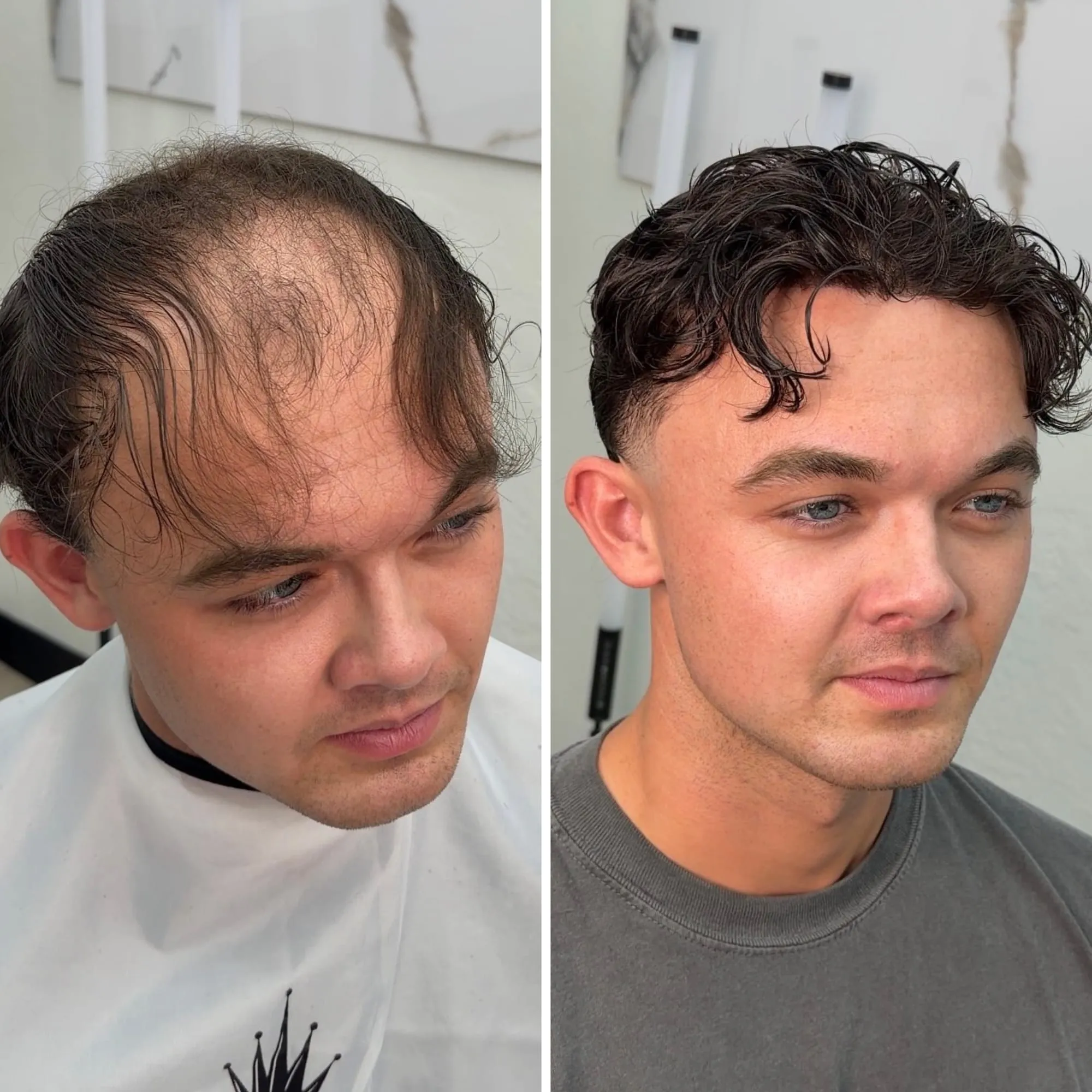
This is what it looks like.
A real client from our chair, photographed before and after his hair system was installed and cut in.
Questions, answered.
How do I know if my hair system needs replacing or just repairing?
Repair covers isolated issues on a sound base: a little edge wear, some shedding, a one-time detangle, or added density through re-ventilation. Replace when the base itself is thinning or yellowed, when knots are letting go along the part, when tangling no longer brushes out, or when several of those signals show up together.
Does yellowing mean my hair system is ruined?
Not always. Light discoloration from product and adhesive can sometimes be cleaned out with the right routine. Yellowing that stays after a proper clean is oxidised residue set into the base material, and at that stage it shows against the scalp and points to a replacement.
Can shedding at the part be fixed?
Early, mild shedding can often be slowed with gentler handling and the correct products. Knot loss concentrated at the part that is opening up gaps is structural, and it is usually addressed with re-ventilation or a new unit rather than day-to-day care.
How long can I keep repairing the same unit?
As long as the base stays strong, repairs and re-ventilation are worth it. Once the base thins, tears, or discolors, repairs are propping up a foundation that is failing, and a fresh unit looks better and holds better for the effort.
Should I wait until my hair system fails before replacing it?
No. Because a custom unit takes time to build, the best practice is to plan the next one while the current system is still wearing well. Owning two and rotating them means you always have a backup ready the moment the signals appear.
Keep reading
Related guides.
How Long Hair Systems Last
How long a hair system lasts depends on the base, your routine, and maintenance. Here is what to expect and how to make yours last longer.
Hair System Maintenance
How to keep a hair system clean, secure, and natural: your at home routine, the maintenance schedule, and what a studio visit covers.
Shedding
Some strand loss is normal because each hair is knotted by hand. Here is the normal versus not threshold, what accelerates it, and when to re-ventilate.
Tangling and Matting
Tangling and matting come from friction, skipped conditioner, and rough drying. How we keep a hair system smooth, plus fixes when it mats.