

Last updated September 28, 2026
Why some shedding is built in
A hair system is not grown hair. Each strand is individually knotted or injected into a sheer base, and those knots are held by the tension of the material around them. Over normal wear, a small number of strands slip free every week. Washing, brushing, sleeping, and the daily push and pull of living in the unit all loosen the occasional knot. This is the same reason a growing scalp releases strands every day, and it is nothing to worry about on its own.
Density is also designed to fade a touch over the life of a base. Units are often ventilated slightly heavier than the final look so that a small, even loss over months settles into a natural fullness rather than looking too thick on day one. A gradual, all over thinning is the base doing exactly what it was built to do.
The normal versus not threshold
Here is the simple test we give clients. Normal shedding is a few strands at a time, spread evenly across the whole unit, with no change to how full it looks in the mirror. Not normal is a sudden jump in volume lost, strands coming out in clumps, or thin spots and see through areas appearing in one place.
- Normal: a small, roughly even trickle of strands during washing and styling, most noticeable in the first weeks of a new unit
- Normal: a slow, uniform softening of density over the months of a base's life
- Watch it: shedding that clearly speeds up compared with previous weeks
- Not normal: bald or sparse spots, especially at the hairline, part, or crown
- Not normal: strands releasing in small clusters rather than one at a time
What accelerates shedding
When loss speeds up, one of a few culprits is usually behind it. Each one weakens the knots or the base holding them, and most are within your control once you know what to look for.
- Friction: rubbing with a towel, sleeping face down on cotton, tight hats, and aggressive brushing all drag knots loose
- Heat: high blow dryer settings, flat irons, hot water, and long sun exposure dry out the base and the strands and stress the knots
- Harsh cleaning: scrubbing, picking at the base, alcohol heavy or high pH products, and vigorous adhesive removal tear at ventilation
- Base age: as a base nears the end of its life the material relaxes and knots that were once secure begin to release faster
- Rough handling during attachment and removal, including pulling adhesive out of the knots instead of dissolving it first
How to slow it down
Most accelerated shedding is really accelerated wear, and gentler habits buy the base real extra time. None of this is complicated, and we walk you through the exact routine for your unit at your maintenance visit.
- Blot the unit dry with a microfiber towel instead of rubbing, and let it air dry when you can
- Keep the dryer on low or cool and skip flat irons on the knotted areas
- Wash gently in one direction with a sulfate free, pH balanced shampoo made for hair systems, and never scrub the base
- Use a wide tooth comb, work from the ends up, and hold the base at the root so you are not pulling on knots
- Sleep on a satin or silk pillowcase and avoid grinding the unit face down into the pillow
- Dissolve adhesive fully with a proper remover before lifting, so the base peels away clean rather than dragging strands with it
When shedding means it is time to re-ventilate
If the base is otherwise sound but specific areas have thinned, re-ventilation is the answer. Re-ventilation is the process of tying fresh strands back into the existing base to restore density, and it lets a unit you like keep going instead of retiring it early. It is a common, planned part of ownership, especially at the hairline and part where the eye looks hardest and where strands naturally thin first.
If the base itself is worn, the lace fraying or the poly thinning and splitting, then re-ventilation is only a short term fix and it is closer to time for a replacement. We assess both at a maintenance appointment. We look at whether the shedding is knots releasing from good material, which we can refill, or material breaking down, which we cannot. For the full picture on both paths, see our guides on repair and re-ventilation and on when to replace a hair system.
How we handle it in the studio
When a client brings in a unit that seems to be shedding fast, we start by separating cause from panic. Often it is friction or heat that a small change in routine resolves, and the unit has plenty of life left. When it is genuine density loss in a repairable base, we re-ventilate the thin zones and send it back out looking full. When the base has aged out, we say so plainly and plan the next unit rather than spend your money reworking material that will not hold. Nico Rigano, Ivette Rigano, and Denisse Diaz make that call with you in the chair at our Peoria, Arizona and Eighty Four, Pennsylvania studios.
Real work
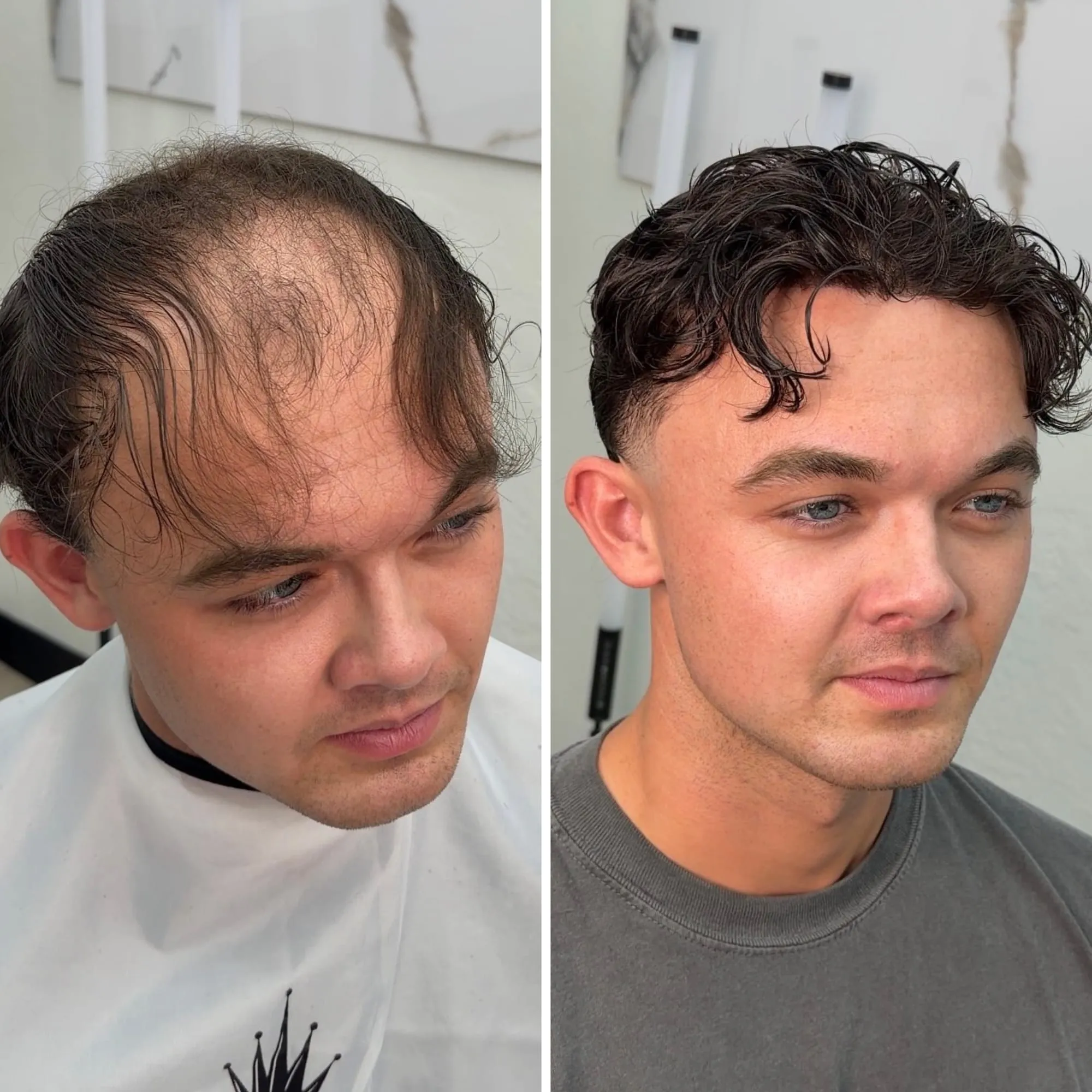
This is what it looks like.
A real client from our chair, photographed before and after his hair system was installed and cut in.
Questions, answered.
How much shedding is normal for a hair system?
A few strands at a time during washing and styling, spread evenly across the whole unit, is normal and expected because every strand is knotted in by hand. It is most noticeable in the first weeks of a new unit. Clumps of strands, sudden increases, or bald spots are not normal.
Why is my hair system shedding all of a sudden?
A sudden jump usually points to friction, heat, harsh cleaning, or a base that has aged out. Rough towel drying, high heat styling, scrubbing during washes, and pulling adhesive out of the knots all loosen strands faster. If the base material is fraying or splitting, the knots let go sooner too.
Can shedding be fixed, or do I need a new unit?
If the base is still sound, thinned areas can be re-ventilated, meaning fresh strands are tied back into the existing base to restore density. If the base itself is worn out, re-ventilation is only a short term fix and it is closer to time for a replacement. We assess which it is at a maintenance visit.
Does washing make a hair system shed more?
Washing releases a few loose strands, which is normal, but harsh washing accelerates it. Scrubbing the base, using alcohol heavy or high pH products, and rubbing hard all drag at the knots. Washing gently in one direction with a sulfate free shampoo made for hair systems keeps loss to the normal level.
Does shedding get worse as a hair system ages?
Yes, gradually and evenly. As a base nears the end of its life the material relaxes and knots release a little faster, which shows up as a slow, uniform softening of density. A sharp increase or uneven loss is a different signal and is worth having us look at.
Keep reading
Related guides.
Repair and Re-Ventilation
How hand-knotting replacement strands, base restitching, and poly recoat restore a hair system, plus the honest repair-vs-replace line we draw.
When to Replace
Replace a hair system when the base thins or yellows, knots let go at the part, tangling stops brushing out, or density drops past a repair.
Washing a Hair System
A clean, honest wash routine for hair systems: deep clean off the head, wash root to tip, keep water off the perimeter, and air dry.
Hair System Maintenance
How to keep a hair system clean, secure, and natural: your at home routine, the maintenance schedule, and what a studio visit covers.