Last updated September 28, 2026
What each method actually is
Both methods put the same thing on your head: a hair unit, meaning a sheer base with human hair tied into it. What differs is how that unit is held on, and that single choice changes almost everything you feel afterward.
The sew-in, sometimes called a man weave, starts with your own hair braided flat into cornrows across the scalp. A hair unit is then stitched to those braids with a curved needle and thread, so the unit is anchored to your hair rather than your skin. A bonded hair system skips the braids entirely. The base is fixed straight to the scalp with double-sided tape, liquid adhesive, or both, so the unit sits flush against the skin with nothing woven underneath.
- Sew-in: cornrow braids plus thread, anchored to your hair
- Bonded: tape or adhesive, anchored to your scalp
- Same hair unit on top, two very different foundations underneath
How much of your own hair each one needs
This is the first fork in the road, and it decides the method for a lot of men before anything else does. A sew-in has to have hair to braid onto. You need a healthy, reasonably dense perimeter and midsection so the cornrows have something to grip. If your hair is patchy, very fine, or gone across the crown, there is not enough foundation to stitch to, and the sew-in stops being an option.
A bonded hair system has no such requirement. It bonds to skin, so it works whether you have a thinning crown, a receding front, or a head you shave completely smooth before every attachment. That is why bonded systems are the standard route for advanced hair loss, while sew-ins tend to suit men who still carry a strong ring of their own growth.
Tension, and why your hairline should care
Cornrows are tight by design. That tension is what holds a sew-in on for weeks, but it also pulls steadily at the roots of the hair being braided, especially along the front and the temples where growth is finest. Worn constantly over months and years, that repeated pull is the kind of stress cosmetically associated with traction on the hairline, which is one reason we take reattachment timing and braid tension seriously rather than treating a sew-in as set-and-forget.
A bonded system braids nothing. The unit sits on the skin, so there is no traction on your own hair at all. For a man who wants to protect the perimeter he still has, that difference matters. It does bring its own responsibility, since adhesive and removal have to be done cleanly to keep the scalp healthy, but the pulling load simply is not part of the equation.
Wear time, cleaning, and the weekly routine
A sew-in is a longer-interval commitment. Most are reset about every 4 to 6 weeks, and between visits you are living with braids underneath that you cannot fully reach. Washing gets the unit and the visible scalp clean, but the skin beneath the cornrows is hard to access, so buildup and itch over a long cycle are the common complaints.
A bonded system runs on a shorter, more open cycle. Depending on whether it is taped or glued, a bond typically holds 1 to 4 weeks, then the unit lifts completely off so the entire scalp gets washed, dried, and inspected before it goes back on. You handle adhesive more often, but you are never sealing a covered scalp for a month at a stretch. Men who reattach at home usually settle into a simple weekly or two-week rhythm.
Side by side on the specifics
Here is how the two methods line up across the factors that actually change your day. Read down the first column to find what you care about most, then compare the two approaches across it.
| Factor | Sew-in method | Bonded hair system |
|---|---|---|
| Attachment | Cornrow braids plus thread | Tape or liquid adhesive on scalp |
| Existing hair needed | Full perimeter to braid onto | None, works on a shaved scalp |
| Reset cycle | About 4 to 6 weeks | About 1 to 4 weeks by adhesive |
| Base at the hairline | Lace or closure over braids | Lace or thin skin, sits flat |
| Scalp access to clean | Limited under the braids | Full, the unit lifts off |
| Tension on your hair | Braids pull at the roots | None, nothing is braided |
| Bulk and lift off the head | More, braids add height | Minimal, film or mesh only |
| Best suited to | Healthy perimeter growth | Little to no existing hair |
Realism at the hairline
Both methods can finish with a natural front, but they get there differently. A sew-in is usually topped with a lace closure or a lace front laid over the braids. That front can look excellent, though the braids beneath add height, so the unit lifts a little further off the head and the transition takes skill to keep flat and undetectable.
A bonded system attaches its base straight to skin, so a lace or thin skin front can sit truly flat with nothing raising it. The front edge can be built at roughly a 0.03 to 0.08 mm thin skin thickness or knotted into fine Swiss lace, which lets the hairline melt into the forehead with no bulk to disguise. For afro-textured hair specifically, we match curl pattern and density on either method, but the flush bonded front is often what men mean when they say they want the hairline to disappear.
How we decide in our chair
We do not lead with the method. We lead with your head of hair and your priorities. If you have a strong perimeter, want the longest interval between resets, and prefer nothing bonded to your skin, a sew-in can be a genuinely good fit, and we will braid and stitch it with tension your hairline can live with. If your hair is advanced in its loss, if protecting a fragile front is the goal, or if you want a flush, easy-to-clean routine you can manage at home, a bonded hair system usually leads.
Nico Rigano, Ivette Rigano, and Denisse Diaz have fitted both across our Peoria, Arizona and Eighty Four, Pennsylvania studios, and the honest recommendation only comes after we look at your growth, your scalp, your texture, and how you actually live. Any figure tied to a custom unit, a longer or thicker build, or European hair gets worked out at that consultation, never guessed at from a page. Bring your questions and we will show you both, on your own head, before you decide.
Real work
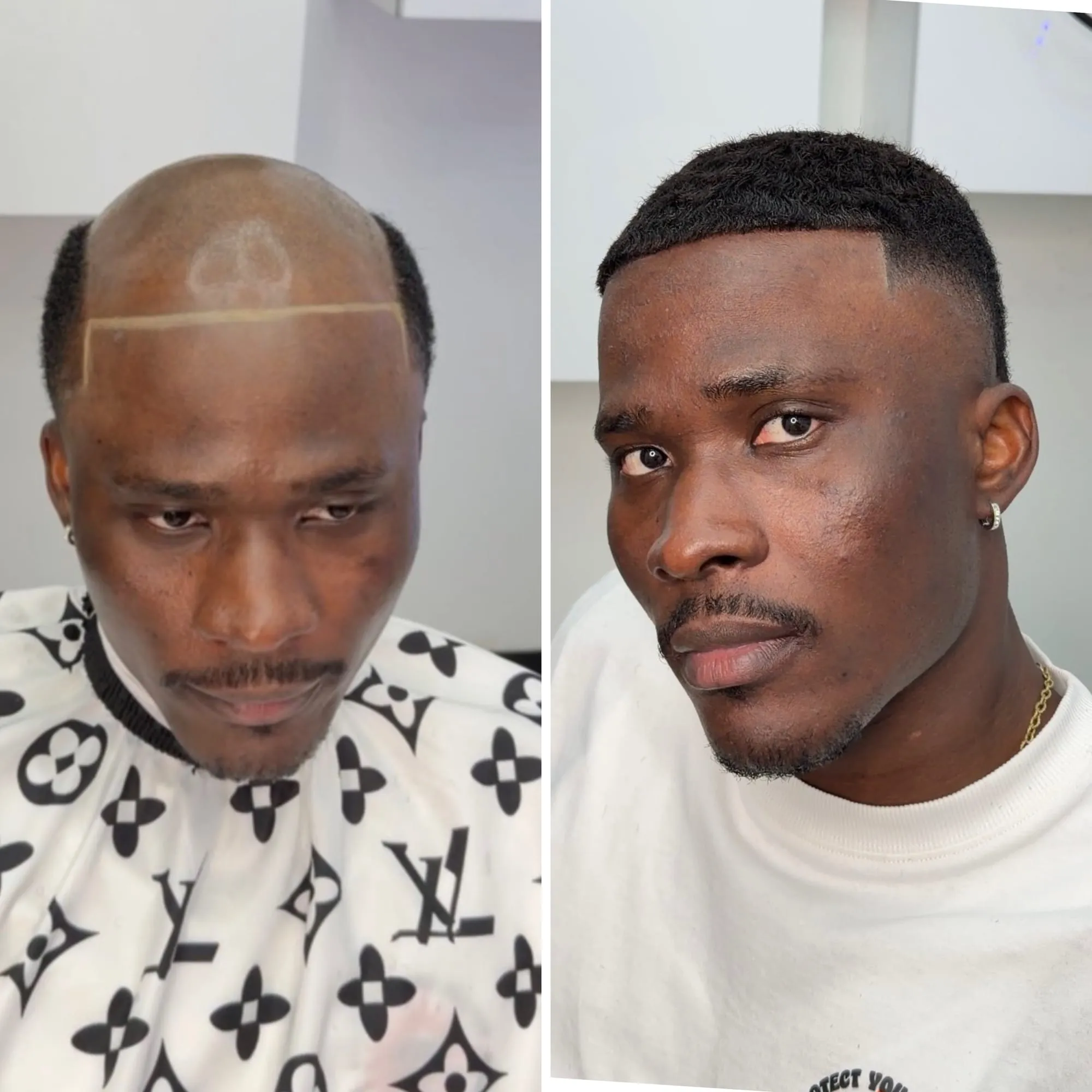
This is what it looks like.
A real client from our chair, photographed before and after his hair system was installed and cut in.
Questions, answered.
What is the main difference between a sew-in and a bonded hair system?
How the unit is held on. A sew-in braids your own hair into cornrows and stitches the unit to those braids with thread, so it anchors to your hair. A bonded hair system attaches straight to the scalp with tape or adhesive, so it anchors to your skin and needs no hair to braid onto.
Can I get a sew-in if I have very little hair?
Usually no. A sew-in needs a healthy perimeter and midsection to braid onto, so patchy, very fine, or largely absent hair leaves nothing to stitch to. A bonded hair system bonds to skin and works on a fully shaved scalp, which is why it is the common route for advanced hair loss.
Which method is gentler on my own hairline?
A bonded system, because it braids nothing and puts no tension on your own hair. Cornrow braids in a sew-in pull steadily at the roots, and over months of constant wear that pull is the kind of stress cosmetically associated with traction on the hairline. We manage braid tension carefully for anyone who prefers a sew-in.
How often does each one get reset?
A sew-in is typically reset about every 4 to 6 weeks. A bonded hair system runs a shorter cycle, roughly 1 to 4 weeks depending on whether it is taped or glued, with the unit lifting completely off each time so the whole scalp can be cleaned.
Which looks more natural for afro-textured hair?
Both can look excellent when the curl pattern and density are matched to yours. A bonded lace or thin skin front sits flat against the skin with no braids raising it, so it is often the choice when a flush, disappearing hairline is the priority. A sew-in with a quality lace closure can also look natural, though the braids add a little height.
Keep reading
Related guides.
Options Compared
Hair systems, transplants, SMP, medication, shaving, or nothing. An honest side by side of coverage, reversibility, commitment, and upkeep.
Attachment Methods
Tape, bonding, and clip attachment for hair systems compared by hold, comfort, and how they suit your routine. How to attach a hair system.
System vs Integration
Integration pulls your existing hair through a mesh; a hair system covers the area for full density. How we pick, and who each one actually fits.
Types of Hair Systems
Lace, skin, and poly hair systems compared by look, feel, durability, and upkeep, so you can choose the right base for your hair and lifestyle.