

Last updated September 28, 2026
The short, honest answer
When people ask if a transplant is permanent, they are usually asking two different questions at once. One is whether the moved hair stays. The other is whether they are done losing hair. Those have different answers, and conflating them is where a lot of disappointment comes from.
- The transplanted follicles are permanent. They are taken from the donor zone at the back and sides, which is genetically resistant to the hormone that drives pattern loss, so they tend to keep growing where they are placed.
- The rest of your hair is not protected. Surgery moves follicles, it does not change your genetics, so the native hair around the graft keeps thinning on its normal Norwood path.
- That combination can leave gaps. As native hair recedes behind a transplanted zone, an island of denser hair can sit in front of newly thin areas, which is why follow-up procedures are common.
- A hair system takes the opposite approach. Nothing about it is permanent, and that is the point. Each unit covers the full area you want covered today, and the next unit covers wherever your loss has moved to.
What permanent actually means after surgery
Two surgical methods dominate. FUE, follicular unit extraction, removes individual follicular units and leaves small dot scars across the donor area. FUT, the strip method, removes a band of scalp and leaves a single linear scar. Both relocate a finite number of grafts, and both are irreversible. Whatever the surgeon takes from the donor zone does not grow back there, so the donor supply only shrinks over a lifetime.
That finite donor supply is the quiet constraint. A man at a lower grade of loss has grafts to spare. A man at Norwood 6 or 7 may not have enough donor density to ever fill the whole scalp to the coverage he pictures, no matter how many sessions he books. The result is permanent, but permanent is not the same as complete, and it is not the same as final. It ages alongside the loss the surgery never addressed.
Transplant and hair system over the long term
Set the two side by side on the factors that actually decide satisfaction years out, not on the day of the procedure.
| Factor | Hair transplant | Hair system |
|---|---|---|
| What is permanent | Relocated donor follicles stay for life | Nothing is permanent; each unit is replaced on a cycle |
| Effect on future loss | None; native hair keeps thinning to its Norwood grade | None either, but coverage is rebuilt each unit so loss is hidden as it happens |
| Time to the final look | 12 to 18 months for grafts to fully mature | One fitting, usually 2 to 3 hours |
| Donor supply | Finite; the back and sides hold a limited graft count | Not limited by your own hair at all |
| Typical repeat need | Often 2 to 3 procedures over a lifetime as loss advances | Reattached every few weeks; unit replaced roughly every 1 to 6 months by base |
| Coverage ceiling | Capped by donor density and grade of loss | Full coverage regardless of how advanced the loss is |
| Reversibility | Surgical and permanent; scars remain | Fully reversible; remove any day with no lasting change |
| Scarring | FUT leaves a linear scar; FUE leaves small dot scars | None |
Why future loss is the deciding factor
The strongest argument against surgery is not cost or downtime. It is that a transplant is a snapshot of your hair loss on the day it is planned, and hair loss is a moving target. A man in his early thirties who transplants a hairline can watch the crown and mid-scalp behind it keep receding, so the transplanted line ends up floating in front of thinner hair a few years later. Surgeons manage this by staging procedures and by leaning on medication to slow the native loss, but the underlying pattern does not stop.
A hair system sidesteps that problem by design. Because it is refreshed on a schedule, every new unit is built for the coverage area you have now. If your loss advances, the next base is simply cut a little larger. You are never locked into a decision you made about your hairline years ago, and you never end up with a mismatch between a fixed graft zone and a shifting pattern of loss around it. Neither option treats or reverses hair loss. One relocates a fixed amount of your own hair once, the other covers the full area cosmetically and keeps pace as the loss changes.
How long each takes to look right
Timeline is where the two feel most different. After a transplant, the moved hairs usually shed within the first two to four weeks, then the donor and recipient areas heal over the following months. New growth typically starts around three to four months, and the full, mature result lands somewhere between twelve and eighteen months. That is a real wait, and it comes with a recovery period, temporary shock loss of nearby native hair for some men, and no guarantee the density matches what you imagined.
A hair system is immediate. A fitting at our Peoria, Arizona or Eighty Four, Pennsylvania studio takes a couple of hours, and you walk out with a full head of hair that day. There is no healing, no shedding phase, and no waiting a year to see whether it worked, because what you see in the chair is the result. The trade is ongoing upkeep. You reattach on a routine and replace each unit as its base wears, rather than paying for maintenance once and waiting.
After a transplant that under-delivered
A large share of the men Nico Rigano, Ivette Rigano, and Denisse Diaz fit have already had surgery. Some are happy with a past transplant but have kept losing native hair and want fuller coverage without booking another operation. Others were never good candidates in the first place, spent a lot, and came out with thin density or a visible scar. A hair system works cleanly over both situations, because the base sits on top of the scalp and does not care what the follicles underneath are doing.
That is the practical reason we frame these as complements more often than rivals. Surgery is a permanent commitment to a fixed graft count. A hair system is a reversible, adjustable way to guarantee coverage today and keep it as your loss moves. Some men do both. If you are weighing the two, we will give you the honest read on your grade of loss, your donor picture, and what each path actually looks like five years out, with no pressure toward the option that happens to be ours.
Real work
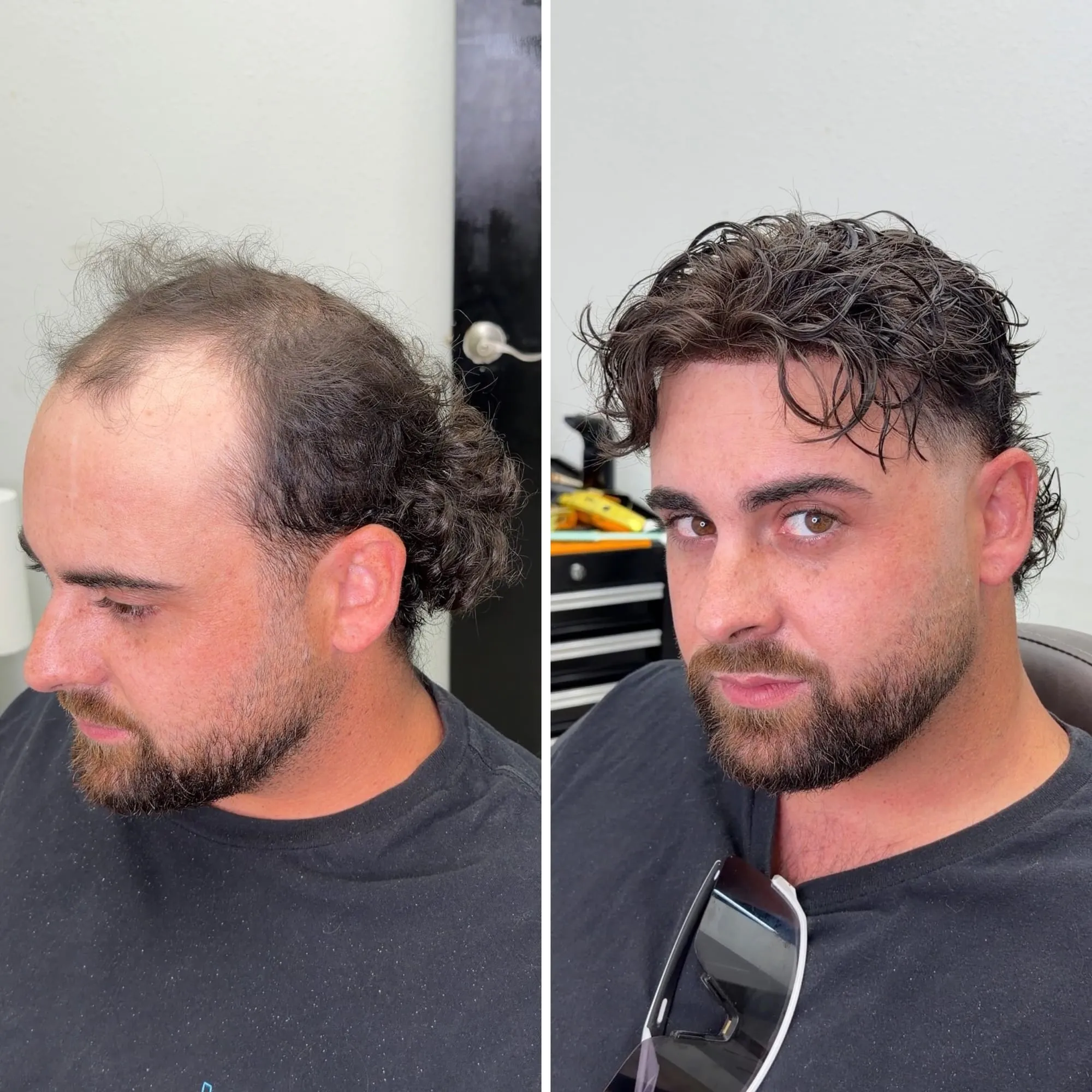
This is what it looks like.
A real client from our chair, photographed before and after his hair system was installed and cut in.
Questions, answered.
Is a hair transplant permanent?
The relocated follicles are permanent, because they come from the donor zone at the back and sides that resists pattern loss. But a transplant does not stop the native hair around the grafts from thinning, so it is permanent without being final. Many men need repeat procedures as their loss advances.
Will a transplant stop me from going bald?
No. A transplant relocates a finite number of follicles; it does not change the genetics driving your hair loss. Native hair keeps thinning on its Norwood path, which is why surgeons often stage two to three procedures and pair surgery with medication to slow the ongoing loss.
Can I wear a hair system after a hair transplant?
Yes. Because a hair system attaches to the scalp surface, it works over transplanted areas, thin donor density, and linear or dot scars alike. Many of the men we fit have had surgery already and want full coverage without booking another operation.
How long before a transplant looks full versus a hair system?
A transplant sheds within two to four weeks, starts regrowing around three to four months, and reaches its mature result at roughly twelve to eighteen months. A hair system is full the day it is fitted, in a single appointment of about two to three hours.
Do transplanted hairs ever fall out?
The moved follicles usually shed once during the first weeks, then regrow and tend to stay. The loss men notice later is their surrounding native hair, which the surgery never protected. That receding native hair is what can leave a transplanted zone looking isolated over time.
Keep reading
Related guides.
Options Compared
Hair systems, transplants, SMP, medication, shaving, or nothing. An honest side by side of coverage, reversibility, commitment, and upkeep.
Hair System vs Hair Transplant
A side by side look at hair systems and hair transplants: results, timeline, upkeep, and who each one suits. Non surgical vs surgical, honestly.
System vs Transplant Cost
How the cost of a hair system and a hair transplant compare over a decade: one-time surgery versus recurring replacement and scheduled service.
After a Failed Transplant
Yes, you can wear a hair system after a failed hair transplant. How we choose scar-aware attachment, base, and hairline to cover old graft work.