

Last updated September 28, 2026
The short answer, and why it works
A transplant moves your own hair from the back of the head to the front and top, and when it underdelivers you are usually left with three problems at once: not enough density where you wanted it, a hairline that reads as unnatural, and scarring in the donor or recipient area. A hair system solves all three in a single step because it does not depend on your existing hair at all. The base carries its own hair at whatever density you choose, sits above the old work, and gives us a fresh hairline to design from scratch.
This is a cosmetic solution, not a medical one. We are not touching the grafts, the scalp, or the scar tissue in any clinical sense. We are covering the area, the same way we would for any pattern of loss, with a couple of extra considerations for how adhesive and base material behave over healed transplant scars.
What a failed transplant usually leaves behind
No two results are identical, but the outcomes we see most often fall into a short list. Knowing which of these you are dealing with is what drives every attachment and base choice further down this page.
- A linear donor scar across the back of the head from the strip (FUT) method, often firmer and less flexible than the surrounding scalp
- Many small round dot scars from the follicular unit extraction (FUE) method, typically 0.7mm to 1.0mm across, scattered through the donor zone
- Surviving transplanted hairs in the recipient area that look sparse, wispy, or pluggy
- A recipient surface with pitting, ridging, or a cobblestone texture from older graft technique
- A hairline set too low or too straight that never looked right
- A depleted donor area with too little hair left to justify another surgery
Matching the attachment to what your scalp is dealing with
Here is how we translate each of those outcomes into a practical build. The first column is what the transplant left you with, then what it means for a hair system, then how we attach and what base we reach for.
| Transplant outcome | What it means for a hair system | Attachment and base approach |
|---|---|---|
| Linear donor scar (FUT) | A single firm line across the back, often right where a base perimeter would bond | Perimeter tape or a soft bond laid over the line, base cut to sit flat across it, skin or poly perimeter for a clean seal |
| FUE dot scars | Small flat round marks, easy to bond over once healed | Full adhesive works fine, lace or skin bonds evenly, no special cut needed |
| Surviving grafts in front | Sparse or pluggy hairs that would push a base up unevenly | We trim them short so the base lies flat, then the unit covers them for even density |
| Pitting or ridging | An uneven recipient surface that resists a thin, flat bond | A slightly thicker, more forgiving base and a flexible adhesive that bridges minor texture |
| Hairline too low or too straight | The old transplant hairline reads as unnatural under any cover | We set the new hairline above or reshape it with a custom front contour so the base hides the old line |
| Depleted donor | Not enough hair left for another surgery | A hair system draws on no donor supply, so density is your choice, not the surgeon's |
Scar-aware attachment, in plain terms
Healed scar tissue behaves a little differently from normal scalp. It can be raised, shinier, firmer, and sometimes carries altered sensation, so we treat it with respect rather than force. For a linear FUT scar that falls under the perimeter, we favor a soft, flexible bond and a base edge cut to lie flat across the line, which keeps the seal even and comfortable. For scattered FUE dots, the surface is usually flat enough that a standard full bond behaves normally.
Adhesive choice matters as much as base choice. A soft tape bond is gentler and is usually reattached every one to two weeks, which suits sensitive or recently healed skin. A longer hold glue can stretch a wear cycle to three to four weeks, sometimes four to six, but asks more of the skin at removal. On or near scar tissue we lean toward the gentler end and always run a small skin test before a full install, so we know how your skin and any scarred areas respond before you commit to a bond.
Base and hairline choices that hide old graft work
The front is where a failed transplant is judged, so it is where we spend the most attention. A lace or thin skin front gives an undetectable hairline with no visible edge, and because we are drawing a brand new hairline we can place it to erase an old one that sat too low. Front contour codes give us the shape: a rounded, mature CC or C contour usually reads more naturally on an adult man than the flat, straight AA line that many older transplants left behind.
Base material is a balance of realism, breathability, and how the scarred scalp sits underneath. Ultra thin skin runs roughly 0.03mm to 0.06mm and vanishes against the scalp but wears fastest. A mid weight skin around 0.08mm to 0.12mm is more durable and still discreet. Lace breathes best over a scalp that may sweat or feel warm around scar tissue. Over pitting or ridging we often step slightly thicker, near 0.10mm to 0.15mm, so the surface texture does not telegraph through. Density is set in percentages, and we usually build medium in the 100 to 130 range so the result looks like real hair rather than the too dense look that gives a transplant away.
Where the cost drivers are
We do not publish prices because a scar-aware build is genuinely custom, and the honest figure comes at consultation once we have seen your scalp. What we can tell you is which choices carry the biggest cost, ranked from most to least, so there are no surprises.
- A fully custom template molded to your exact scar map and head shape, the single largest driver on a post transplant build
- European hair, which is finer and blends more naturally with most Caucasian hair than other origins
- A silk top or injected front for the most invisible hairline over an old graft line
- Hair length over six inches, which uses more raw hair per unit
- Higher density selections, which add hair count across the base
How we approach it at your consultation
We start by looking, not selling. Nico Rigano, Ivette Rigano, or Denisse Diaz will map your donor and recipient scarring, check how the tissue moves and how flat the surface sits, and talk through what the previous surgery was trying to achieve. From there we choose the base, adhesive, hairline, and density together, and we run a skin test so your bond is proven before your first full install. We fit clients at both studios, in Peoria, Arizona and in Eighty Four, Pennsylvania.
This page is the decision and comparison view. If you want the fuller picture of daily life, expectations, and what to bring to your first visit as a post transplant client, read our companion persona guide for men after a failed hair transplant. And if you are still weighing whether to try surgery again at all, our hair system versus hair transplant comparison lays out that choice honestly.
Real work
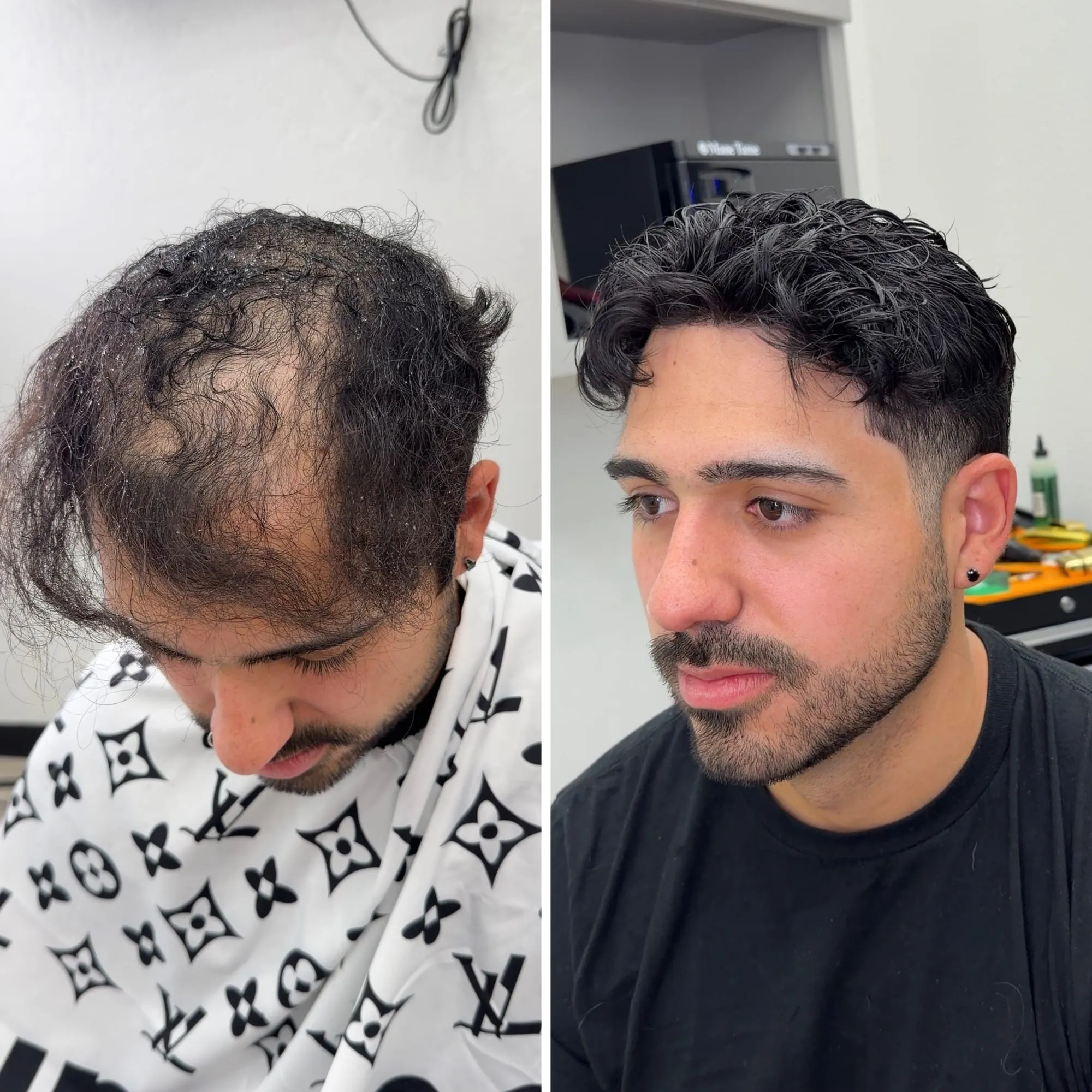
This is what it looks like.
A real client from our chair, photographed before and after his hair system was installed and cut in.
Questions, answered.
Can I wear a hair system over transplant scars?
Yes. A hair system bonds over both FUT linear scars and FUE dot scars and covers them completely. On firmer or recently healed scar tissue we favor a soft, flexible bond and a base edge cut to lie flat, and we always skin test first to see how the scarred area responds.
What happens to the hair I already had transplanted?
Nothing clinical. We trim any surviving transplanted hairs short so the base lies flat, then the unit covers them for even density. A hair system does not treat, remove, or regrow grafts. It sits above them cosmetically.
Will a hair system fix a hairline that was set too low?
It hides it. Because we design a brand new hairline into the base, we can place it above the old transplant line and shape it with a rounded contour code like CC or C, so the low or too straight line the surgery left is covered entirely.
Is attachment different because of the scarring?
Slightly. Scar tissue can be firmer and more sensitive, so we lean toward gentler adhesives, often a soft tape bond reattached every one to two weeks rather than a long hold glue, and we cut the base to sit flat across a linear scar. A skin test comes before any full install.
Do I need enough donor hair left to get a hair system?
No. A hair system carries its own hair on the base and draws on no donor supply at all, so a depleted donor area is not a barrier. Your density is a choice we make together, not a limit set by how much hair the surgery left behind.
Keep reading
Related guides.
Options Compared
Hair systems, transplants, SMP, medication, shaving, or nothing. An honest side by side of coverage, reversibility, commitment, and upkeep.
Hair System vs Hair Transplant
A side by side look at hair systems and hair transplants: results, timeline, upkeep, and who each one suits. Non surgical vs surgical, honestly.
Attachment Methods
Tape, bonding, and clip attachment for hair systems compared by hold, comfort, and how they suit your routine. How to attach a hair system.
Is A Transplant Worth It
A transplant is worth it for the right candidate with a stable donor area and realistic goals. Here is when it fits and when it does not.