

Last updated September 28, 2026
Two costs, two different shapes
The live comparison between a hair system and a hair transplant is about outcomes, permanence, and how each looks and feels. This page is narrower and more useful for planning: it is only about the money, and specifically about how that money is spread across a decade. The two options are not just different prices, they are different shapes of spending, and that shape is what most cost comparisons miss.
A transplant is front-loaded. The large number lands early, as a surgical fee, and in the honest version of the picture it can be followed by a revision session and by medication a physician may advise to hold onto the hair you were not transplanting. A hair system is level. There is a first unit and a fitting, then a repeating pattern of replacements and maintenance that stays roughly the same year after year. Neither shape is automatically cheaper. They suit different budgets and different tolerances for a large sum up front.
The cost components over a decade
Here is the like-for-like breakdown of where money goes on each path across ten years. No figures appear because the figures are set at your consultation and by your surgeon, and anyone quoting you a firm decade total sight unseen is guessing. What is definitive is the structure: which components exist on each path, and whether they happen once or repeat.
| Cost component | Hair system path | Hair transplant path |
|---|---|---|
| First outlay (Year 1) | First unit, fitting, and cut-in | Surgical procedure fee, paid once |
| Recurring service | Scheduled maintenance visits on your interval | None for the graft itself |
| Replacement | A new unit on your wear interval, repeating | Not applicable; relocated grafts are permanent |
| Home supplies | Adhesive or tape, remover, system-safe shampoo, ongoing | Ordinary hair care; nothing procedure-specific |
| Possible later procedure | Not applicable | A revision or second session if density or a receding native hairline calls for it |
| Ongoing medication | None tied to the system | Often advised to protect remaining native hair; your physician decides |
| Shape over the decade | Level and repeating, predictable per year | Front-loaded, with possible tails from revision and medication |
Year one versus the later years
The single most misleading thing you can do is compare the two options on year one alone. In year one the transplant looks far more expensive, because the whole surgical fee lands at once while the system has only asked for a first unit and a fitting. Judged there, the transplant loses on cost every time.
Stretch the frame to ten years and the comparison changes character. The transplant's early number stops growing, apart from any medication and any revision, while the system keeps drawing its steady annual rhythm of replacements and maintenance. The later years are where the two paths converge or cross, and where the honest answer to which is cheaper actually lives. That is exactly why a ten-year view, not a first-appointment view, is the right lens.
The hair system decade: level and repeating
A hair system's ten-year cost is not one bill, it is a pattern you can plan around. Three things set that pattern: how long each unit lasts before it is replaced, how often you come in for maintenance, and the small supplies you use at home between visits. Once those are settled at your consultation, the yearly figure stops moving, and ten years is simply that yearly rhythm repeated.
The advantage of this shape is that there is no large sum to clear up front and few surprises later. The trade is that the spending never fully stops. As long as you wear a system, you replace units and keep a maintenance schedule, so the decade total is the sum of many predictable, moderate outlays rather than one big one. For men who would rather budget a steady line than write a single large check, that predictability is the appeal.
The transplant decade: front-loaded with tails
A transplant relocates your own follicles from a donor area to where you want density. It is a medical procedure, it is permanent, and the relocated hair grows like the rest of your hair, which is its genuine long-term advantage on cost: once it has taken, the graft itself does not ask for recurring service or replacement.
The honest version of the transplant decade has two tails, though, and leaving them out is how the surgical fee gets made to look like the whole story. The first is a possible revision or second session, common when a man wants more density than one pass gives or when his native hairline keeps receding around the transplanted zone. The second is medication a physician may recommend to protect the hair that was not transplanted, since a transplant moves existing follicles but does not stop loss elsewhere. Both are decisions for your surgeon and physician, not for us, and both belong in an honest ten-year total.
Which is cheaper long term depends on these drivers
There is no universal winner, but there is a short list of drivers that decides the outcome for any individual man. Run your own situation through these, in roughly this order of impact, and the cheaper path over ten years usually becomes clear.
- How many units you go through over the decade, which is driven by your base choice, your climate, and how you treat the system. This is the biggest single lever on the system-path total.
- Your maintenance interval, set to your routine. Someone who trains hard and sweats comes in more often than someone in an office, and that rhythm moves the yearly figure.
- Whether the transplant needs a revision or a second session, which can meaningfully raise the front-loaded total and is hard to predict before surgery.
- Whether ongoing medication is part of the transplant plan, which turns a one-time fee into a fee plus a small recurring line for as long as your physician advises it.
- Home supplies on the system path, which are real but the smallest driver, and negligible on the transplant path.
How we price it, and why the figure waits
In our chair in Peoria and in Eighty Four, we quote a hair system by its real drivers: the base you choose, your maintenance rhythm, and how your climate and routine age a unit. That is why you will not find a decade total published here. A firm ten-year figure would have to assume your base, your interval, and how many units you wear through, and assuming those would make the number dishonest. What we can promise is that the yearly rhythm we set at your consultation is the yearly rhythm it stays.
The transplant side of the comparison is not ours to price. The surgical fee, any revision, and any medication are set by a surgeon and a physician, and we will always tell you to get those numbers from them directly rather than from us. If you want the structure translated into real numbers for your hair and your routine, book a consultation. There is no obligation attached, and an honest ten-year comparison is worth more than a headline price either way.
Real work
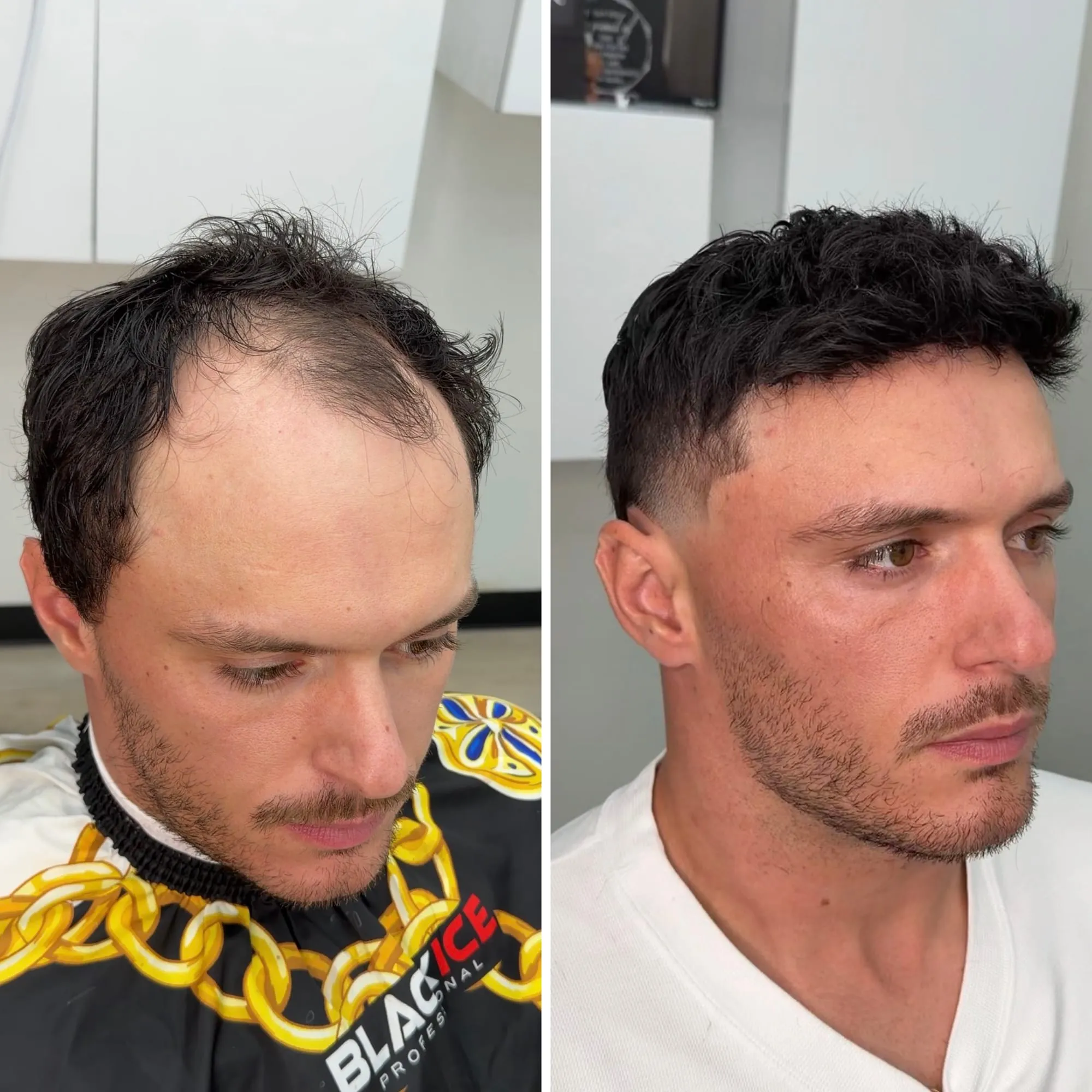
This is what it looks like.
A real client from our chair, photographed before and after his hair system was installed and cut in.
Questions, answered.
Which is cheaper over ten years, a hair system or a transplant?
It depends on your drivers. A transplant front-loads the cost in one surgical fee, then adds any revision and any medication a physician advises. A hair system spreads a steadier cost across replacements and maintenance. The decade total turns on how many units you wear through and whether the transplant needs a second session, so the honest comparison is structural, not a single number.
Why does the transplant look cheaper in some comparisons?
Because they compare year one against year ten, or they count only the surgical fee and leave out revision procedures and the medication often advised to protect your remaining native hair. Include those tails and stretch the frame to a full decade and the two paths sit much closer together.
Does a hair system ever stop costing money?
No, and we would rather be straight about that. As long as you wear one, you replace units on your interval and keep a maintenance schedule. The upside is predictability: no large sum up front and a steady yearly rhythm you can budget around, rather than one big outlay.
Why will you not just publish a ten-year total?
Because an honest total depends on your base, your maintenance interval, your climate, and how many units you wear through, and the transplant side depends on a surgeon and a physician we do not set prices for. A published decade figure would have to assume all of that. We quote the real drivers at your consultation instead.
Keep reading
Related guides.
Hair System vs Hair Transplant
A side by side look at hair systems and hair transplants: results, timeline, upkeep, and who each one suits. Non surgical vs surgical, honestly.
Cost Per Year
What a hair system costs to run per year and month comes down to how long it lasts, your maintenance rhythm, and supplies. Here is the whole picture.
Is A Transplant Worth It
A transplant is worth it for the right candidate with a stable donor area and realistic goals. Here is when it fits and when it does not.